In high-power fiber laser and CO2 laser cutting environments, the auxiliary system often dictates the difference between 99.5% uptime and catastrophic nozzle damage. For operations managers and plant engineers, the laser cutter air compressor is not merely a utility—it is a precision tool that directly influences cut-edge quality, consumable lifespan, and energy expenditure. While beam quality and motion control capture the spotlight, the compressed air system determines whether a workshop achieves consistent 24/7 production or faces intermittent failures masked as “laser source issues.”
Based on field data from heavy fabrication facilities in mining equipment manufacturing and structural steel processing, the wrong compressor selection can elevate operating costs by 35% annually due to oil carryover contamination and pressure drop penalties. This analysis dissects the technical specifications, industry standards, and lifecycle economics that define an optimal laser cutter air compressor configuration, integrating insights from Aivyter’s industrial engineering protocols.
1. Defining the Technical Nexus: Why Standard Compressors Fail in Laser Cutting
Industrial laser resonators (both fiber and CO2) operate with micron-level tolerances. The assist gas—often compressed air—must meet ISO 8573-1:2010 Class 1.2.1 or stricter criteria. Standard reciprocating piston compressors or oil-flooded rotary screws, without exhaustive filtration, introduce three failure vectors:
- Oil Aerosol Migration: Even trace amounts of hydrocarbon (as low as 0.01 mg/m³) deposit on protective glass and collimation lenses, causing thermal lensing and power attenuation. In fiber lasers, this reduces piercing capability on 20mm mild steel by up to 40%.
- Pressure Dew Point Instability: Laser nozzles require consistent pressure within ±0.5 bar. Uncontrolled condensate formation leads to micro-droplet impact, spatter adhesion, and inconsistent kerf geometry.
- Particulate Scoring: Particles exceeding 0.1 microns abrade the ceramic ring in cutting heads, leading to capacitive height sensor errors and head collisions—a common source of downtime in automated cells.
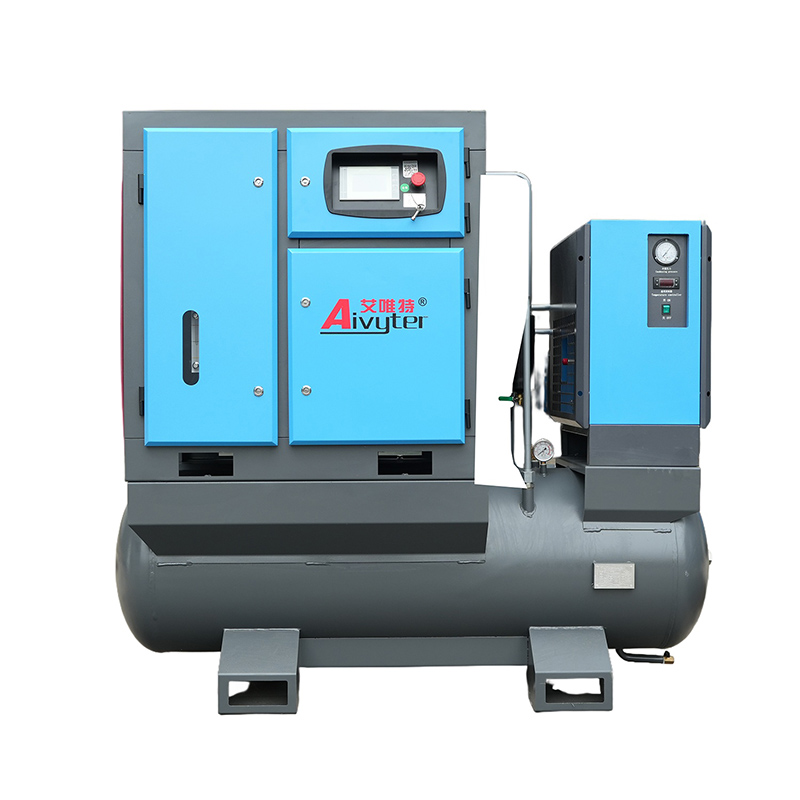
Therefore, specifying a laser cutter air compressor involves evaluating not just CFM ratings but contamination control architecture. Aivyter’s industrial portfolio emphasizes Class 0 oil-free rotary screw technologies paired with refrigerated air dryers and coalescing filtration stages to meet these thresholds.
2. Critical Performance Metrics: Pressure Stability and Volumetric Efficiency
Laser cutting dynamics demand a compressor system that maintains a narrow pressure bandwidth during peak demand cycles. For instance, a 12kW fiber laser cutting 1-inch stainless steel requires assist gas pressure between 10 to 14 bar, with flow rates fluctuating from 800 to 2,500 liters per minute during piercing. Two technical parameters separate industrial-grade systems from commercial units:
2.1. Pressure Fluctuation Range (ΔP)
Advanced variable frequency drive (VFD) screw compressors achieve ΔP ≤ 0.3 bar under pulsed load conditions. Fixed-speed piston units typically exhibit ΔP > 1.5 bar, causing inconsistent dross formation. In structural steel fabrication, this variation results in secondary grinding operations, increasing labor costs by $18–$25 per ton processed.
2.2. Specific Power (kW per m³/min)
Energy consumption constitutes 70% of total lifecycle costs for compressed air systems. Modern two-stage oil-free rotary screw compressers achieve specific power values below 6.5 kW/(m³/min) at 10 bar. By contrast, outdated single-stage compressors operate at 8.2–9.0 kW/(m³/min). For a facility running 6,000 annual operating hours, this efficiency delta translates to $12,000–$18,000 in annual energy savings.
Integrating a laser cutter air compressor with centralized control systems allows load/unload optimization, reducing idle energy waste by 28–33% according to field tests conducted in mining equipment workshops.
3. Air Quality Classification: ISO 8573-1 and Practical Implementation
Many purchasing specifications erroneously focus solely on particulate removal. However, comprehensive air quality for laser cutting encompasses three contaminant classes:
- Solid Particulate: Class 1 (≤0.1 microns, ≤0.1 mg/m³) is mandatory for protecting the cutting head optics and nozzle orifices.
- Water (Liquid and Vapor): Class 2 (pressure dew point ≤ -40°C) prevents condensation inside beam delivery systems and ensures stable plasma formation during high-power cutting.
- Total Oil (Aerosol, Liquid, Vapor): Class 1 (≤0.01 mg/m³) eliminates the risk of silicone/oil deposits on the final focusing lens. For high-power applications, Class 0 (as certified by TÜV or similar) is the industry benchmark.
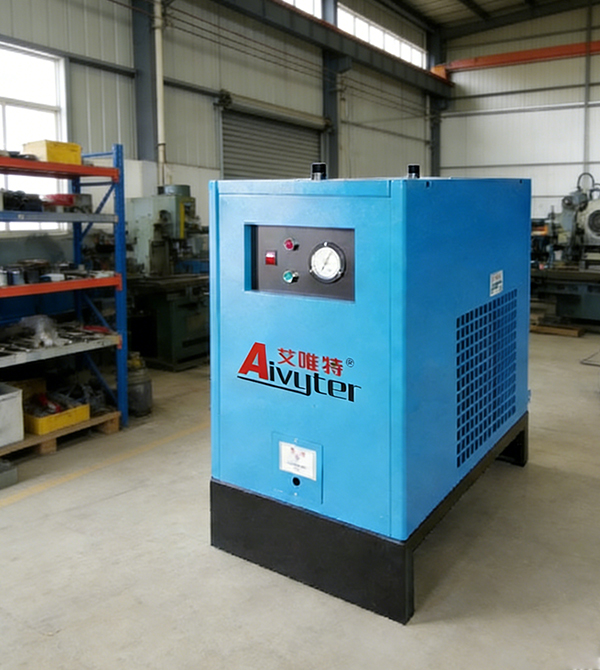
To achieve these classifications, the compressed air line requires a coordinated system: an oil-free compressor stage, a refrigerated or desiccant dryer sized for the inlet temperature, and multi-stage filtration (pre-filter, coalescing, and activated carbon adsorber). Aivyter provides pre-configured air treatment packages tailored to laser cutting throughput, ensuring compliance with these standards without over-engineering. For detailed specifications, consult https://www.aivyter.com/ for application engineering support.
4. Application-Specific Demands in Heavy Industry: Mining and Construction Sectors
In mining equipment fabrication—where cutting thickness ranges from 10mm to 80mm AR500 steel—the reliability of the laser cutter air compressor directly impacts production schedules. High-ozone environments (typical in open-pit mine workshops) accelerate oxidation in standard aluminum heat exchangers. Industrial compressors designed with stainless steel coolers and corrosion-resistant coatings extend service intervals by 2,000 hours.
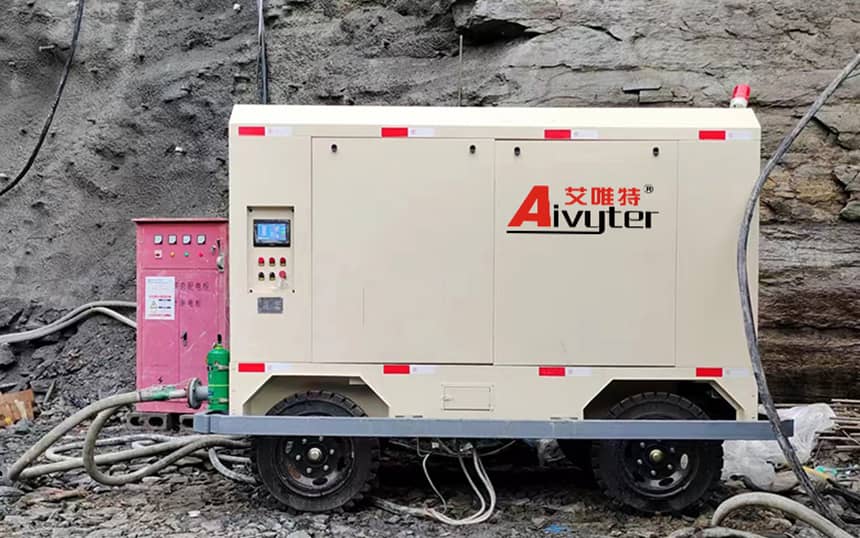
Similarly, in tunneling and civil engineering, mobile laser cutting units used for on-site modification of steel ribs require compact, oil-free compressors that tolerate significant ambient temperature swings (-20°C to 45°C). Data from a Chilean mining contractor indicated that switching to a VFD-controlled oil-free rotary screw reduced unscheduled maintenance from 14 incidents per quarter to 2, primarily by eliminating oil emulsification in cold-start conditions.
These verticals also demand telemetry integration. Modern compressor controllers with Modbus TCP/IP allow central maintenance systems to monitor filter saturation, operating hours, and pressure profiles, enabling predictive maintenance rather than reactive repairs.
5. Lifecycle Cost Analysis (LCCA) and ROI Calculations
A robust financial model for compressor acquisition must extend beyond initial capital expenditure (CAPEX). We evaluate a typical 30kW laser cutting cell operating two shifts (4,500 hours/year) with a required flow of 1.8 m³/min at 12 bar.
Scenario A: Oil-Lubricated Piston Compressor + Filtration
Initial Investment: $9,500
Annual Energy Cost (assuming $0.12/kWh): $7,840
Annual Filter/Service Consumables: $2,100
Downtime Cost (due to lens contamination): $4,500
5-Year Total Cost of Ownership: $78,400
Scenario B: Oil-Free VFD Rotary Screw (Aivyter Industrial Series)
Initial Investment: $24,500
Annual Energy Cost: $4,870
Annual Maintenance: $950
Downtime Cost: $500
5-Year Total Cost of Ownership: $54,850
The premium oil-free system delivers a 30% lower TCO over five years, with payback occurring at month 18. The reduction in consumable costs alone (lenses, nozzles, ceramic rings) accounts for 40% of the savings. Additionally, the oil-free compressor eliminates disposal costs associated with oily condensate—a significant environmental compliance factor in EU and North American jurisdictions.
6. Integration with Laser Cutting Automation and Industry 4.0
Modern fabrication facilities employ centralized compressed air networks with master controllers. When integrating a dedicated laser cutter air compressor, engineers must account for signal integration with the CNC (Computer Numerical Control). Features such as “ready-to-cut” interlocks, which prevent laser firing until pressure and dew point thresholds are verified, reduce scrap rates by up to 2% in high-mix production environments.
Furthermore, data historians should log key performance indicators: specific energy consumption per part, filter differential pressure trends, and ambient-to-discharge temperature differentials. Aivyter’s IoT-ready controllers provide OPC-UA outputs, allowing seamless integration into MES (Manufacturing Execution Systems). For facilities aiming for ISO 50001 certification, such granular data is indispensable.
7. Maintenance Protocols and Contingency Planning
Given that a compressor failure halts the entire cutting operation, redundancy design is a non-negotiable aspect of system engineering. Two common architectures include:
- N+1 Redundancy: Installing three compressors where only two are needed for full flow, allowing one unit to be offline for service without production loss.
- Integrated Dry Air Receiver: A 1,000-liter receiver placed downstream of the dryer ensures surge capacity during piercing cycles, preventing pressure sags that compromise cut initiation.
Maintenance intervals should be scheduled around filter element replacements (typically 4,000–6,000 hours) and oil-free airend overhauls (every 24,000 hours). Using genuine components from manufacturers like Aivyter guarantees that efficiency ratings remain within 2% of OEM specifications.
Frequently Asked Questions (FAQ)
Q1: Can I use a standard workshop piston compressor for my 6kW fiber laser cutter?
A1: Not recommended for sustained industrial use. Standard piston compressors generally cannot maintain the ISO 8573-1 Class 1.2.1 air quality required by modern fiber lasers. They introduce pressure fluctuation (±1.5 bar) and oil aerosol that rapidly degrades the protective glass and cutting head optics, increasing consumable costs by up to 300% over six months. A properly sized oil-free rotary screw with filtration is the industry standard.
Q2: What is the ideal pressure dew point for a laser cutter air compressor system?
A2: For fiber and CO2 laser cutting, a pressure dew point of -40°C (Class 2) is the minimum standard. This prevents moisture from condensing in the beam delivery tube or cutting head, which can cause micro-explosions during piercing and compromise cut edge quality. For extremely humid environments or high-duty cycles, a desiccant dryer achieving -70°C dew point provides an additional safety margin.
Q3: How do I calculate the required flow rate (CFM/m³/min) for my laser cutting machine?
A3: The required flow depends on nozzle diameter, cutting pressure, and pierce cycles. As a rule: for nozzle diameters 1.5mm to 3.0mm, multiply the nozzle area by the cutting pressure (in bar) and a utilization factor (typically 0.7–0.85). Alternatively, consult the laser manufacturer’s technical data sheet; a 4kW laser typically requires 0.8–1.2 m³/min, while a 12kW system may demand 2.2–3.0 m³/min at 12–14 bar. Add a 20% buffer for future expansion.
Q4: Are oil-free compressors worth the higher initial investment for laser cutting?
A4: Yes, based on total cost of ownership analyses. While oil-free rotary screw units have a higher upfront cost, they eliminate the risk of oil carryover, reduce filtration replacement frequency by 40–50%, and lower energy consumption by 15–25% compared to equivalently sized oil-flooded machines. The elimination of lens and nozzle damage typically recoups the premium within 12–24 months in high-utilization scenarios.
Q5: How often should I replace the air filtration stages downstream of the laser cutter air compressor?
A5: Pre-filters (3-micron) and coalescing filters (0.01-micron) should be replaced at 4,000 operating hours or when differential pressure exceeds 0.5 bar. Activated carbon adsorbers, essential for removing hydrocarbon vapors, typically require replacement every 6,000–8,000 hours or annually, whichever comes first. Implementing a filter service schedule via your compressor’s controller (like Aivyter’s digital panels) prevents unplanned quality issues.
Q6: What type of dryer works best for laser cutter air compressor systems in cold climates?
A6: In ambient temperatures below 5°C, refrigerated dryers risk freezing of condensate, causing system blockages. A heated desiccant dryer (twin-tower regenerative) with a -40°C pressure dew point is the preferred choice. Ensure the dryer is rated for the full flow of the compressor, accounting for altitude derating if the facility is above 1,000 meters.
For engineering consultation on matching a laser cutter air compressor to your specific laser cutting cell and production targets, visit Aivyter to access technical whitepapers and application datasheets. Precision in auxiliary systems defines profitability in metal fabrication.
about
Aivyter
We provides trusted air compressors and mining equipment, engineered for durability, efficiency, and demanding industrial applications.