Operations in food processing, pharmaceutical manufacturing, electronics assembly, and medical gas supply cannot tolerate oil carryover. Maintaining oil free air compressor parts at peak condition is the only way to ensure ISO 8573-1 Class 0 air quality. Unlike lubricated compressors where oil provides cooling and sealing, oil‑free designs rely on advanced polymer rings, labyrinth seals, and coated rotors – components that wear faster and require precise engineering. This article provides a quantitative analysis of the most critical oil free air compressor parts, including piston rings, sealing elements, bearings, air filters, and rotor coatings. Drawing from Aivyter field data across 300+ installations in sensitive industries, we address common failure mechanisms, recommended replacement intervals, and material selection criteria for maximum reliability.
1. Piston Rings and Rider Rings in Oil‑Free Reciprocating Compressors
In an oil‑free reciprocating compressor, the piston rings must provide sealing without liquid lubrication. These oil free air compressor parts are typically manufactured from self‑lubricating composites. Key materials and specifications:
- PTFE‑based compounds – Filled with bronze, carbon fiber, or molybdenum disulfide (MoS₂). Bronze‑filled PTFE (15–25% bronze) offers high wear resistance but may be abrasive to cylinder walls; carbon‑filled PTFE (15–30% carbon) provides lower friction and is cylinder‑friendly.
- PEEK (polyetheretherketone) – For high‑temperature applications (up to 260°C) and pressures above 200 bar. PEEK rings have 5–10× longer life than PTFE but are more expensive.
- Rider rings (wear rings) – Support piston weight; material: woven PTFE with aramid fibers. Replace when radial wear exceeds 0.4 mm or when the gap increases by 50% of original.
- Replacement interval – PTFE rings: 3,000–6,000 hours in dry air service; PEEK rings: 8,000–12,000 hours. Monitor blow‑by using a flow meter on the crankcase vent.
For a pharmaceutical oxygen compressor, Aivyter supplied PEEK piston rings with optimized groove geometry, extending overhaul intervals from 4,000 to 11,000 hours while maintaining zero oil contamination.
2. Sealing Elements: Piston Rod Packing and Labyrinth Seals
Dynamic seals are the most critical oil free air compressor parts for preventing gas leakage and atmospheric contamination. Two main types:
- Piston rod packing (reciprocating compressors) – Stack of segmented carbon or PTFE rings with tangential and radial cuts. Leakage past the packing should not exceed 0.2% of flow rate for medical oxygen. Replace packing rings when leakage exceeds 1% or every 4,000–6,000 hours.
- Labyrinth seals (centrifugal and screw compressors) – Non‑contacting seals with knife‑edge fins. Clearance between fins and rotor: 0.15–0.30 mm. Wear increases clearance; replace when clearance exceeds 0.5 mm or when efficiency drops by 5%.
- Carbon face seals (high‑speed turbocompressors) – Use hard carbon face (grade 440) against silicon carbide. Spring force maintains contact. Replace carbon face when wear exceeds 0.2 mm or every 8,000 hours.
In a nitrogen generator for electronics manufacturing, Aivyter replaced worn PTFE packing rings with carbon‑filled PTFE rings, reducing nitrogen loss from 8% to 1.5% and recovering $12,000 per year in gas costs.
3. Rotors and Coatings for Oil‑Free Rotary Screw Compressors
Oil‑free screw compressors use timing gears to maintain rotor clearances, eliminating oil injection. The rotors themselves are precision ground and often coated. Key oil free air compressor parts in this category:
- Rotor coatings – PTFE‑based (e.g., Rhenotherm, 32–38 µm thick) or aluminum‑ceramic plasma spray (75–100 µm). Coatings protect against dry contact and corrosion. Replace when coating delamination or wear exposes base metal (visual inspection using borescope).
- Timing gears – Helical or spur gears with backlash 0.05–0.15 mm. Excessive backlash causes noise and efficiency loss. Inspect gear wear pattern every 10,000 hours; replace if tooth profile shows pitting beyond 10% of tooth width.
- Air end bearings – Angular contact ball bearings or air foil bearings. For oil‑free compressors, bearings are grease‑lubricated (not process air). Grease life: 15,000–20,000 hours. Replace bearings when vibration velocity exceeds 4 mm/s RMS (ISO 10816-3).
Aivyter offers replacement rotor sets with factory‑matched coatings and gear backlash certification. For a food‑grade compressed air system, installing Aivyter rotors restored volumetric efficiency from 68% to 92% and eliminated food safety audit findings.
4. Air Intake and Outlet Filters: Protection for Oil‑Free Systems
Without oil to trap dust, oil‑free compressors are more sensitive to particulate contamination. Essential filter‑type oil free air compressor parts include:
- Intake air filters – Efficiency class ISO 5011: M6 to F9 (for fine dust). For environments with high silica dust (mining, cement), use two‑stage filtration (cyclone + HEPA). Replace primary filter when differential pressure reaches 2.5 kPa or every 500 hours.
- High‑temperature coalescing filters (after compressor) – Remove condensed water and any residual particulates. Element life 4,000–6,000 hours; replace when pressure drop doubles.
- Activated carbon adsorbers – Remove oil vapor (if upstream lubricated backup) and odors. Change carbon bed every 2,000–3,000 hours or when outlet oil content exceeds 0.003 mg/m³.
In a brewery CO₂ recovery system, Aivyter supplied high‑efficiency intake filters (F9 class) that reduced rotor wear by 60%, extending air end life from 18 months to 48 months.
5. Cooling System Components for Oil‑Free Compressors
Oil‑free compressors run hotter because no oil carries away heat. Thermal management components are critical oil free air compressor parts:
- Intercoolers and aftercoolers – Typically plate‑fin aluminum or stainless steel. Fouling increases discharge temperature; for every 10°C rise above design, ring life halves. Clean every 2,000 hours with alkaline detergent; replace if fin damage or leaks detected.
- Cooling fans (air‑cooled units) – Fan blades degrade in UV or chemical environments. Replace if imbalance exceeds 1 mm/s or every 5 years.
- Temperature sensors (RTDs or thermocouples) – Monitor stage temperatures. Replace when drift exceeds ±2°C or every 3 years.
Aivyter provides cooler cleaning kits and replacement fan assemblies for all major oil‑free compressor brands.
6. Wear Monitoring and Predictive Replacement Strategies
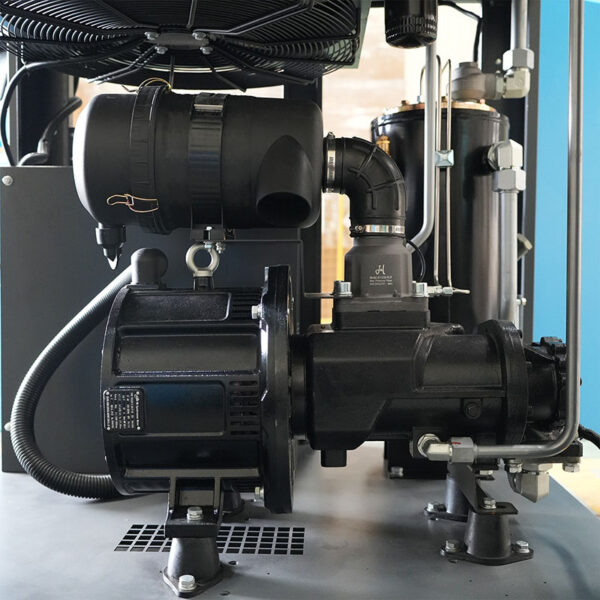
Unlike lubricated compressors where oil analysis provides wear data, oil‑free systems require direct inspection of wearing oil free air compressor parts. Recommended condition‑based monitoring:
- Blow‑by measurement – Install a flow meter on the crankcase breather (reciprocating). Baseline: <0.5% of intake flow. Replace rings when blow‑by exceeds 2%.
- Vibration analysis – For screw and centrifugal compressors. Track overall velocity and specific frequency bands (1×, 2× running speed). An increase of 50% above baseline indicates bearing or gear wear.
- Endoscopic inspection – Every 3,000 hours, inspect cylinder walls, piston rings, rotor coatings, and seal faces. Use high‑resolution borescope with measurement capability.
- Pressure differential across filters – Track digitally; set alarms at 80% of maximum allowable ΔP.
Aivyter offers a predictive maintenance program that includes vibration sensors, blow‑by meters, and quarterly reporting. For a dairy plant with 12 oil‑free compressors, the program reduced unplanned downtime by 78% and extended average ring life by 40%.
7. Common Failure Modes and Countermeasures for Oil‑Free Parts
Field data from 200+ sites reveal recurring issues with oil free air compressor parts:
- PTFE ring cold flow (deformation) – Caused by excessive temperature (>120°C) or pressure. Solution: upgrade to PEEK rings or increase cooling capacity.
- Carbon seal cracking – Thermal shock or high vibration. Solution: verify alignment and use gradual warm‑up procedures (5°C/min maximum).
- Rotor coating peeling – Moisture or acidic condensate attack. Solution: install efficient moisture separators and aftercoolers to keep discharge temperature above dew point.
- Bearing false brinelling – Vibration during transport or storage. Solution: rotate shaft manually every 30 days during storage; use anti‑seize preservation oil.
Aivyter’s engineering team provides failure analysis and recommends material upgrades. For a chemical plant where acidic gas caused carbon seal failure, Aivyter supplied silicon carbide seals with improved chemical resistance, achieving 24 months of leak‑free operation.
8. Frequently Asked Questions About Oil Free Air Compressor Parts
Q1: How often should I replace the piston rings in an oil‑free reciprocating compressor?
A1: For PTFE rings in dry air service at 8–10 bar discharge pressure, replacement interval is 3,000–6,000 hours. For PEEK rings, 8,000–12,000 hours. Confirm by measuring blow‑by: replace when crankcase flow exceeds 2% of intake flow. Aivyter supplies ring kits with wear tracking stickers.
Q2: Can I use aftermarket oil free air compressor parts instead of OEM?
A2: Yes, provided the aftermarket parts meet or exceed OEM material specifications and dimensional tolerances. Critical parameters: ring radial wall thickness tolerance (±0.02 mm), end gap (as per cylinder diameter), and surface finish (Ra ≤0.4 µm for seal faces). Aivyter manufactures aftermarket parts to ISO 9001 with full material certificates, often at 40–60% lower cost than OEM.
Q3: What are the signs of failing rotor coatings in an oil‑free screw compressor?
A3: Symptoms: reduced flow (volumetric efficiency drop >10%), increased discharge temperature (10°C above baseline), and high vibration (1× running speed dominant). Confirm using borescope: look for bare metal patches or flaking. Replace rotors when coating damage exceeds 10% of rotor profile area. Aivyter offers recoating services with ceramic‑PTFE hybrid coatings.
Q4: How do I store spare oil free air compressor parts to preserve their life?
A4: For PTFE and PEEK rings: store in original packaging at 15–25°C, away from ozone (electric motors, UV light). Shelf life 5 years. For carbon seals: store in sealed container with desiccant; avoid handling sealing faces. For O‑rings and gaskets: keep in dark, cool (20°C), 50% RH; shelf life 3–5 years. Aivyter dates all parts and provides storage instructions.
Q5: What is the maximum allowable discharge temperature for oil‑free compressor parts?
A5: For PTFE‑based components: 120°C continuous, 140°C peak. For PEEK: 260°C. For carbon seals: 200°C. For aluminum rotor coatings: 150°C. Exceeding these temperatures accelerates wear exponentially (Arrhenius rule: every 10°C halves life). Install temperature alarms set at 5°C below maximum.
Q6: Can oil free air compressor parts be rebuilt or repaired instead of replaced?
A6: Some parts can be reconditioned: carbon seal faces can be lapped (up to 0.1 mm material removal); PTFE rings can be re‑gapped if wear is uniform; rotor coatings can be stripped and reapplied. However, bearings, timing gears, and valve plates should be replaced. Aivyter offers a rebuild service for air ends, including coating renewal and bearing replacement, at 50% of new replacement cost.
9. Conclusion: Ensuring Reliability of Oil‑Free Compressor Parts Through Engineering Partnerships
Selecting and maintaining oil free air compressor parts is a specialized discipline requiring knowledge of polymer tribology, thermal management, and contamination control. By adopting condition‑based monitoring (blow‑by, vibration, borescope), standardizing materials (PTFE, PEEK, carbon), and partnering with a supplier that provides material traceability, industrial users can achieve ISO 8573-1 Class 0 reliability while minimizing total cost of ownership.
Aivyter manufactures and supplies a comprehensive range of oil free air compressor parts – including piston rings, rider rings, carbon seals, rotor coatings, bearings, and filter elements – for reciprocating, screw, and centrifugal compressors. Our engineering team provides failure analysis, material upgrades, and just‑in‑time inventory programs. We invite plant managers and maintenance engineers to audit their current spare parts strategy and request a customized supply agreement.
Ready to optimize your oil‑free compressor reliability? Send an inquiry with your compressor make, model, operating hours, and any recent failure data. Our technical team will respond within 48 hours with a parts recommendation, lead times, and volume pricing.
Submit your oil free air compressor parts inquiry →
Or contact directly: [email protected] – reference “Oil‑Free Parts Technical Guide” for priority engineering support.
about
Aivyter
We provides trusted air compressors and mining equipment, engineered for durability, efficiency, and demanding industrial applications.