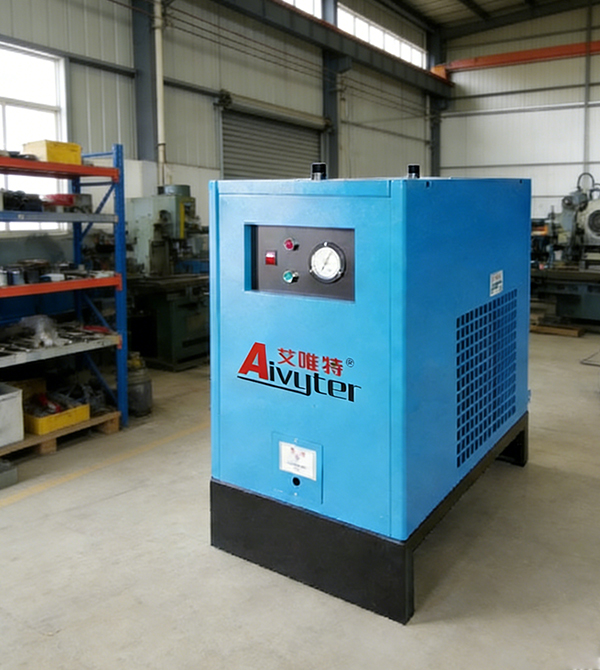
In industrial environments ranging from underground mining to large-scale construction projects, moisture in compressed air lines remains a persistent operational threat. Water condensation leads to pneumatic tool failure, corrosion of piping networks, and contamination of sensitive instrumentation. For plant engineers and procurement specialists, selecting the correct air treatment component is not a commodity decision—it is a process integrity choice. A refrigerated dryer consistently provides the most cost-efficient, reliable dew point suppression for standard industrial applications. This guide draws on field experience in abrasive, high-humidity environments to outline how modern drying technology aligns with productivity targets and maintenance reduction strategies.
Aivyter has engineered compressed air solutions for over a decade, integrating robust refrigerated dryer units that withstand the vibration, dust, and thermal loads typical of extractive industries. This article covers thermodynamic principles, sizing parameters, application-specific challenges, and maintenance protocols that directly influence mean time between failures (MTBF).
The Thermodynamic Principle: How a Refrigerated Dryer Achieves Pressure Dew Point
Compressed air leaving a screw or piston compressor is saturated with water vapor. As the air cools downstream, condensation forms, creating two-phase flow that erodes valves and washes away lubricants. The core function of any refrigerated dryer is to mechanically chill compressed air to a target temperature, typically between 35°F and 50°F (1.5°C to 10°C), forcing water vapor to condense into liquid. This liquid is then separated and automatically discharged. The dried air is reheated by incoming hot air via an integrated air-to-air heat exchanger, preventing pipe sweating and reducing re-evaporation risks.
Cycling versus Non-Cycling Designs
Two primary configurations dominate industrial specifications: cycling (thermal mass) and non-cycling (continuous run). Non-cycling dryers maintain a constant refrigeration circuit, offering stable dew point performance under fluctuating loads. Cycling dryers incorporate a large thermal storage medium (e.g., eutectic solution) that allows the compressor to shut off during low-demand periods, reducing electricity consumption. For mining sites where power supply can be unstable, Aivyter often recommends hybrid control logic that prioritizes dew point stability over energy savings. Each refrigerated dryer should be selected based on actual flow profile and ambient temperature extremes—not simply nameplate compressor output.
- Air-to-air heat exchanger: Pre-cools incoming saturated air using outgoing cold dry air, improving efficiency and reducing evaporator load.
- Refrigerant evaporator: Directly chills the air to condense moisture; finned tube geometry must resist fouling in dusty environments.
- Moisture separator + auto drain: High-efficiency cyclonic separation combined with zero-loss or solenoid drains removes bulk liquid.
- Hot gas bypass valve: Prevents evaporator icing at low loads; mandatory for cycling systems operating below 50% flow.
Critical Applications in Mining, Civil Construction & Industrial Engineering
Each sector imposes distinct demands on compressed air drying equipment. Understanding these nuances separates reliable operation from recurring downtime events.
Underground and Open-Pit Mining
Mining pneumatic networks span kilometers of buried pipe. Temperature gradients between surface compressor rooms (often >40°C) and underground drivages (15–25°C) create substantial condensation zones. Without a properly sized refrigerated dryer, water collects in low points, causing hammering in rock drills and premature failure of air hoists. Furthermore, particulate matter (coal dust, silica) mixed with moisture forms abrasive sludge that accelerates wear in control valves. Mining engineers increasingly specify refrigerated dryers with IP54 enclosures and oversized condensate drains that tolerate high sediment loads.
Heavy Construction & Earthmoving
Mobile compressor fleets used for pile driving, sandblasting, and concrete spraying operate in open environments with rapid weather changes. A refrigerated dryer on a portable compressor must handle engine vibrations, fuel contaminants, and wide ambient swings (-10°C to 45°C). Non-cycling models with corrosion-resistant brazed plate heat exchangers show better field durability. Construction project managers should mandate dew point logging at pneumatic tool manifolds, verifying that the installed drying system maintains pressure dew point below 5°C even at partial flow.
Precision Engineering & Automation
Robotic assembly lines, CNC machines, and air bearings require Class 3 or better air quality (ISO 8573-1). Here, a refrigerated dryer acts as the primary dryer, often followed by particulate and coalescing filters. However, note that refrigerated technology cannot achieve pressure dew points below freezing—for sub-zero applications, additional desiccant drying is required. Nevertheless, for the vast majority of factory automation, a correctly specified refrigerated dryer provides sufficient moisture protection without energy penalties associated with regenerative dryers.
Engineering Selection Parameters: Sizing Beyond Flow Rate
Selecting a refrigerated dryer solely on compressor flow rating leads to underperformance. Four correction factors must be applied to the nominal capacity:
- Inlet air temperature: Dryer capacity is rated at 35°C inlet; every 5°C increase reduces capacity by 10-15%.
- Ambient temperature: Air-cooled condensers lose efficiency above 40°C, requiring derating or switching to water-cooled variants.
- Operating pressure: Lower pressure reduces the air density and mass flow, effectively lowering dryer capacity. Conversely, high pressure improves separation efficiency.
- Required pressure dew point (PDP): Demanding PDP = 3°C rather than 7°C can reduce effective flow by 20%.
Aivyter provides a digital sizing tool for engineers, incorporating site-specific variables like altitude and cooling water temperature. For mining applications, we recommend oversizing the refrigerated dryer by one frame size to account for future production increases and degraded condenser performance due to dust accumulation.
Maintenance Protocols That Extend Service Life
Field data from 150+ industrial sites indicates that 68% of unplanned dryer failures result from neglected condensate drains or fouled heat exchangers. Implement the following checklist:
- Weekly: Verify auto-drain operation by manually cycling; clean strainers on drain lines.
- Monthly: Inspect air-cooled condenser coils; blow out compressed air or use non-abrasive cleaning agents.
- Quarterly: Check refrigerant pressures against factory chart; low suction pressure indicates restricted expansion valve or filter-drier.
- Annually: Replace coalescing prefilters (if installed) and calibrate dew point sensor. Perform ultrasonic leak detection on hot gas bypass valve.
Proactive maintenance directly correlates with total pneumatic system reliability. Many mining operators integrate dryer alarms (high dew point, fan failure) into their plant SCADA system for remote monitoring. Aivyter offers optional Modbus communication on all industrial refrigerated dryer series, enabling predictive alerting before production interruption occurs.
Refrigerated vs. Desiccant Dryers: Operational Boundaries
Engineers frequently ask whether a refrigerated dryer can replace a desiccant system. The answer depends exclusively on required pressure dew point. Refrigerated technology is physically incapable of achieving sub-zero PDP (below 0°C). If the application demands PDP -40°C for outdoor winter operations or pharmaceutical processes, a heated desiccant or blower purge dryer is mandatory. However, for 95% of general industrial, construction, and mining tools (PDP requirement +3°C to +10°C), a high-quality refrigerated dryer offers lower initial investment, simpler maintenance, and no purge air loss.
Hybrid solutions exist: a refrigerated dryer pre-cools air to +5°C, removing bulk moisture, followed by a small desiccant dryer to polish to -40°C. This reduces energy consumption by 40-60% compared to a standalone desiccant dryer. For large mining complexes with mixed air quality zones, this staged approach is increasingly common.
Common Operational Issues and Engineering Countermeasures
Even robust refrigerated dryers encounter field problems. Below are typical symptoms with root cause analysis:
- High discharge dew point (>10°C): Usually caused by refrigerant leak, hot gas bypass stuck open, or evaporator frosting. Perform leak detection and check superheat settings.
- Frequent compressor cycling: In non-cycling dryers, indicates defective thermostat or wrong thermal expansion valve bulb placement.
- Water downstream of dryer: Most often a failed condensate drain or separator. Test drain manually; inspect internal baffle.
- Excessive pressure drop: Dirty heat exchanger passages or undersized dryer. Measure differential pressure; clean chemically if oil carryover has coked surfaces.
For troubleshooting assistance, Aivyter maintains a 24/7 engineering support line with remote diagnostic capability. Our field service engineers carry common refrigerant kits and OEM spare parts to minimize downtime in remote locations.
Frequently Asked Questions (FAQ)
Q1: What is the typical pressure dew point range achieved by an industrial refrigerated dryer?
A1: A properly functioning refrigerated dryer delivers pressure dew points between 35°F and 50°F (1.5°C to 10°C) at rated conditions. Cycling dryers may see slightly higher PDP during transient loads. For applications requiring sub-freezing dew points, supplement with a desiccant dryer.
Q2: Can a refrigerated dryer be installed outdoors in harsh mining climates?
A2: Yes, provided the unit has appropriate NEMA 4X / IP54 protection, crankcase heater for low ambient startup (below 5°C), and corrosion-resistant coating on condenser fins. Aivyter offers ‘M-series’ refrigerated dryers with heavy-duty filters and insulated enclosures for extreme environments.
Q3: How often should automatic condensate drains be serviced?
A3: For ball-float drains, inspect every 500 operating hours for debris accumulation. For electronic timed drains, replace the valve diaphragm annually. A clogged drain is the primary cause of moisture carryover—install a secondary safety drain on critical systems.
Q4: Is a refrigerated dryer necessary if I already have a coalescing filter?
A4: Coalescing filters remove liquid aerosols and oil, but they cannot reduce the water vapor content. As air cools downstream of the filter, new condensation forms. Only a refrigerated dryer (or desiccant dryer) lowers the vapor’s dew point, preventing post-filter condensation. The two technologies are complementary, not alternatives.
Q5: What is the difference between a cycling and a non-cycling refrigerated dryer for variable flow applications?
A5: Non-cycling dryers run the refrigeration compressor continuously, offering tight dew point control (±2°C) even at flows down to 20% of rating. Cycling dryers stop the compressor when thermal mass is fully frozen; they are more energy-efficient but exhibit PDP swings up to 5°C. For laser cutting or robotic welding, use non-cycling. For intermittent tools like impact wrenches, cycling is acceptable.
Optimize Your Compressed Air System with Expert Selection
Choosing the correct refrigerated dryer requires balancing flow characteristics, environmental severity, and maintenance access. Oversized dryers waste capital and energy; undersized dryers produce wet air and accelerate downstream equipment wear. Aivyter engineers analyze each client’s compressed air profile—including load cycles, ambient extremes, and allowable pressure drop—to specify a dryer that maintains ISO 8573-1 Class 4 or better compliance. Our standard industrial series includes integrated pre-filters, differential pressure gauges, and Modbus-ready controllers.
Ready to eliminate moisture-related failures in your pneumatic network? Share your compressor specifications and operating conditions with our technical team. We provide detailed sizing reports, 3D installation drawings, and lifecycle support agreements for mining houses, engineering contractors, and manufacturing facilities worldwide.
Send your inquiry to Aivyter’s industrial drying specialists for a customized proposal and on-site commissioning assistance.
about
Aivyter
We provides trusted air compressors and mining equipment, engineered for durability, efficiency, and demanding industrial applications.