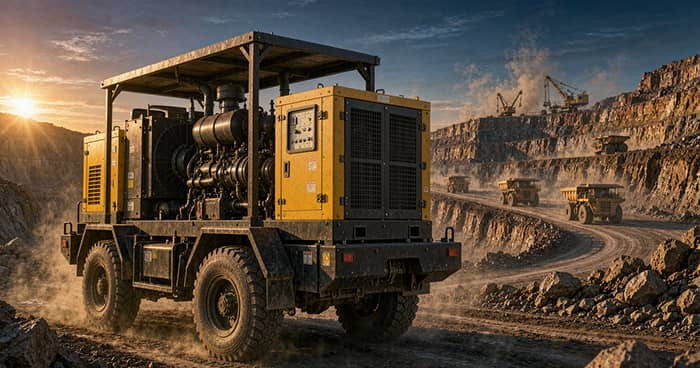
Why the Right Mining Air Compressor Matters More Than You Think
Compressed air is often called the “fourth utility” in heavy industry — right alongside electricity, water, and gas. In mining and tunneling, it is not a convenience; it is the lifeblood of the operation. Pneumatic drills, rock breakers, bolting rigs, ventilation systems, and shotcrete sprayers all depend on a steady, reliable supply of clean, pressurized air. When the compressor fails, the entire face can grind to a halt.
Yet compressor selection is frequently treated as a routine procurement decision — a box to tick based on the lowest upfront quote. That is a costly mistake. In a typical underground or surface mine, energy to run air compressors can account for 10–30% of total site electricity consumption, and a poorly matched unit can waste thousands of dollars every month in excess power, unnecessary maintenance, and downtime. Choosing correctly is therefore not an engineering footnote; it is a strategic financial decision.
Consider the math on a mid-size underground operation: a 250 kW compressor running 6,000 hours a year at $0.12/kWh consumes roughly $180,000 of electricity annually. An efficiency gap of just 10% against a better-matched unit is $18,000 a year — often more than the entire price difference between a budget machine and a premium one. Add the cost of an unplanned failure, where a stopped development heading can burn thousands of dollars per shift in idle labor and delayed ore, and the case for rigorous specification becomes obvious. Compressed air is one of the few mine utilities where the cheapest-looking decision is routinely the most expensive one over time.
This guide walks through the main compressor types used in mining, the criteria that actually matter when sizing and specifying a unit, a side-by-side comparison, and application-specific recommendations. Whether you operate a deep underground gold mine, a tunnel-boring project, or an open-pit quarry, the goal is the same: match the right machine to the right duty, and keep total cost of ownership (TCO) as low as the duty cycle allows.
Understanding the Main Types of Mining Air Compressors
Not all compressors are built for the same abuse. Mining demands rugged construction, continuous-duty ratings, and tolerance for dust, vibration, and temperature swings. Below are the five categories you will encounter most often.
Screw Air Compressors
Rotary screw compressors are the workhorses of modern mining. Two meshing helical rotors trap air and compress it continuously, delivering a smooth, pulse-free flow that suits pneumatic tools and processes alike. They dominate stationary mine installations because they are efficient at partial loads, run for tens of thousands of hours between major services, and scale easily from 7.5 kW to over 500 kW.
For mining, oil-injected screw compressors remain the default where trace oil in the air stream is acceptable (most pneumatic tools do not care). They offer the best balance of purchase price, efficiency, and reliability. Aivyter’s screw compressor range is engineered for energy-saving, low-noise, and continuous operation in exactly these industrial environments.
Oil-Free Air Compressors
When the end use is sensitive — instrument air, breathing air systems, food-grade or pharmaceutical-adjacent processes, or operations with strict emission rules — oil-free (Class 0) compressors remove the risk of lubricant contamination entirely. They use coatings, water injection, or oil-free screw/scroll stages to guarantee contaminant-free output.
The trade-off is cost: oil-free units typically carry a 20–40% price premium and slightly lower specific power efficiency than their oil-injected siblings. But for mines with on-site laboratories, gas analysis, or air-driven medical/refuge-chamber systems, the premium is non-negotiable.
Portable (Diesel) Screw Air Compressors
Surface mining, quarrying, and exploration drilling often happen far from grid power. Diesel-driven portable screw compressors solve mobility: mounted on skids or trailers, they follow the pit face, the drill rig, or the shotcrete crew. Aivyter’s portable units pair proven diesel engines (Cummins, Yuchai, Doosan, and others) with efficient screw elements to deliver high airflow and fuel economy in tough outdoor conditions.
These are the right call when the air demand moves, when temporary peak demand exceeds the stationary plant, or when a backup is needed during main-unit servicing.
Air Dryers and Treatment Systems
Compressed air leaving any compressor is hot and saturated with water vapor. In a mine, that moisture turns into internal corrosion, frozen lines in cold climates, and ruined pneumatic tools. Refrigerated and desiccant air dryers remove this moisture; filters strip particulates and oil aerosols. For instrument air or any process where condensation is unacceptable, a dryer is not optional — it is part of the system.
PSA Gas Generators
Some mining operations need more than air. Pressure Swing Adsorption (PSA) generators produce on-site nitrogen or oxygen, used for inerting, fire suppression in coal mines, leaching processes, and blasting support. Producing gas on-site avoids the logistics and cost of delivered cylinders and gives a continuous, pure supply. This is a specialized but increasingly common addition to the mine air plant.
Key Selection Criteria: How to Size and Specify
Picking a compressor is less about brand and more about matching duty to specification. Five criteria drive 90% of the decision.
1. Required Pressure and Flow Rate (Bar / CFM)
Every pneumatic tool and process has a rated pressure (typically 7–10 bar / 100–145 psi for most mining tools) and a flow demand measured in cubic feet per minute (CFM) or cubic meters per minute (m³/min). The fatal error is sizing to the *nameplate* of one tool. Instead:
- List every air-consuming device and its simultaneous-demand CFM.
- Apply a diversity (use) factor — not all tools run at once. A realistic 60–80% coincidence factor is common.
- Add 25–30% headroom for leaks (mines are leak-prone), altitude, and future expansion.
- Account for pressure drop across long underground pipe runs; size the compressor outlet a bar or two above tool requirement.
Undersizing strangles productivity; oversizing wastes capital and energy. A proper compressed-air audit is the single highest-return step in the whole selection process.
2. Energy Efficiency and Total Cost of Ownership
Over a 10-year life, electricity is ~70–80% of a compressor’s total cost; the purchase price is often under 15%. Two numbers matter: *specific power* (kW per m³/min or per 100 CFM) and the unit’s part-load behavior. Look for variable-speed drive (VSD) models where demand fluctuates — VSD can cut energy 20–35% versus fixed-speed units in variable-demand profiles.
Demand a full TCO model from any supplier: include energy, maintenance parts, oil/filters, downtime risk, and residual value. A slightly pricier, more efficient machine usually pays for itself inside two years.
3. Operating Environment — Underground vs Surface
Underground mines impose unique constraints: restricted ventilation, flammable-gas zones (requiring flameproof/explosion-proof certification), limited space, and difficult access for service. Surface and quarry sites face dust, ambient heat, and weather exposure. The environment dictates cooling method, enclosure rating (IP55 or higher), and whether you need ATEX/IECEx or MSHA-compliant certification.
4. Air Purity Requirements (Oil-Free vs Oil-Injected)
Decide early whether your duty needs Class 0 oil-free air. If only pneumatic tools and general-purpose air are involved, oil-injected screw units with good filtration are economical and robust. If instrument air, refuge chambers, or process gas is involved, step up to oil-free or add rigorous downstream treatment.
5. Maintenance, Spare Parts, and After-Sales Support
A compressor is only as good as the support behind it. In remote mining locations, spare-parts availability and response time beat a marginally better spec sheet. Evaluate: local service coverage, recommended spare-parts stock list, mean time between failures (MTBF) data, and training for your mechanics. Aivyter maintains a 75+ person after-sales service team across 70+ countries — a factor worth weighting heavily for operations far from a major city.
Comparison Table: Which Compressor Type Fits Your Operation
| Type | Best For | Pressure Range | Mobility | Relative Efficiency | Typical CapEx | Purity |
|---|---|---|---|---|---|---|
| Oil-injected screw (stationary) | Main mine air plant, continuous duty | 7–13 bar | Fixed | High | Medium | Oil-bearing (filterable) |
| Oil-free screw (stationary) | Instrument/process air, refuge chambers | 7–10 bar | Fixed | Medium-High | High | Class 0 (oil-free) |
| Portable diesel screw | Surface drilling, quarrying, backup | 7–25 bar | Mobile | Medium (fuel-based) | Medium | Oil-bearing |
| Air dryer + filters | Mandatory with any wet system | n/a | Fixed | n/a (treatment) | Low | Upgrades to dry/clean |
| PSA gas generator | N2/O2 for inerting, leaching, fire suppression | n/a | Fixed | Process-dependent | Medium-High | High-purity gas |
Application Scenarios and Recommendations
Underground Mining
Underground operations need continuous, certifiable, space-efficient air. A central oil-injected screw plant with VSD plus a robust dryer and ring-main is the backbone. For development headings far from the main, mobile diesel screw units can be staged locally. Where refuge chambers or instrument air exist, dedicate an oil-free or treated branch. Plan for flameproof certification and easy component access — you do not want to dismantle a 3-tonne airend in a 2.5-meter drift.
Tunneling and Shotcrete Support
Tunnel boring and shotcrete (sprayed concrete) support consume enormous, pulsating air volumes. Shotcrete machines and bolters run in dusty, wet conditions. Here, rugged portable or skid-mounted screw compressors with heavy filtration shine. Pair with an adequately sized dryer to keep shotcrete-quality consistent and lines from freezing in alpine tunnels.
Surface Mining and Quarrying
Open pits and quarries favor mobile diesel screw compressors that track the drill rig and crusher. Grid-connected stationary screw units serve fixed workshops and processing plants. Dust ingestion is the enemy — specify heavy-duty inlet filtration and a maintenance schedule that accounts for it. For fixed installations at the processing plant or workshop, a stationary oil-injected screw compressor with VSD pays back quickly where demand varies with shift patterns. Specify corrosion-resistant enclosures and elevated air intakes; ground-level intakes on a quarry floor ingest grit that destroys filters and rotors alike.
Drilling and Blasting Support
Down-the-hole (DTH) and rotary blasthole drills demand high pressure (often 17–25 bar) and high volume. High-pressure portable screw compressors are purpose-built for this; mismatching with a standard 7–10 bar unit will crater drill penetration rates and burn more fuel per meter.
Energy-Saving Strategies That Pay Back Fast
Even a correctly sized compressor leaves money on the table if the system around it is sloppy. The highest-impact, lowest-cost improvements:
- Fix leaks. A single 3 mm leak at 7 bar wastes roughly 5–7 m³/h — thousands of dollars a year. A quarterly leak survey pays for itself immediately.
- Lower system pressure. Every 1 bar reduction saves ~7% compressor energy. Set the minimum pressure that tools actually need.
- Use VSD on variable demand. If your load factor swings, VSD is the single biggest energy lever.
- Recover heat. Up to 90% of input energy leaves as heat; recover it for mine-site heating or process water.
- Right-size dryers and filters. Oversized dryers and clogged filters add needless pressure drop (and thus energy).
- Maintain inlet filters. A restricted inlet can drop capacity 5% and raise energy 2–3% — trivial to prevent, expensive to ignore.
Common Selection Mistakes That Drain Mine Budgets
Even experienced procurement teams repeat the same avoidable errors. Recognizing them up front protects both capital and operating budget.
Mistake 1: Buying on Upfront Price Alone
The cheapest unit on paper is rarely the cheapest to own. A compressor with a 10% worse specific power will, over a decade, burn far more in electricity than the savings on the invoice. Always request and compare a 10-year TCO model rather than the headline CapEx number.
Mistake 2: Ignoring the Duty Cycle
A unit sized for continuous 24/7 duty that actually runs 4 hours a day is grossly oversized — and oversized fixed-speed machines waste energy at part load. Conversely, a machine sized for average demand will trip and starve tools at peak. Match the compressor type (fixed vs VSD) to the *shape* of your load curve, not just its average.
Mistake 3: Forgetting the Distribution System
A perfectly sized compressor can be defeated by undersized, leaky, or poorly routed pipe. Long underground runs with sharp bends and cheap fittings create pressure drop that forces the compressor to run harder. Budget for properly sized, low-drop ring mains and a leak-management program from day one.
Mistake 4: Under-Specifying Inlet Filtration
In mining, air ingested is air full of abrasive dust. Skimping on inlet filtration or stretching service intervals destroys rotors and shortens airend life. The marginal savings are trivial next to a premature airend rebuild. Treat filtration as mission-critical, not a consumable afterthought.
Mistake 5: Overlooking Certification and Compliance
Underground flammable-gas zones require flameproof or intrinsically safe certification (ATEX/IECEx or regional equivalents). Specifying a non-compliant unit can mean it cannot be commissioned at all — a catastrophic late-stage surprise. Confirm certification requirements for your jurisdiction before shortlisting, not after award.
Monitoring, IoT, and Predictive Maintenance in 2026
The biggest shift in mining compressed air since 2024 is not mechanical — it is digital. Modern screw compressors increasingly ship with embedded controllers that log pressure, temperature, vibration, runtime, and energy per cubic meter. Paired with IIoT gateways, this data enables three capabilities that directly protect uptime and budget.
Remote condition monitoring lets a central reliability team watch every unit across multiple sites from one dashboard. Abnormal vibration or rising discharge temperature triggers a planned intervention before a failure strands a heading. For operations in remote regions where a service visit is days away, this visibility is transformative.
Energy dashboards turn the abstract “air is expensive” into a live cost-per-m³ number per site and per shift. When operators can see that a leaking header is costing real money hourly, leak programs actually get funded and sustained.
Predictive maintenance uses trend data to schedule airend and bearing service at the optimal moment rather than on a fixed calendar — capturing remaining useful life without risking unplanned downtime. As fleets grow, the savings compound.
Aivyter’s newer control platforms support these telemetry features, and the after-sales network can help miners configure alert thresholds suited to their duty. The takeaway for 2026 buyers: treat connectivity and data export as a selection criterion, not a nice-to-have. A compressor that cannot tell you how it is performing is a black box in an operation that can no longer afford surprises.
FAQ — Frequently Asked Questions
Q1: What size air compressor do I need for a mine?
Start from your tools, not the catalog. Sum the simultaneous CFM (or m³/min) of every air device, apply a 60–80% diversity factor for non-simultaneous use, then add 25–30% for leaks, altitude, and growth. Match pressure to the highest-rated tool plus line losses. For most underground development headings, that lands in the 20–60 m³/min range; large open pits can exceed 100 m³/min across multiple units. A professional compressed-air audit removes the guesswork.
Q2: Oil-free or oil-injected — which is better for mining?
For general pneumatic tools and most breaking/bolting work, oil-injected screw compressors with good filtration are the economical, reliable choice. Choose oil-free (Class 0) only where air contacts products, instruments, refuge chambers, or processes that cannot tolerate lubricant. Paying the oil-free premium everywhere is wasted money; skipping it where purity matters is a safety and quality risk.
Q3: How much does a mining air compressor cost?
CapEx varies widely: a small portable diesel unit may run tens of thousands of dollars, while a large VSD stationary plant with dryers can reach several hundred thousand. But focus on TCO, not sticker price — energy alone typically dwarfs purchase cost over the life of the machine. Request a 10-year TCO model (energy + maintenance + downtime) from any supplier before deciding.
Q4: Can portable diesel compressors replace stationary units underground?
Not as the primary source. Underground mains need continuous, certifiable, flameproof air fed from a fixed plant. Portable diesel units are excellent for staging at distant development headings, surface drilling, and backup during maintenance — but diesel exhaust and mobility make them unsuitable as the underground backbone. Use them to extend reach, not to replace the core plant.
Q5: What maintenance does a screw compressor need in dusty mining conditions?
Dust is the #1 killer of mining compressors. Priorities: frequent inlet-filter inspection/replacement (often monthly in heavy dust), oil and separator-element changes on schedule, coolant checks on oil-free units, and vibration/temperature trending to catch bearing issues early. Keep a recommended spare-parts kit on site and train local mechanics. A proactive plan beats emergency callouts by a wide margin.
Q6: How do I calculate compressed air cost per cubic meter?
Multiply your electricity tariff ($/kWh) by the compressor’s specific power (kWh per m³ produced), then divide by typical operating efficiency and add allocated maintenance. Example: at $0.10/kWh and 0.10 kWh/m³ specific power, base energy cost is ~$0.01/m³ before losses and maintenance — often 30–50% higher in practice once leaks and part-load inefficiency are counted. Tracking actual kWh against logged output is the only way to know your true number.
Mining Air Compressor Selection Checklist
Before you issue a tender or approve a purchase order, run through this checklist. If any item is unanswered, that is your next task — not a reason to proceed.
- ☐ Air audit completed — simultaneous CFM/m³-min demand mapped, diversity factor applied, 25–30% headroom added.
- ☐ Pressure verified — tool requirement plus line-loss margin confirmed (typical 7–13 bar; DTH drilling 17–25 bar).
- ☐ Duty cycle profiled — load shape known, VSD vs fixed-speed decision made on data.
- ☐ Environment classified — underground vs surface; flameproof/ATEX/IECEx certification confirmed for the jurisdiction.
- ☐ Purity defined — oil-free (Class 0) specified only where contamination is unacceptable; filtration plan for everything else.
- ☐ TCO modeled — 10-year energy + maintenance + downtime comparison across shortlisted units.
- ☐ Distribution designed — low-drop ring main sized; leak-management program budgeted.
- ☐ Support confirmed — spare-parts availability, response time, and local service coverage validated for your site’s location.
- ☐ Monitoring planned — telemetry, energy dashboard, and predictive-maintenance alert thresholds configured from commissioning.
Tick every box and you have removed the most common sources of overspend and downtime. Skip one and you are gambling with both capital and production.
Summary
Choosing a mining air compressor is a specification exercise, not a price-comparison exercise. Start with a proper air audit, size for simultaneous demand plus headroom, then weigh energy efficiency (VSD), certification for your environment, air purity needs, and — critically — the after-sales support you can actually get in a remote location. Screw compressors remain the backbone; oil-free units earn their premium only where purity is mandatory; portable diesel units extend reach to the pit face and the drill rig.
The winners in 2026 are operations that treat compressed air as a managed utility: audit it, fix the leaks, right-size the pressure, and recover the heat. Do that, and the “fourth utility” becomes one of your lowest-risk, highest-return assets.
about
Aivyter
We provides trusted air compressors and mining equipment, engineered for durability, efficiency, and demanding industrial applications.