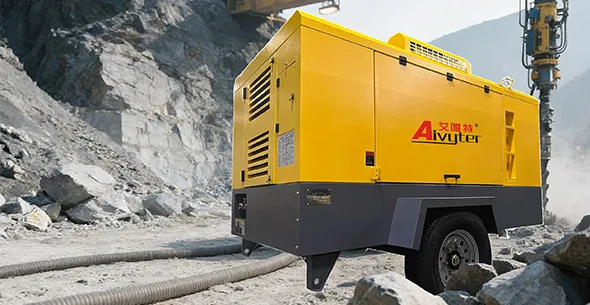
1. Free Air Delivery (FAD) and Pressure Requirements
The primary specification of any portable diesel compressor is its flow rate (m³/min or cfm) and working pressure (bar or psi). Undersized units starve tools; oversized units waste fuel.
- Typical air demand per tool:
- Rock drill (22–27 mm): 2.5–3.5 m³/min @ 6–7 bar.
- Paving breaker (30 kg): 1.8–2.5 m³/min @ 6 bar.
- Sandblasting nozzle (6 mm): 1.5–2.0 m³/min @ 6–7 bar.
- DTH hammer (3–4 inch): 6–10 m³/min @ 10–12 bar.
- Calculate total demand: Sum all tool flows, add 15% for leakage and future expansion.
- Pressure rating: Select a compressor with maximum pressure 10–15% above tool requirement. Higher pressure allows for hose losses (0.1 bar per 30 m of hose).
For a typical road construction crew running two breakers and a rock drill, a 7 m³/min @ 7 bar unit is adequate. For deep hole drilling (DTH), a high‑pressure variant (12–14 bar) is necessary.
2. Engine Power and Fuel Efficiency
The diesel engine must supply enough shaft power to drive the air end at rated conditions. Engine power (kW) should be 10–15% higher than the compressor absorbed power to handle altitude and temperature derates.
- Specific fuel consumption: Good portable diesel compressors consume 6–8 L/h per 1 m³/min of FAD at full load. For a 7 m³/min unit, expect 45–55 L/h.
- Engine type: Tier 4 Final or Stage V for emission‑controlled regions; Tier 3 or equivalent for other areas. Electronic governors maintain constant speed under varying load.
- Fuel tank size: Minimum 8 hours continuous operation – a 400 L tank for a 7 m³/min unit provides about 8–10 hours.
Aivyter equips its portable diesel compressors with fuel‑efficient Yanmar, Cummins, or Deutz engines, with telemetry for real‑time consumption monitoring.
3. Air End Type: Rotary Screw vs. Reciprocating
Almost all modern portable diesel compressors use oil‑injected rotary screw air ends. They offer continuous duty, lower noise, and longer life than reciprocating units.
- Rotary screw advantages: 100% duty cycle, vibration‑free, easy maintenance (only oil and filter changes).
- Reciprocating (piston): Lower initial cost but higher vibration, more frequent valve maintenance, and not suited for continuous operation > 8 hours/day.
- Single‑stage vs. two‑stage screw: Two‑stage screws are more efficient at pressures above 10 bar, saving 8–12% fuel.
For any job requiring more than 4 hours of daily runtime, specify a rotary screw portable diesel compressor.
4. Aftercooler and Air Quality
Compressed air leaving the air end is hot (80–110°C) and contains water vapor. For tools and blasting, this moisture causes rust and clogs. A proper portable diesel compressor includes:
- Aftercooler (air‑to‑air or air‑to‑oil) – reduces discharge temperature to 15–20°C above ambient, condensing up to 70% of water.
- Water separator – centrifugal or coalescing type to remove liquid water. Drain automatically or via manual valve.
- Air receiver tank – provides pulsation damping and additional cooling. Tank must be drained daily.
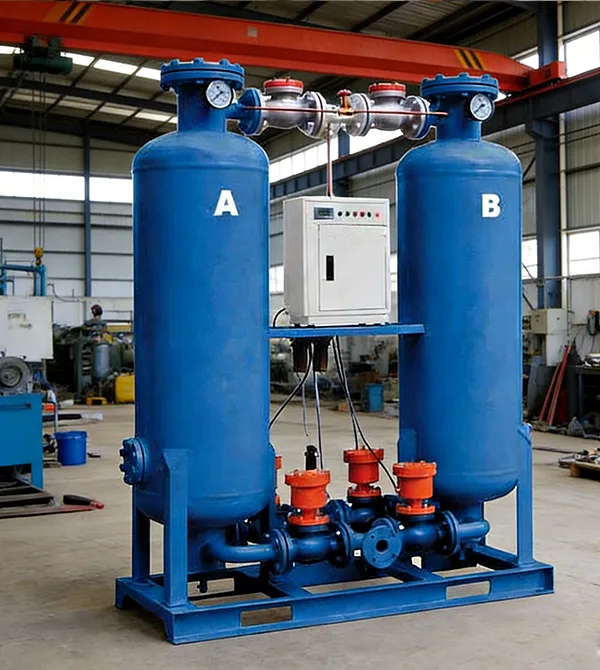
For sensitive applications (instrumentation, painting), add a desiccant dryer downstream. For general construction, an aftercooler + separator is sufficient.
5. Portability and Undercarriage Design
Mobility is the key advantage of a portable diesel compressor. The chassis and towing system must match the terrain.
- Skid‑mount – For crane lifting onto trucks or barges. No wheels; suitable for stationary but relocatable use.
- Two‑wheeled trailer – For highway towing (max speed 80 km/h). Requires brakes and lighting.
- Rugged off‑road undercarriage – Heavy‑duty axles, pneumatic tires (or solid tires for rocky sites), and pintle hook.
- Forklift pockets and lifting lugs – Standard for all units.
Check the towing speed rating. Many compactors are limited to 25 km/h off‑road; highway units must have DOT‑approved lights and brakes.
6. Noise Control and Enclosure
Construction sites and mines have noise limits (often 85 dBA at 7 m). A well‑designed portable diesel compressor enclosure keeps noise within legal limits while allowing cooling air flow.
- Sound‑attenuated canopy – Typically reduces noise by 15–20 dBA. Look for ratings below 75 dBA at 7 m for residential areas.
- Cooling air inlets – Must be large enough to prevent overheating. Louvers should face away from operator area.
- Exhaust silencer (spark arrestor) – Required for forestry and flammable environments.
In urban construction, a “super‑silenced” unit (68 dBA) may be mandated. Ask for a noise test report.
7. Altitude and Temperature Derating
Engine and air end performance drop at high altitude and high ambient temperature. For every 300 m above sea level, engine power decreases by 3%. For every 5°C above 25°C, compressor output decreases by 2%.
- Altitude compensation: For sites above 1,500 m, select a compressor with a turbocharged engine or a larger displacement to maintain sea‑level FAD.
- High‑temperature package: Oversized cooler and fan for ambient up to 50°C.
- Cold start kit: Battery heater, engine block heater, and low‑viscosity oil for operation below -10°C.
Always provide the supplier with site altitude and expected temperature range. Aivyter offers altitude‑rated packages for mines in the Andes and Himalayas.
8. Maintenance Access and Service Intervals
Downtime for maintenance kills productivity. A rugged portable diesel compressor should allow easy access to daily service points.
- Service doors – Large, lockable, and gas‑strut assisted. All filters (air, oil, fuel) reachable without removing panels.
- Oil change interval – 500–1,000 hours for standard oil; 2,000 hours for synthetic oil. Electronic monitoring tracks hours.
- Air filter restriction indicator – Shows when to replace primary filter.
- Remote drain valves – For water separator and receiver tank, routed to a common point.
Request a maintenance checklist and parts list. Common consumables (oil filters, air filters, belts) should be locally available.
9. Safety Features and Compliance
Mining and construction sites enforce strict safety standards. Ensure the compressor includes:
- Emergency stop button – Red, mushroom‑type, located on both sides.
- High‑temperature shutdown – For air end and engine coolant.
- Low oil pressure shutdown – Prevents engine damage.
- Safety relief valve – On air receiver, set to 10% above working pressure.
- Fire extinguisher bracket – Mounted externally.
- Compliance decals – CE, ASME, or local certification.
Aivyter’s portable compressors meet ISO 1217 and include a full safety package.
Case Study: Supplying Compressed Air for a Highway Tunnel Project
A tunnel project in the Rocky Mountains required a portable diesel compressor to power two rock drills and a scaling rig at 2,500 m altitude. Aivyter supplied a 12 m³/min @ 10 bar unit with a turbocharged Deutz engine and altitude compensation. The compressor ran 14 hours/day for 18 months with 98% uptime. Fuel consumption averaged 68 L/h, within 5% of estimate. The client saved $40,000 in fuel compared to a competitor’s non‑derated unit.
Frequently Asked Questions (FAQ)
Q1: How do I calculate the required size of a portable diesel compressor for a fleet of pneumatic tools?
A1: Use the formula: Total FAD = Σ(tool consumption × utilization factor). Utilization factor for rock drills = 0.6 (they drill only 60% of cycle). For breakers = 0.4. Example: Two rock drills (3 m³/min each) × 0.6 = 3.6 m³/min; one breaker (2.5 m³/min) × 0.4 = 1.0 m³/min. Total = 4.6 m³/min. Add 15% for leakage → 5.3 m³/min. Select a 6 m³/min compressor. For simultaneous operation, use factor 1.0.
Q2: What is the typical lifespan of a portable diesel compressor in mining conditions?
A2: With proper maintenance, a rotary screw unit lasts 10,000–15,000 hours before major overhaul (air end replacement). The diesel engine may last 8,000–12,000 hours. Many units are rebuilt and run for 20,000+ hours. Key factors: regular oil changes, clean air filters, and avoiding overspeeding. Aivyter offers remanufacturing programs.
Q3: Can I run a portable diesel compressor in freezing conditions?
A3: Yes, but you need a cold weather package. This includes: (1) Engine coolant heater (block heater), (2) Battery warmer or high CCA battery, (3) Low‑viscosity synthetic oil (5W‑30), (4) Heated air intake for the compressor. Also, drain the water separator after every shift to prevent freezing. Avoid idling for long periods – it causes wet stacking. Let the engine warm up at 1,200 RPM for 5 minutes before loading.
Q4: What is the difference between a portable diesel compressor and a stationary electric compressor?
A4: Portable diesel units are self‑contained (engine + compressor), towable, and operate without grid power – ideal for remote sites and mobile crews. Stationary electric compressors are cheaper to run (electricity vs. diesel), quieter, and require a three‑phase power supply. They are fixed installations. For jobs that move every few days, a portable diesel compressor is the right choice. For permanent factories or long‑term mines with power lines, electric is better.
Q5: How do I troubleshoot low air delivery from my portable diesel compressor?
A5: Follow this sequence: (1) Check air filter – clean or replace. (2) Check for hose leaks – spray soapy water on fittings. (3) Verify engine RPM – should be at rated speed (e.g., 2,200 RPM). (4) Inspect the air end oil level – low oil reduces sealing. (5) Measure pressure at the discharge flange – if low, the unloader valve may be stuck. (6) Perform a capacity test (fill a known volume). If still low, the air end may need service. Aivyter’s technical support provides remote diagnostics.
Request a Sizing Recommendation or Quotation
Choosing the right portable diesel compressor requires a detailed analysis of your tools, site altitude, and duty cycle. Aivyter offers a free compressed air audit – send us your tool list and operating hours. Our engineers will calculate the optimal flow and pressure, recommend a model (oil‑injected or oil‑free), and provide a fuel consumption estimate. We can also arrange a rental trial for 30 days to validate performance before purchase.
Submit an inquiry to our industrial air division → Click here for a response within 24 hours
about
Aivyter
We provides trusted air compressors and mining equipment, engineered for durability, efficiency, and demanding industrial applications.