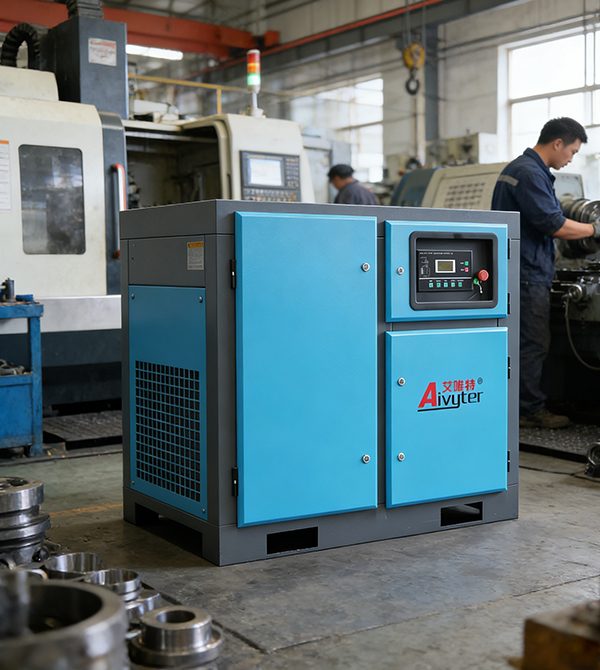
Across mining, heavy manufacturing, and large-scale construction, compressed air is the fourth utility after electricity, water, and gas. Selecting an industrial compressor machine requires matching technology type (rotary screw, reciprocating, or centrifugal) to flow demand, pressure requirements, duty cycle, and air purity standards. This guide provides engineering criteria and field data to help plant managers and procurement teams make informed decisions based on ISO 1217 and ISO 8573-1 standards.
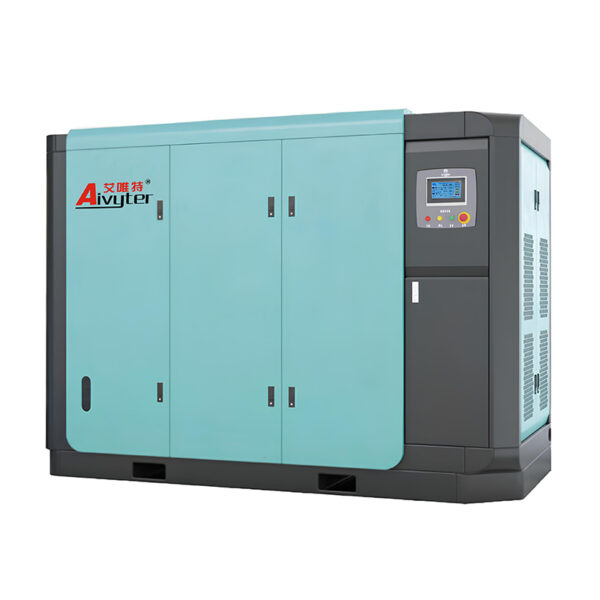
1. Industrial Compressor Machine Types: Rotary Screw, Reciprocating, and Centrifugal
Each industrial compressor machine technology has distinct operating envelopes. Selecting the wrong type leads to excessive energy consumption or premature failure.
- Rotary screw (oil-injected) – Best for continuous 24/7 operation, flow range 0.5–100 m³/min, pressure up to 15 bar. Efficiency remains high at part load when equipped with variable speed drive (VSD). Typical specific power: 6.5–8.5 kW/(m³/min) at 7 bar. Preferred for manufacturing, automotive assembly, and pneumatic conveying.
- Reciprocating (piston) – Suitable for intermittent duty (40–60% duty cycle), flow range 0.1–5 m³/min, pressure up to 30 bar. Lower initial cost but higher maintenance (valve and piston ring replacement every 2,000–4,000 hours). Common in construction, tire inflation, and small workshops.
- Centrifugal (dynamic) – For very high flow (>50 m³/min) at moderate pressure (2–10 bar). Oil-free by design. Requires stable, high flow demand (turndown limited to 70–100%). Efficiency peaks at 100% load. Used in large petrochemical plants, steel mills, and air separation units.
- Oil-free rotary screw – For applications requiring ISO 8573-1 Class 0 air (food, pharma, electronics). Higher cost (+60–100%) and lower efficiency than oil-injected but essential where oil contamination is unacceptable.
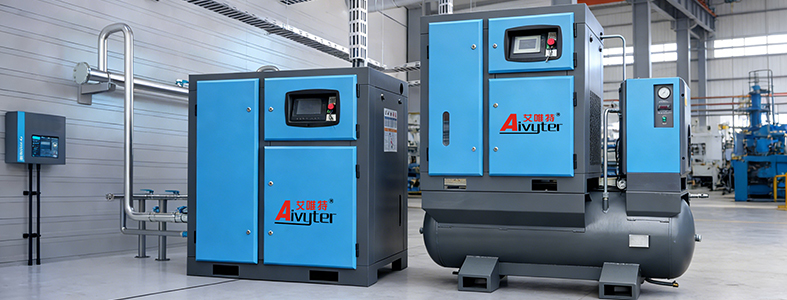
Aivyter offers all four types, with application engineers who conduct site audits before recommending an industrial compressor machine configuration.
2. Performance Metrics: FAD, Specific Power, and Part-Load Efficiency
When comparing quotes for an industrial compressor machine, demand certified performance data based on ISO 1217 Annex C or D (intake at 20°C, 1 bar, 0% RH). Key parameters:
- Free Air Delivery (FAD) – Actual volume flow at discharge corrected to inlet conditions. A 75 kW rotary screw should deliver 12–13.5 m³/min at 7 bar. Reject suppliers quoting displacement (theoretical) rather than FAD.
- Specific power (kW per m³/min) – The primary energy efficiency metric. For 7 bar oil-injected: premium units achieve 6.8–7.2 kW/(m³/min); standard units 7.5–8.2. For reciprocating at 7 bar, expect 8.5–10 kW/(m³/min) due to part-load losses.
- Part-load efficiency (for VSD units) – Request efficiency at 40%, 60%, and 80% of full flow. A well-designed VSD maintains >88% of full-load efficiency down to 50% flow. Poor designs drop below 75%.
- Pressure dew point (for integrated dryers) – Specify +3°C for refrigerant dryers, -40°C for desiccant dryers, measured at rated flow and 35°C ambient.
Aivyter provides computer-generated performance maps for each industrial compressor machine proposal, including specific power at five pressure setpoints.
3. Critical Components: Air End, Bearings, and Cooling System
The reliability of an industrial compressor machine depends on the quality of its core components. Specification details to request from any supplier:
- Air end (rotor profile) – Asymmetric profiles with ground rotors (58–62 HRC) and L/D ratio ≥1.6 for oil-injected. Hardened 20CrMo steel or equivalent. Expected life >60,000 hours.
- Bearings – Tapered roller or angular contact ball bearings on discharge side (SKF, FAG, or NSK). L10 life >50,000 hours at maximum pressure. For oil-free machines, ceramic hybrid bearings or active magnetic bearings.
- Cooling system – Air-cooled or water-cooled. Air-cooled requires ambient temperature ≤45°C and adequate ventilation (0.5 m³/min per kW of fan power). Water-cooled needs flow rate of 4–6 L/min per 10 kW of shaft power, with inlet temperature ≤32°C. Prefer stainless steel or copper-fin coolers to prevent corrosion.
- Drive train – Direct coupling eliminates gear losses (2–3% efficiency gain). Geared drives allow motor speed optimization but add maintenance. VSD units require inverter-duty motors (Class F insulation, IP55).
Industrial compressor machine air ends from Aivyter feature SKF bearings and a 5-year warranty.
4. Industry-Specific Applications: Mining, Manufacturing, Construction
Different sectors impose distinct demands on an industrial compressor machine. Below are proven configurations.
- Mining (underground) – Compressors must be ATEX or MSHA certified for methane/dust atmospheres. Intake air filtration for dust loads >10 mg/m³. Pressure 7–10 bar for rock drills, 5–6 bar for aeration. Containerized units with sound enclosures <85 dBA.
- Heavy manufacturing (steel, cement) – Large central plants with multiple compressors (2–10 units) and a master controller. Heat recovery systems capture 70–90% of input energy for space heating or process water preheating.
- Construction (mobile) – Diesel-driven portable compressors with pressure up to 12 bar. Must operate at -20°C to +50°C ambient. Suppliers must provide global rental support and 48-hour parts delivery.
- Food and beverage – Oil-free or Class 0 certified compressors with stainless steel piping, condensate management (oil-water separators), and regular air quality testing.
For industrial compressor machine solutions, Aivyter provides site-specific engineering, including vibration analysis and thermal imaging of existing systems.
5. Industry Pain Points: Oil Carryover, Overheating, and Pressure Drop
Even a high-quality industrial compressor machine suffers from common operational issues. Diagnose using these field-proven methods.
- Excessive oil carryover (>10 ppm) – Causes: damaged separator element, oil level too high, or coalescer collapse. Measure pressure drop across separator (<0.8 bar for new, replace if >1.2 bar). Use synthetic PAO or PAG oil which resists foaming.
- High discharge temperature (>105°C for oil-injected) – Leads to oil coking and varnish. Check cooler fins, coolant flow, and thermostat valve. For water-cooled, ensure flow rate ≥4 L/min per 10 kW of shaft power and inlet temperature ≤32°C.
- Pressure drop in distribution piping – Every 0.5 bar drop increases energy consumption by 4–5%. Measure pressure at compressor discharge and at point of use. Common causes: undersized pipes, multiple quick-connects, or dirty filters.
- Short air end life (<30,000 hours) – Usually due to dust ingestion or operating above rated pressure. Install intake filter with MERV 15 efficiency (≤1 µm) and never exceed maximum working pressure.
Preventive maintenance schedule: change oil and separator every 4,000–8,000 hours depending on oil type and environment; inspect air filter monthly; record run hours and temperature trends weekly.
6. Selecting an Industrial Compressor Machine Supplier: Audit Checklist
Beyond product specifications, evaluate a supplier of industrial compressor machine units on these operational criteria:
- ISO 9001:2015, ISO 50001 (energy management), ISO 14001 – Minimum quality and environmental standards.
- Local service network – Response time guarantee (≤4 hours for critical breakdowns). Genuine spare parts availability for at least 10 years after model discontinuation.
- Remote monitoring – IoT-enabled controllers with Modbus TCP/IP or Profibus for real-time performance tracking. Request a demo of their SCADA integration.
- Training and documentation – Provide full O&M manuals, electrical schematics, and part number cross-references. On-site training for maintenance staff should be included.
- Reference installations – Ask for three references in your industry with similar flow and pressure requirements. Contact them to verify actual specific power and downtime rates.
Aivyter maintains a global service network with 48-hour parts delivery to major industrial hubs, and every industrial compressor machine customer receives access to a dedicated online portal with performance dashboards.
7. Total Cost of Ownership (TCO) Calculation for Industrial Compressors
For a 10-year operation, energy accounts for 70–80% of TCO. Initial purchase price is only 10–15%. Use this formula when comparing quotes for any industrial compressor machine:
- Annual energy cost (USD) = FAD (m³/min) × Specific power (kW/(m³/min)) × Operating hours × Electricity rate ($/kWh) × Load factor² (for VSD, use part-load profile).
- Example: A 75 kW compressor delivering 12.5 m³/min at 7 bar, specific power 7.0 kW/(m³/min), 7,000 hours/year, $0.11/kWh → annual energy = 12.5 × 7.0 × 7000 × 0.11 = $67,375.
- If a second supplier offers specific power 7.7 kW/(m³/min) but purchase price $5,000 lower, the higher efficiency unit saves $6,737 per year, payback period <1 year.
- Maintenance cost – Include oil, separators, air filters, oil filters, and cooler cleaning. Typical annual maintenance = 8–12% of purchase price for oil-injected, 15–20% for oil-free.
- Downtime cost – Estimate lost production per hour of unplanned shutdown. Add this to TCO if supplier’s mean time between failures (MTBF) is low.
Aivyter provides a free TCO calculator spreadsheet for every industrial compressor machine proposal, helping buyers compare energy and maintenance costs over 5, 10, and 15 years.
Frequently Asked Questions (FAQ)
Q1: What is the typical service life of an industrial compressor machine?
A1: A well-maintained rotary screw industrial compressor machine operates for 80,000–100,000 hours (15–20 years at 8,000 hours/year). Reciprocating units last 20,000–30,000 hours before major overhaul. Centrifugal compressors can exceed 150,000 hours with proper bearing and seal maintenance. Key factors: intake air quality, oil change intervals, and operating pressure relative to rating.
Q2: How do I calculate the required size (FAD) for my factory?
A2: Sum the air consumption of all tools and processes, then add 20–30% for leakage and future expansion. Measure actual consumption using a flow meter on your existing system over a typical production week. For new facilities, use the formula: FAD (m³/min) = (Σ tool flow) × load factor × diversity factor. A professional industrial compressor machine supplier like Aivyter will conduct a 7-day data logging study to determine precise demand profile.
Q3: What is the difference between VSD and fixed-speed industrial compressors?
A3: Fixed-speed compressors run at constant motor RPM; they load/unload based on pressure. VSD (variable speed drive) adjusts motor speed to match air demand continuously. For systems with flow variation >30% and low-flow periods >20% of operating time, VSD reduces energy consumption by 25–40%. For stable base loads (>80% constant), fixed-speed is more efficient and has lower initial cost.
Q4: How often should I change the oil in an oil-injected screw compressor?
A4: With mineral oil: 2,000–3,000 hours. With synthetic PAO or PAG oil: 6,000–8,000 hours. Always follow the industrial compressor machine manufacturer’s recommendation. Oil change intervals also depend on ambient temperature and moisture ingress. Take an oil sample annually for spectrometric analysis to detect metal wear and water content. Extending intervals beyond 8,000 hours risks varnish formation and bearing damage.
Q5: Can I install an industrial compressor machine outdoors?
A5: Yes, if the unit has a weatherproof enclosure (IP54 or higher), space heaters for the oil separator and control panel (operating down to -10°C), and sun shading for hot climates (>40°C). Outdoor installation requires a concrete foundation with vibration isolation pads and proper drainage. Outdoor-rated industrial compressor machines from Aivyter include stainless steel fasteners and corrosion-resistant coolers.
Q6: What is the acceptable pressure drop across an air filter?
A6: A clean intake filter (MERV 15 or better) has a pressure drop of 0.01–0.02 bar. Replace or clean when drop reaches 0.05 bar. For downstream particulate filters (0.01 µm), clean pressure drop is 0.1–0.2 bar; replace at 0.6 bar. Excessive pressure drop increases energy consumption – each 0.1 bar adds ~1% to power draw.
Request a Compressed Air System Audit and Industrial Compressor Quotation
Selecting the right industrial compressor machine involves matching technology type, FAD, specific power, part-load efficiency, and service support to your specific application. Aivyter provides turnkey compressed air solutions: site measurement of existing flow and pressure, 7-day demand profiling, proposal of optimized configurations (including heat recovery and air treatment), and post-installation performance verification. Submit your current compressor size, operating hours, electricity rate, and any pressure or purity issues for a free preliminary TCO comparison and energy savings estimate.
Send your inquiry to Aivyter engineering team → https://www.aivyter.com/contact.html (or use the online form). Include photos of your existing compressor room and a recent electricity bill for an accurate savings analysis.
about
Aivyter
We provides trusted air compressors and mining equipment, engineered for durability, efficiency, and demanding industrial applications.