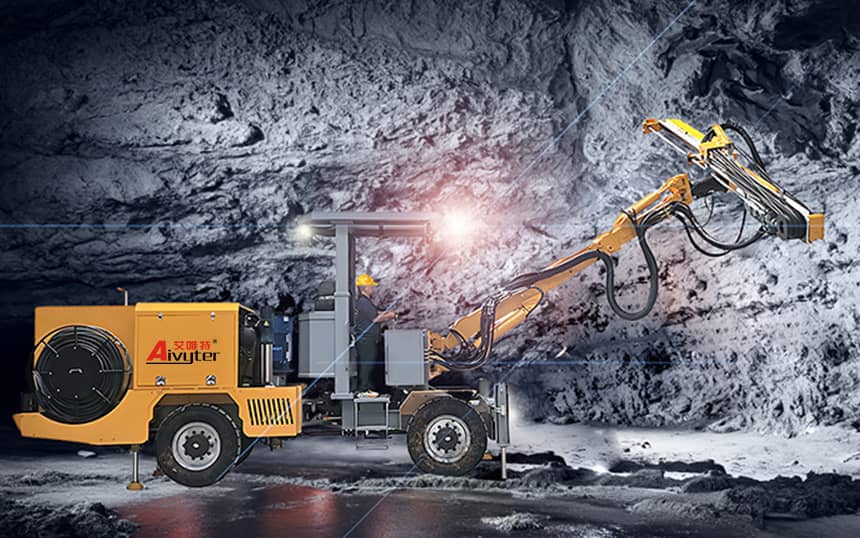
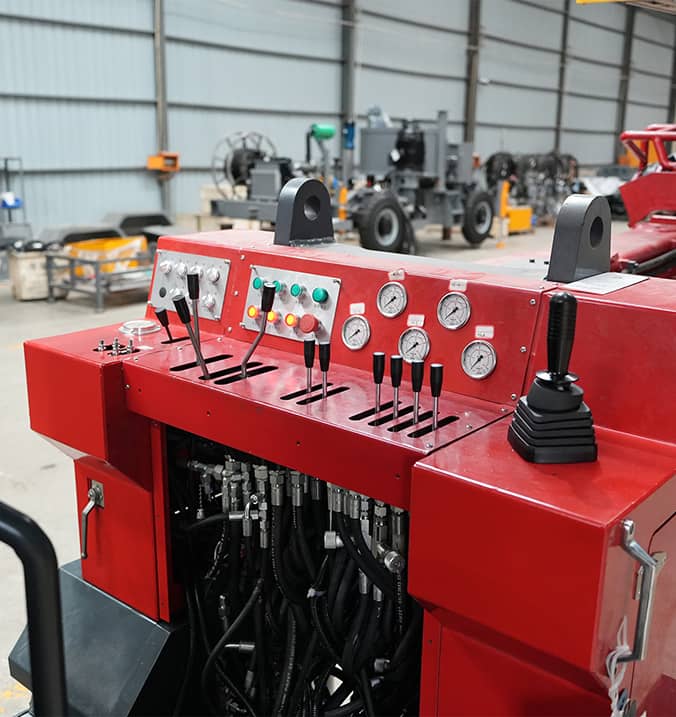
Modern underground excavation requires rigorous machinery capable of standing up to high-stress rock formations. For decades, the extraction of mineral resources and the advancement of civil tunnels depended heavily on labor-intensive drilling methods. The introduction of mechanized face drilling systems changed this dynamic, establishing jumbo mining as a standard practice across the global mining sector. These systems utilize heavy-duty hydraulic drifters, robust articulated chassis, and automated positioning booms to drill precise blast holes in hard rock. Manufacturers like Aivyter develop these heavy machines to withstand the demanding conditions found deep underground. This article examines the engineering principles, specific application profiles, and operational strategies that define modern face drilling systems in underground mining.
Engineering Architecture of Face Drilling Jumbos
To understand the efficiency of these systems, one must examine the specific components that make up a jumbo drill rig. These machines are not merely mobile drilling platforms; they are highly integrated hydraulic and mechanical systems designed to convert electrical and hydraulic power into mechanical impact energy with minimal transmission loss.
Hydraulic Rock Drifters and Impact Energy
The heart of the machine is the hydraulic drifter, often referred to as the rock drill. Unlike rotary drills, a drifter uses a reciprocating piston to deliver high-frequency percussive blows to the drill steel. This kinetic energy is transmitted through the shank and drill rod to the bit, fracturing the rock face. This percussive action is paired with continuous rotation to ensure the button bit strikes fresh rock with every impact.
Standard drifters operate at impact frequencies between 40 and 70 Hz. Operating pressures within the percussion circuit often exceed 150 to 230 bar, depending on the rock hardness. The rotation motor, typically driven by a hydraulic gear or radial piston motor, provides the torque required to prevent the steel from binding in fractured ground. Proper synchronization between impact energy, feed force, and rotation speed is vital to maximize penetration rates and prevent drill string damage.
Boom Design and Positioning
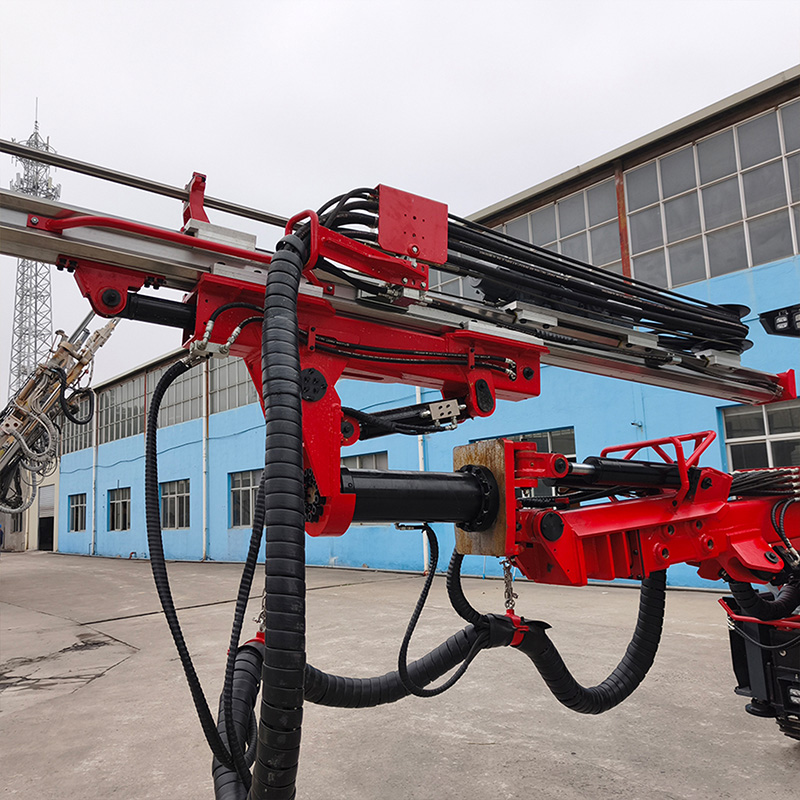
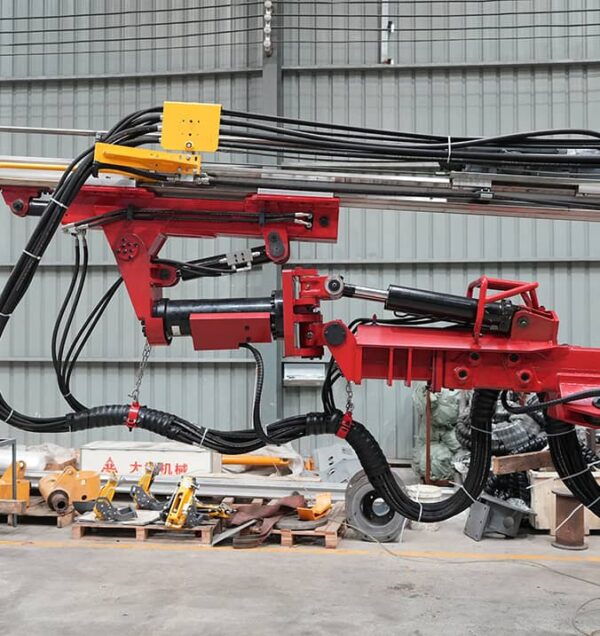
Modern rigs feature one, two, or three booms, depending on the tunnel cross-section. The structural engineering of these booms must balance flexibility with absolute rigidity. Booms are designed with parallel holding mechanisms, ensuring that once the operator positions the feed beam, the drill hole remains parallel to the tunnel axis during movement. This parallel alignment is a fundamental factor in achieving accurate pull rates during blasting.
The boom cylinders must withstand significant torsional stresses during drilling cycles, necessitating high-tensile steel constructions and heavy-duty spherical bearings. By incorporating automated positioning sensors, modern booms allow operators to execute predefined drill patterns with high accuracy, minimizing human error and reducing overbreak.
Feed Rails and Travel Systems
The feed system holds the drifter and moves it forward as the hole is drilled. Most modern drill rigs utilize a heavy-duty aluminum or steel profile feed rail. A hydraulic cylinder or hydraulic motor connected to a heavy-duty leaf chain or steel cable provides the feed force. Adequate feed force is necessary; too little force results in loose contact between the bit and the rock, leading to energy loss and damage to the shank adapter, while excessive force causes drill steel bending and premature bit wear.
Primary Application Scenarios in Hard Rock Environments
Underground hard rock operations depend on systematic excavation processes where predictability is paramount. Mechanized drilling platforms serve several distinct roles within these environments, extending beyond simple face drilling to support broader ground control and development activities.
In decline driving and horizontal development, jumbo mining methodologies allow operations to drill out an entire face pattern within a few hours. The round typically includes cut holes (to create a free face for the rock to break towards), helper holes, and perimeter holes (roof and ribs). Precise hole alignment ensures that when the blast occurs, the rock breaks neatly to the design profile, reducing overbreak (unnecessary excavation) and underbreak (which requires costly secondary blasting).
While long-hole drills are standard for bulk mining methods, jumbo rigs are highly effective for selective extraction methods such as cut-and-fill mining. Here, the machine drills horizontal or slightly inclined holes into the ore vein. After blasting and mucking, the void is filled, and the jumbo stands on the fill material to drill the next lift. This method provides high selectivity and minimizes dilution of valuable minerals with waste rock.
Ground stability is a paramount concern in underground works. While specialized bolting rigs exist, many operations configure their face jumbos to handle rock bolting tasks. The jumbo drills the bolt holes in the roof and walls, and the operators can then manually or semi-automatically install split sets, friction bolts, or resin-grouted rebar. This multi-role capability reduces the need for multiple machines at the active face, simplifying logistical requirements.
Overcoming Operational Challenges in Underground Excavation
Operating heavy machinery thousands of meters underground presents significant mechanical challenges. Equipment must operate in hot, humid, dusty, and wet environments where unplanned downtime can disrupt the entire mine production cycle.
Drill Steel Deviation
Hole deviation is a common issue that disrupts blasting patterns. When a drill bit encounters changing geological strata or fractures at an angle, the drill string tends to bend, leading to misaligned holes. This results in uneven fragmentation, stubborn toe structures at the bottom of the face, and poor advance rates. High-performance drilling units mitigate this by integrating automatic parallel-holding booms and dampening systems in the drifter that adapt the impact energy and feed pressure to the hardness of the rock.
Extreme Wear and Abrasive Conditions
Quartz-rich rock types generate highly abrasive dust when drilled. Even with continuous water flushing, this dust can quickly wear down the drill bit buttons, the feed slides, and the external seals of the hydraulic drifter. To combat this, modern units manufactured by companies like Aivyter use specialized alloy steel components and advanced sealing systems. Regular lubrication via centralized auto-greasing units ensures that key wear areas remain protected from water and abrasive fines.
Hydraulic System Integrity
Underground mines are harsh environments where high-pressure hydraulic hoses are subjected to falling rock, abrasion against tunnel walls, and constant bending. A single hose rupture can halt operations. Systems designed with internal hose routing through the boom structures minimize exposure to external hazards, ensuring consistent pressure delivery to the drifter and positioning cylinders. Utilizing high-performance jumbo mining equipment with robust hose reel systems protects these hydraulic lines during continuous extension and retraction cycles.
Selecting the Appropriate Drilling Rig for Site Geology
Selecting a drill jumbo requires an in-depth evaluation of the mine’s geological profile and structural design. A machine that is too large will struggle to navigate tight corners, while an underpowered unit will fail to meet development targets in high-strength rock formations.
- Tunnel Dimensions and Turning Radius: The physical envelope of the underground workings dictates the maximum size of the machine. Narrow-vein operations require compact, highly maneuverable single-boom rigs that can navigate tight corners and work in drifts as narrow as two meters. Conversely, large-scale civil tunneling or massive decline development projects demand heavy, multi-boom rigs capable of covering faces over fifty square meters from a single setup.
- Power Source and Carrier Selection: Operations must choose between diesel-driven carriers and electric-hydraulic units. Typically, the carrier is powered by a diesel engine to facilitate rapid travel between different faces of the mine. Once positioned at the drilling face, the machine is connected to the mine’s electrical grid via a trailing cable, powering the hydraulic pumps electrically. This dual-power configuration minimizes underground diesel emissions and reduces ventilation requirements.
- Automation and Data Integration: Modern mining practices rely increasingly on instrumentation. Modern drill jumbos can be equipped with basic electronic direct-positioning systems or advanced fully computerized navigation systems. These systems import drill patterns directly from engineering offices, guiding the operator to position the boom precisely at each designated coordinate. This ensures high compliance with the planned blast design and provides valuable feedback data regarding rock hardness and drilling speed across the face.
Industrial Equipment Inquiries and Engineering Support
Selecting the correct heavy machinery for your underground operations is a step that requires detailed engineering assessment. At Aivyter, we provide robust, reliable, and field-tested solutions engineered to meet the harsh demands of underground hard rock excavation. Our engineering team is available to assist you in selecting the ideal configurations, boom layouts, and drifter capacities tailored to your specific geological profiles and drift dimensions.
For inquiries regarding custom specifications, spare parts availability, or to receive a comprehensive engineering proposal for your upcoming project, please submit your detailed operational requirements through our official channels. Our representatives will review your parameters and provide a professional, tailored solution to support your underground mining and tunneling operations.
Frequently Asked Questions
Q1: What are the primary factors that determine the selection of a single-boom versus a double-boom jumbo?
A1: The selection primarily depends on the cross-sectional area of the drift and the required excavation speed. Single-boom jumbos are ideal for tight, narrow-vein mining tunnels (typically under 15-20 square meters of face area) where maneuverability is key. Double-boom jumbos are chosen for larger tunnels and declines because they can drill out a face pattern in approximately half the time, making them highly efficient for high-speed development projects where rapid advance rates are prioritized.
Q2: How does water flushing prevent tool wear during underground drilling operations?
A2: Water flushing is vital for cooling the drill bit and clearing rock cuttings from the borehole. High-pressure water is delivered through the center of the shank adapter and the drill steel directly to the face of the bit. This continuous flow flushes out the crushed rock chips, preventing them from being reground, which would otherwise cause extreme abrasive wear on the carbide buttons and lead to rapid tool failure.
Q3: What mechanical purpose does the dampening system in a hydraulic drifter serve?
A3: The dampening system, often referred to as a reflex or shock absorption system, is designed to absorb the destructive shockwaves that bounce back through the drill steel when the bit strikes fractured rock or voids. By absorbing these reverse energy waves hydraulically, the system protects the internal components of the drifter, the feed mechanism, and the boom joints from excessive vibration, thereby extending the service life of the equipment.
Q4: Can a standard face jumbo be utilized for rock bolting and ground reinforcement tasks?
A4: Yes, many standard face jumbos are highly adaptable and can be used to drill bolt holes for split sets, mechanical bolts, or resin bolts. While dedicated bolting rigs are more efficient for high-volume support installation, a standard jumbo provides an excellent, versatile solution for smaller operations or sections where a single machine must perform both face drilling and immediate ground support installation.
Q5: What are the standard maintenance protocols required to ensure hydraulic drifter longevity?
A5: Maximizing drifter lifespan requires a strict preventive maintenance schedule. This includes daily inspections of hydraulic seals, checking shank adapter wear, and monitoring the auto-lubrication system to ensure continuous oil mist delivery to the front head. Hydraulic oil filters must be changed regularly to prevent contaminants from entering the high-pressure circuits, and the accumulator pressures should be verified and recharged with nitrogen at specified operating hour intervals.
about
Aivyter
We provides trusted air compressors and mining equipment, engineered for durability, efficiency, and demanding industrial applications.