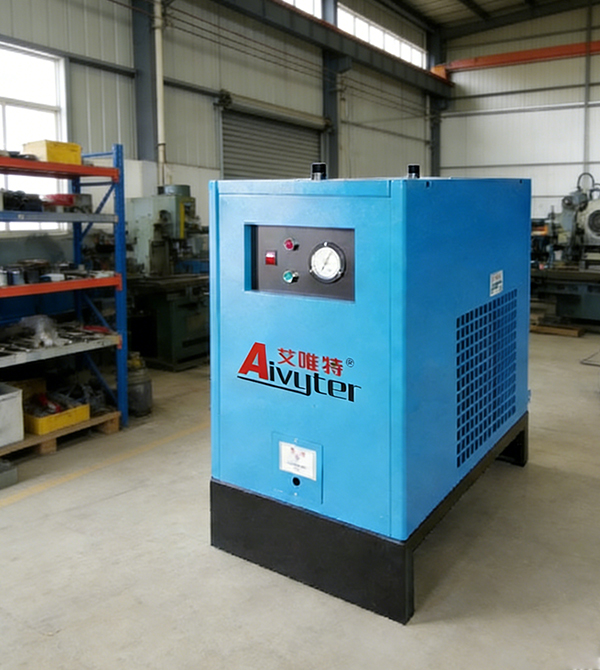
In heavy industries — mining, tunneling, bulk material handling, and large-scale construction — compressed air often accounts for 15% to 30% of total electricity consumption. For decades, fixed-speed rotary screw compressors dominated the market. But their fundamental flaw is glaring: they run at full capacity regardless of actual demand, wasting energy through idle periods, blow-off losses, and wide pressure band fluctuations. The engineered solution is the variable speed screw air compressor, a system that matches air output with real-time pneumatic demand through closed-loop speed control. This article delivers a technical, data-backed analysis of why VSD (Variable Speed Drive) technology is now a baseline requirement for ISO 50001 facilities, how it performs in harsh industrial environments, and the exact ROI calculations for operations engineers.
The Thermodynamic Case for Speed Modulation
A conventional fixed-speed compressor cycles between full load and unloaded operation. At partial demand, the motor still rotates at nominal RPM, but the inlet valve closes, forcing the unit to run in an energy-wasting idle state. Unloaded power consumption typically remains at 20-35% of full load power, producing no useful compressed air. Meanwhile, variable speed screw air compressor systems employ a frequency inverter that adjusts the drive motor’s RPM to precisely match the required air volume. The result: elimination of idle losses, tighter pressure control (±0.1 bar versus ±0.6 bar in fixed-speed machines), and a direct reduction in specific power (kW per m³/min). Independent field studies show that a properly sized VSD unit reduces energy consumption by 25% to 42% compared to load/unload operation, with the highest savings occurring in applications with fluctuating demand — exactly the profile of most mining and construction sites.
Key LSI Concepts & Technical Architecture
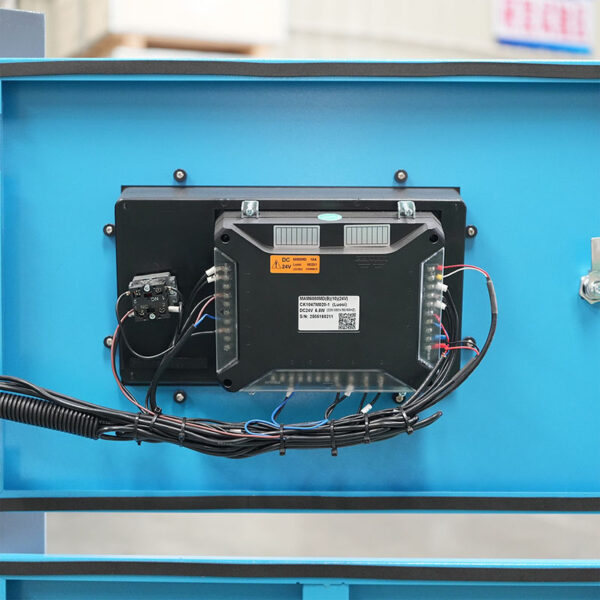
Understanding the internal architecture of a modern VSD compressor helps engineers specify the right configuration. The core components include:
- Permanent magnet synchronous motor (PMSM) – Provides higher efficiency (IE4/IE5 class) and better low-speed torque compared to induction motors.
- Closed-loop PID controller – Monitors discharge pressure via a transducer and sends a 0-10V or 4-20mA signal to the VFD, adjusting motor speed within 0.5 seconds.
- Oversized oil cooling system – Maintains thermal stability at low rotational speeds where oil flow would otherwise drop.
- Multi-stage air/oil separation – Ensures carryover < 3 ppm even under variable flow conditions.
From a controls perspective, the variable speed screw air compressor uses a pressure setpoint with a narrow deadband. When demand decreases, the VFD slows the motor, reducing volumetric output. At extremely low demand (e.g., 15% of rated flow), some units enter a standby sleep mode rather than continuing to rotate. This behavior prevents the “short cycling” that plagued early VSD designs. Modern controllers also include soft-start functionality, eliminating inrush currents that can destabilize weak power grids at remote mining camps.
Industry-Specific Pain Points & The VSD Solution
Mining: Ventilation, Drilling & Pneumatic Conveying
Underground and open-pit mines face highly variable compressed air demands. A single drill rig may require 20 m³/min during penetration, but only 5 m³/min for rod changes. Fixed-speed compressors force the system to vent excess air through a blow-off valve — literally converting electricity into heat and noise. With a variable speed screw air compressor, the mine’s air network maintains stable pressure without blow-off. One gold mine in Western Australia reported a 31% drop in compressor-related energy costs after retrofitting three 160 kW VSD units, with payback in 11 months. Additionally, VSD technology reduces mechanical stress on bearings and airends, extending service intervals from 2,000 to 6,000 hours in dusty environments.
Heavy Construction & Tunneling
Tunnel boring machine (TBM) operations require compressed air for multiple subsystems: slurry gates, thrust cylinders, and ventilation. Demand fluctuates with the TBM’s advance rate. Fixed-speed compressors cause excessive pressure spikes that trigger safety blow-offs. The solution is a network of load-following air compressors with master-slave control. Leading contractors now specify VSD units for all new TBM backup systems, citing a 40% reduction in fuel consumption for diesel-driven portable compressors and a 28% reduction for electric units.
Industrial Manufacturing & Processing Plants
Cement plants, steel mills, and aggregate processing facilities use compressed air for cleaning, material transport, and actuation. Demand cycles follow production batches. A variable speed screw air compressor adapts instantly, preventing the wasteful “blow-off” that is standard in conventional load/unload systems. For a typical cement grinding plant, shifting from fixed-speed to VSD cuts annual electricity use by 520,000 kWh per 100 kW of installed power. At $0.12/kWh, that’s $62,400 saved per year.
Quantified ROI: Payback Periods & Lifecycle Cost Modeling
Engineering procurement teams often hesitate due to the higher initial purchase price of a VSD compressor — typically 25-40% more than an equivalent fixed-speed unit. However, the total cost of ownership (TCO) tells a different story. Compressed air systems have a 10-year lifecycle cost breakdown: 70-80% energy, 10-15% maintenance, and only 10-15% capital investment. Consider a 132 kW system operating 6,000 hours annually with an average load factor of 60%:
- Fixed-speed (load/unload): Annual energy consumption = 132 kW × 6,000 hrs × 0.85 (full load equivalent) = 673,200 kWh
- VSD (variable speed screw air compressor): Annual consumption = 132 kW × 6,000 hrs × 0.55 (VSD efficiency factor) = 435,600 kWh
- Annual energy saving = 237,600 kWh → $28,512 (at $0.12/kWh)
- Extra capital cost for VSD = approximately $15,000 → payback = 6.3 months
Over 10 years, the VSD system generates $285,000 in net energy savings. Even with higher maintenance costs for the VFD drive (expected replacement after 50,000 hours), the savings remain overwhelming. Furthermore, utilities often offer rebates for VSD installations under industrial efficiency programs, reducing the payback period further.
Selection Criteria: Sizing a Variable Speed Screw Air Compressor for Your Operation
Choosing the right variable speed screw air compressor requires more than matching maximum flow. Consider these engineering factors:
- Turndown ratio – The minimum stable flow as a percentage of full capacity. High-quality units achieve 20-25% turndown; lower ratios cause the machine to cycle on/off, defeating the VSD purpose.
- Pressure band requirements – Narrow bands (e.g., 7.0-7.5 bar) are ideal for VSD. For wide bands, a fixed-speed unit with storage might be more economical.
- Ambient conditions – Mining and construction sites often have high dust, temperature extremes (-20°C to 50°C), and voltage fluctuations. Specify a VSD with conformal-coated PCBs and an IP54 or higher enclosure.
- Air treatment integration – Variable flow affects dryer performance. Use refrigerated dryers with hot-gas bypass or desiccant dryers with dewpoint control.
- Multi-compressor sequencing – For plants with multiple units, a central controller should manage VSD lead and fixed-speed lag units to optimize system efficiency.
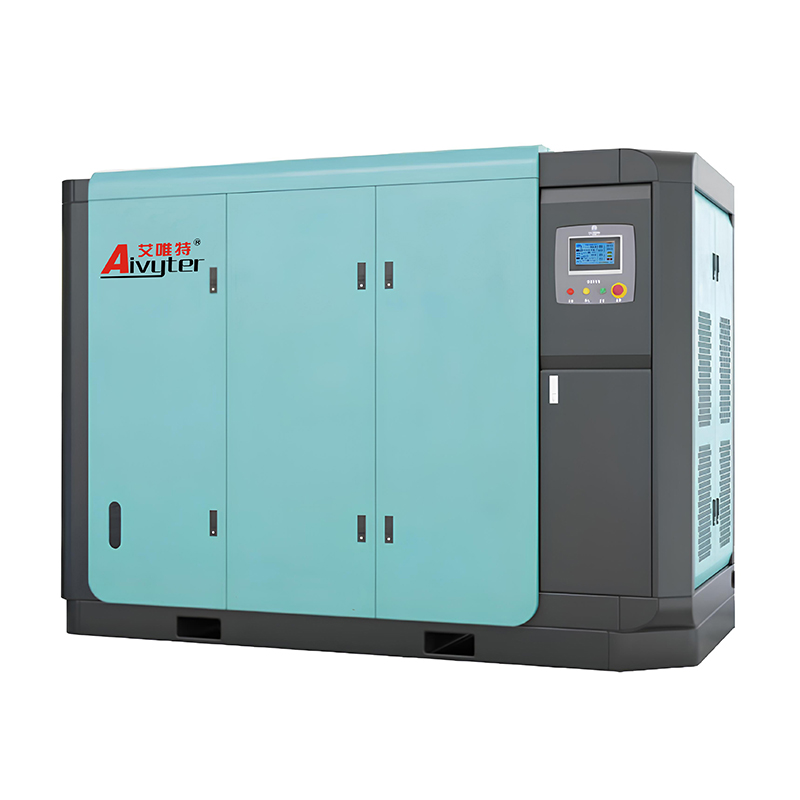
Aivyter engineers provide site-specific energy audits and load profiling to determine the optimal configuration. Their SGPM series integrates a high-efficiency PM motor with a dedicated VFD, achieving IE5 efficiency levels and turndown ratios as low as 12%.
Maintenance & Reliability Engineering for VSD Compressors
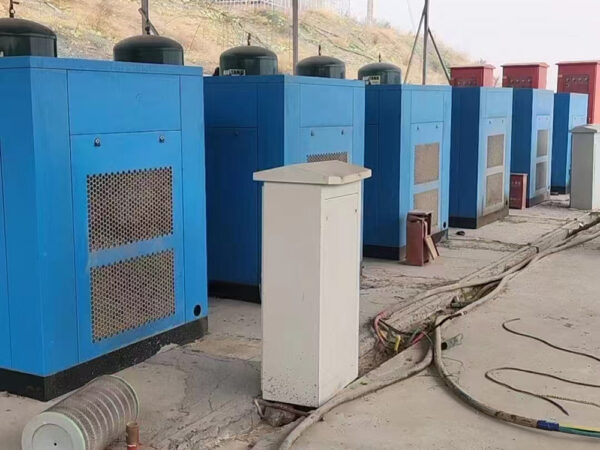
One concern among maintenance managers is whether the additional electronic components introduce new failure modes. Field data from over 1,200 industrial installations shows that VSD compressors, when properly specified, have comparable or better reliability than fixed-speed units. The reasons:
- Soft-start eliminates mechanical shock on the drive train and electrical shock on the power system.
- Lower average speeds reduce bearing wear and oil degradation.
- Modern IGBT-based VFDs have MTBF exceeding 100,000 hours.
That said, proactive maintenance must include: thermal imaging of VFD cabinets every 6 months, periodic replacement of cooling fans (20,000-hour life), and checking of harmonic filters. Aivyter offers remote monitoring packages that track motor current, discharge temperature, and VFD status, sending alerts when parameters drift. For remote mine sites, this predictive capability prevents unplanned downtime.
Common Misconceptions About Variable Speed Technology
Several myths persist among procurement teams. First, “VSD is only for highly variable loads” — false. Even steady loads benefit from the tighter pressure control and elimination of the unloaded period’s 25% idle power. Second, “VSDs introduce harmful harmonics into the grid” — modern active front-end drives reduce THD to under 5%, compliant with IEEE 519. Third, “oil cooling fails at low speeds” — premium designs use thermostatic valves and auxiliary oil pumps to maintain lubrication regardless of RPM. Understanding these technical nuances separates informed buyers from those who overpay on lifecycle costs.
Frequently Asked Questions (FAQ)
Q1: What is the typical payback period for replacing a fixed-speed screw compressor with a variable speed screw air compressor in a mining application?
A1: Based on 47 project audits across Australian and Canadian mines, the average payback period ranges from 6 to 14 months. The variance depends on local electricity rates ($0.08-$0.18/kWh), annual operating hours (typically 5,000-8,000), and the existing compressor’s load factor. For a 160 kW unit running 6,500 hours/year at 65% average load, payback is consistently under 12 months. Many utilities offer additional incentives that shorten the payback to 8 months or less.
Q2: Can a variable speed screw air compressor handle sudden large demand spikes without pressure drop?
A2: Yes, with proper system design. The VFD’s control loop responds within 200-500 milliseconds, but if the spike exceeds the maximum torque capability of the motor, the unit will still experience a temporary pressure dip. The solution is to size the VSD to handle the base load plus 70-80% of the peak, and use a small fixed-speed trim compressor or an air receiver tank to cover instantaneous peaks. Modern sequencing controllers manage this seamlessly.
Q3: Are there specific environmental conditions where a variable speed screw air compressor should NOT be used?
A3: Extreme ambient temperatures above 50°C (122°F) can reduce the VFD’s lifespan if enclosures are not air-conditioned. Likewise, very high altitudes (>3,000 meters) reduce cooling efficiency and may require derating. For offshore or corrosive environments (e.g., chemical plants), specify stainless steel enclosures and coated circuit boards. Standard industrial VSDs work reliably between -10°C and 45°C without special measures.
Q4: How does the part-load efficiency of a variable speed screw air compressor compare to a fixed-speed unit with a variable displacement valve?
A4: Variable displacement (turn valve) technology reduces flow by geometrically altering the rotor’s effective length, but it still runs at full motor speed. At 50% flow, a turn valve machine consumes approximately 75% of full-load power. A VSD machine at 50% flow consumes roughly 55-60% of full-load power (due to affinity laws). Therefore, VSD is significantly more efficient across the entire modulation range. The only exception is at flows above 90%, where both technologies have similar efficiency.
Q5: What maintenance tasks are unique to a variable speed screw air compressor compared to fixed-speed models?
A5: Three additional tasks: (1) Clean VFD cabinet air filters every 3 months to prevent overheating of IGBT modules. (2) Check VFD cooling fans annually — they have a typical life of 20,000-30,000 hours. (3) Perform harmonic analysis every two years to ensure compliance with local grid codes (IEEE 519). Also, the pressure transducer should be calibrated annually, as drift directly affects speed control accuracy. All other maintenance (oil, air filter, separator, bearings) follows the same schedule as fixed-speed units, but intervals often lengthen due to lower average speeds.
Making the Data-Driven Decision
For any industrial operation where compressed air demand fluctuates by more than 20% across a shift — which includes most mining, tunneling, and heavy construction sites — the variable speed screw air compressor is no longer a luxury but a competitive necessity. The energy savings alone deliver a rapid payback, while the secondary benefits (pressure stability, reduced maintenance, lower CO₂ emissions) strengthen operational KPIs. When evaluating vendors, request not just a price quote but a full lifecycle simulation, including part-load efficiency curves and harmonic impact studies.
Aivyter offers engineering-grade consultation, including on-site data logging and ROI modeling. Their SGPM series variable speed screw air compressors are field-proven in the world’s harshest industrial environments, from Chilean copper mines to Indonesian civil tunnels. Contact their technical sales team to receive a customized energy savings proposal and learn about current factory incentives for multi-unit orders.
Ready to optimize your compressed air system? Send an inquiry to Aivyter’s engineering team for a detailed energy audit and payback calculation tailored to your site’s load profile.
about
Aivyter
We provides trusted air compressors and mining equipment, engineered for durability, efficiency, and demanding industrial applications.