Understanding CFM and PSI for Air Compressors
Referring to basic knowledge about air compressors, we cannot leave out CFM and PSI. Do you ever wonder what CFM and PSI really mean? These two terms are often the center of discussions among professionals and DIY enthusiasts alike. CFM (Cubic Feet per Minute) measures air flow, while PSI (Pounds per Square Inch) measures air pressure. This article explains their roles, differences, and how they work together to power pneumatic tools efficiently.
What is CFM?
CFM stands for Cubic Feet per Minute. It measures the amount of air a compressor delivers over time. Simply put, it shows how much air the machine can move in one minute.
Understanding CFM is key when picking an air compressor for various tasks. It gauges the flow rate of air moving in and out of a space. Higher CFM means more air delivered per minute, which is crucial for tools that require continuous airflow.
Here’s a quick look at the CFM requirements for common air tools (at 90 PSI):
| Tool | Average CFM |
|---|---|
| Brad Nailer | 0.3 CFM |
| Drill | 3-6 CFM |
| Grinder | 4-6 CFM |
| Dual Sander | 11-13 CFM |
| Ratchet | 2.5-5 CFM |
| Paint Sprayer | 4-11 CFM |
What is PSI?
PSI stands for Pounds per Square Inch. It measures the force or pressure applied by compressed air. Essentially, it indicates how much power the air has to complete a task.
PSI determines how much pressure your compressor can generate. Higher PSI delivers more force to your tools. Matching the PSI to your tools ensures they operate effectively.
Typical PSI requirements for various applications:
| Application | Recommended PSI |
|---|---|
| Tire Inflation | 30-35 PSI |
| Paint Spraying | 40-60 PSI |
| Air Hammer | 90-100 PSI |
| Impact Wrench | 90-100 PSI |
| Sandblasting | 100+ PSI |
The Relationship Between CFM and PSI
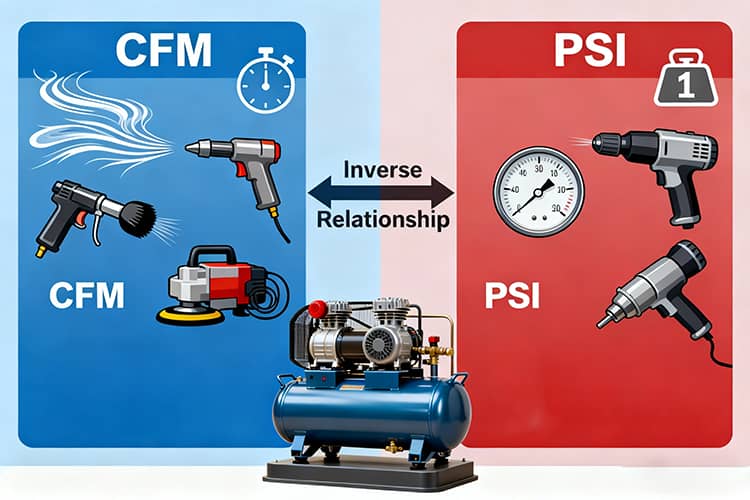
CFM and PSI work in inverse proportion. As PSI increases, the available CFM decreases. Compressors deliver less air when under higher pressure. It’s a trade-off between force and air volume that affects how tools operate.
Balancing CFM and PSI ensures the compressor meets your tool’s needs. For example, paint sprayers demand higher CFM for constant airflow, while nail guns need higher PSI for powerful bursts. Always check your tool’s CFM and PSI requirements before picking an air compressor.
Example tool requirements:
| Tool | CFM | PSI |
|---|---|---|
| Brad Nailer | 0.3 CFM | 90 PSI |
| Spray Gun | 4-11 CFM | 40-60 PSI |
| Impact Wrench | 5 CFM | 90-100 PSI |
Factors Affecting CFM and PSI
- Compressor Design and Configuration: Piston compressors deliver higher PSI; rotary screw compressors often generate more CFM. Single-stage models suit small jobs; two-stage compressors are for heavy-duty applications.
- Tank Size and Air Capacity: Larger tanks store more air, providing consistent CFM output. Smaller tanks refill more often, affecting CFM and PSI.
- Power Supply: Electric, gasoline, or hydraulic power affects compressor performance. Electric compressors are quieter but lower in power; gasoline models are portable for sites without electricity.
- Altitude and Atmospheric Pressure: Higher elevations reduce air density, lowering both CFM and PSI output.
- Air Leaks: Even small leaks reduce CFM and PSI, impacting tool efficiency.
Calculating CFM and PSI Requirements
Check the manufacturer’s specifications for your tools. For multiple tools, sum the CFM requirements and add a 30% buffer. Plan ahead for future tool additions to ensure your compressor can handle expanded workloads.
Conclusion
Understanding CFM and PSI is crucial for choosing the right air compressor. Matching your compressor’s air flow and pressure to your tools ensures optimal performance. For expert advice and customized solutions, contact Aivyter to select the best air compressor configuration for your application.
about
Aivyter
We provides trusted air compressors and mining equipment, engineered for durability, efficiency, and demanding industrial applications.