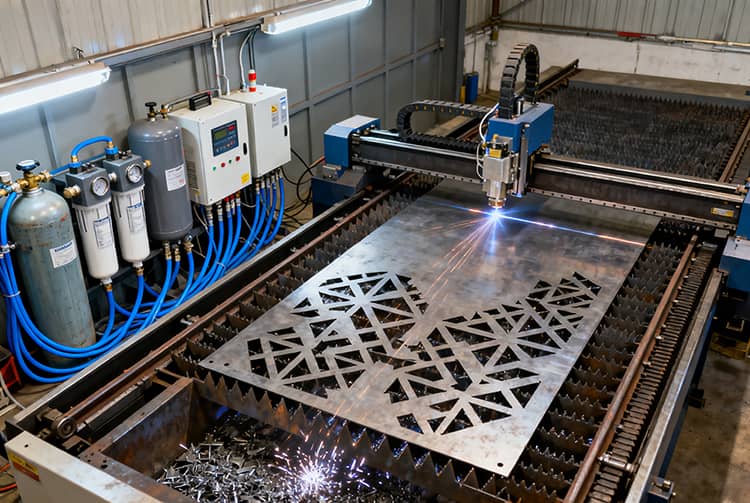
Laser cutting is a manufacturing process that uses a high-power, high-density laser beam to heat materials to the point of vaporization. As the laser moves across the workpiece, a narrow cutting kerf (as small as 0.1 mm) is formed, enabling fast, precise, and clean cutting. Laser cutting is widely used in metal fabrication, sheet metal processing, automotive parts, kitchenware, aerospace components, electronics, instruments, medical devices, and more.
Learn more about how laser cutting works here: What is Laser Cutting?
The Role of Assist Gas in Laser Cutting
In addition to the laser source itself, assist gas is a key factor in achieving stable and high-quality cutting performance. Assist gas:
- Supports combustion and controls heat input
- Blows away molten metal and debris to keep the cut clean
- Prevents dust from reaching the laser nozzle
- Protects the focusing lens and extends lens service life
The most common assist gases are:
- Oxygen (O₂): Strong oxidation, but may cause burnt or darkened cut edges.
- Nitrogen (N₂): Used for stainless steel and high-precision cutting. Higher cost.
- Compressed Air: Contains ~20% oxygen and supports both productivity and cost efficiency.
More about compressed air: Compressed Air Overview
Why Compressed Air Is Increasingly Preferred
Compressed air is becoming the mainstream choice because it provides a balance of speed, cut quality, stability, and cost control. It is suitable for stainless steel, carbon steel, galvanized plate, aluminum, and many other materials.
3 Key Parameters When Selecting an Air Compressor for Laser Cutting
1. Pressure
The cutting pressure affects the cutting speed and edge quality. Higher pressure helps create cleaner cuts. While laser power determines cutting thickness, pressure influences cutting efficiency.
2. Airflow
Laser cutting heads have multiple nozzle sizes (e.g., 1.0 to 4.0 mm). Nozzle size directly determines airflow demand. Typically, the cutting gas consumes 80–90% of total compressed air usage.
3. Air Quality
Clean, dry air is essential. If compressed air contains water mist or oil, it may contaminate the protective lens, disperse the laser beam, cause cutting failure, reduce product quality, and potentially damage the laser head.
Aivyter Integrated Laser Cutting Air Supply Solution
To guarantee stable gas supply and clean air quality, Aivyter provides the SGAT Integrated Screw Air Compressor for Laser Cutting.
- Built-in air compressor, refrigerated dryer, air tank, air-water separator, precision filter set, and automatic drainage system
- Ensures stable gas purity and consistent pressure
- Reduces installation complexity and space requirements
- Digital smart control supports remote monitoring
- 5-level precision filtration delivers clean, dry, and oil-free air
Conclusion
Compressed air is not only cost-effective but also highly reliable for modern laser cutting applications. However, the stability and quality of the compressed air supply directly affect cutting efficiency, precision, and finished product consistency. Choosing a laser-grade integrated air supply solution ensures long-term operational stability and reduced maintenance downtime.
For project consultation and system sizing, contact our screw air compressor support team.
about
Aivyter
We provides trusted air compressors and mining equipment, engineered for durability, efficiency, and demanding industrial applications.