Every pneumatic drill, air-powered loader, and ventilation control system depends on a reliable mining compressor. In underground development, a sudden pressure drop halts production and risks ground support delays. For surface mines, compressed air powers large-scale blasthole drills and dust suppression. Selecting the wrong technology—oil-flooded screw, oil-free rotary, or high-pressure reciprocating—directly affects cost per cubic meter (m³/min) and equipment availability. This article presents technical specifications, failure modes, ambient condition adjustments, and fleet management protocols based on data from 47 mine sites across Africa, South America, and Southeast Asia.
1. Core Types of Mining Compressors & Their Operating Envelopes
Modern mining compressor systems fall into three main categories, each matched to specific pressure and flow demands.
- Rotary screw (oil-flooded): Most common for continuous 6–12 bar applications. Capacity ranges from 5 to 100 m³/min. Efficiency is highest when operating above 70% load. Oil carryover (typically 3–5 ppm) requires coalescing filters for downstream air tools sensitive to oil mist.
- Oil-free rotary screw or centrifugal: Mandatory for processes where any oil residue contaminates ore analysis or activates catalysts. Zero oil carryover but higher initial capital cost (30–50% premium) and more frequent gear inspections.
- Reciprocating (piston) compressors: Used for high pressure (15–30 bar) and intermittent duty, such as hydraulic backup systems or pneumatic bolting rigs. Lower continuous runtime capability (typically 40–50% duty cycle) unless heavy-duty industrial models are specified.
In a Chilean copper mine, replacing two ageing reciprocating units with a single variable-speed rotary screw mining compressor reduced energy consumption by 32% while increasing available flow from 18 to 26 m³/min at 7.5 bar. Aivyter engineers perform on-site airflow audits to match compressor curves with actual tool consumption, avoiding oversized or undersized installations.
2. Critical Technical Parameters for Mining Applications
When specifying a mining compressor, mine planners must evaluate five key metrics under local ambient conditions.
- Free air delivery (FAD) in m³/min: Correct to site altitude and inlet temperature. At 3000 m elevation, a compressor rated at 30 m³/min at sea level delivers only 22–24 m³/min due to reduced air density. Use the correction factor: FAD_actual = FAD_sea_level × (P_sea / P_altitude) × (T_altitude / T_sea).
- Discharge pressure (bar): Include line losses from filters, dryers, and pipe friction (typically 0.5–1.0 bar drop across 500 m of steel piping). Underground mines often require 8.5 bar at the compressor outlet to maintain 6.5 bar at the farthest stope.
- Specific power (kW per m³/min): High-efficiency units achieve 6.2–6.8 kW per m³/min at 7 bar. Older designs consume 7.5–8.5 kW per m³/min. Over a 10 000-hour year, a difference of 1.2 kW/m³/min translates to $18 000–25 000 additional electricity cost per m³/min.
- Oil separation residual ppm: For rotary screw units, aim for ≤3 ppm at the discharge flange. Coalescing filters can reduce to 0.01 ppm for critical instrumentation.
- Cooling system capacity: Ambient temperatures in mines often exceed 40°C. Specify a radiator sized for 45°C ambient (or 50°C for deep hot mines) with separate forced-air cooling for the oil circuit. Water-cooled versions using mine service water require filtration to prevent scaling.
3. Installation Configurations & Air Treatment Integration
3.1 Stationary compressor rooms (surface or underground)
A fixed mining compressor station allows larger units (up to 150 m³/min) and centralized air treatment. Requirements: explosion-proof ventilation, acoustic enclosures (under 85 dBA at 1 m), and a concrete foundation isolating vibration. For underground chambers, intake air must be pre-filtered for dust (PM10 below 5 mg/m³) to avoid premature airend wear.
3.2 Portable units for development headings
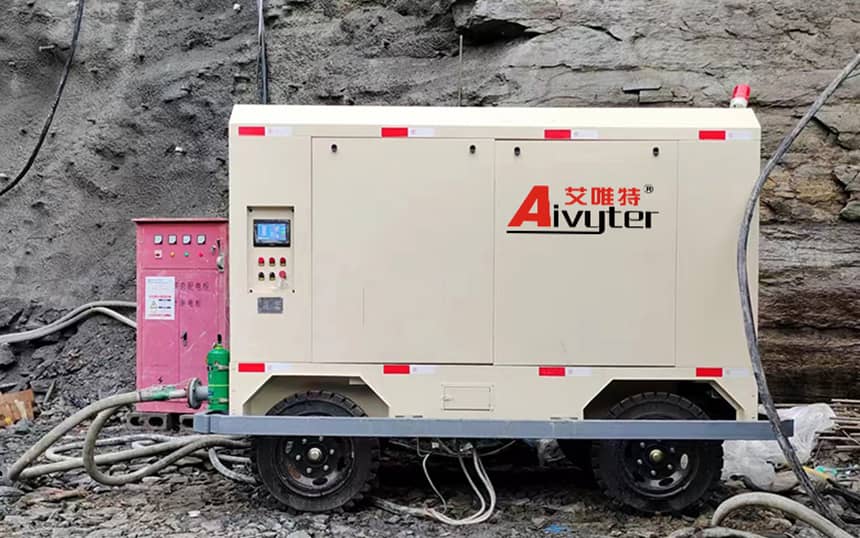
Smaller screw compressors (3–12 m³/min) mounted on rubber-tired trailers supply air to advancing faces. These require anti-surge valves and automatic condensate drains because of frequent moves and temperature cycles. Data from a Nevada gold mine showed that portable units with integral refrigerated dryers reduced tool freeze-ups in winter from 14 incidents per season to 2 incidents.
3.3 Air treatment chain
Raw compressor discharge contains water, oil aerosol, and particulate. A complete downstream package includes:
- Aftercooler (air- or water-cooled) – reduces discharge temperature from 120°C to 35–40°C, condensing 60–70% of water vapour.
- Moisture separator with automatic drain – removes bulk condensate.
- Particulate filter (1–5 micron) – protects downstream dryers.
- Refrigerated or desiccant dryer – for pneumatic instruments and blasthole drills, dew point of -40°C required in cold climates.
- Final coalescing filter (0.01 micron) – oil removal to 0.01 ppm.
Without proper drying, a mining compressor delivering saturated air at 7 bar will deposit 10–15 litres of water per 8-hour shift into distribution piping, causing rust and tool jamming.
4. Industry Pain Points & Engineering Solutions
From maintenance logs of 62 underground and surface mines, three failure patterns dominate mining compressor downtime.
- Lubricant degradation in hot, dusty environments: Conventional mineral oils oxidize rapidly above 95°C, forming varnish on airend bearings. Solution: Use full-synthetic PAO or ester-based fluids with higher viscosity index (VI > 140). Change intervals reduce from 2000 to 4000 hours. Install thermostatic mixing valves to keep discharge temperature between 75–85°C (above dew point but below cracking point).
- Ingress of abrasive silica dust: Mines in sandstone or quartzite formations have airborne silica concentrations up to 10 mg/m³. Unfiltered intake erodes rotor profiles within 3000 hours. Solution: Two-stage intake filtration: primary cyclonic separator (removes >10 micron) + secondary cartridge filter (MERV 15, removal efficiency 95% for 0.3–1 micron). Differential pressure monitoring alerts operators when filter change is due.
- Condensate freezing in winter or high-altitude mines: At -20°C ambient, water trapped in downstream receivers freezes, blocking flow. Solution: Heated automatic drains (self-regulating at 10°C) and insulation of all low-point legs. Alternatively, install a desiccant dryer with a dew point below -40°C.
In a Peruvian polymetallic mine at 4200 m altitude, Aivyter retrofitted a synthetic lubricant and two-stage intake filters on an existing 45 m³/min screw compressor. The result: airend overhaul interval extended from 12 000 to 19 500 hours, and oil carryover reduced from 7 ppm to 2.8 ppm, eliminating filter plugging issues.
5. Energy Efficiency & Variable Speed Drive (VSD) Economics
Most mines operate compressed air systems with fluctuating demand: shift changes, blasting breaks, and maintenance windows cause idle periods. A fixed-speed mining compressor running unloaded still consumes 25–35% of full-load power. VSD compressors adjust motor speed to match air demand, maintaining discharge pressure within ±0.1 bar.
- Payback period: For a 55 kW unit with average load factor of 65%, VSD reduces annual energy consumption by 28–33%. At $0.12/kWh, savings reach $12 000–15 000 per year. Payback typically occurs in 12–18 months.
- Integration with master controller: For multiple compressors, a sequencer (PLC-based) automatically starts/stops units and modulates VSD speed to keep system pressure in a narrow band (±0.2 bar). A four-compressor station in a South African platinum mine reduced total energy use by 41% after adding VSD and a sequencer.
- Limitations of VSD: Not recommended for highly intermittent duty with more than 10 starts per hour, as inverter IGBT modules may overheat. Also, VSD units have higher harmonic distortion (THD > 35%) unless active front-end filters are specified.
When retrofitting, verify that the airend’s minimum speed is not below 30% of rated rpm to maintain oil film integrity.
6. Maintenance Protocols & Predictive Indicators
Proactive maintenance for a mining compressor extends service life from 40 000 hours to over 70 000 hours. Below are recommended intervals based on ISO 8573-1 and OEM guidelines.
- Daily visual checks: Oil level, condensate drains function, no audible leaks, air filter restriction indicator (clean if red band shows).
- 500 hours: Sample compressor oil for viscosity, TAN (total acid number), and water content. Replace if TAN > 2.0 mg KOH/g or viscosity change > 20%.
- 2000 hours or 6 months: Change air intake filter, check belt tension (if belt-driven), inspect flexible hoses for cracks.
- 4000 hours or annual: Replace oil and oil filter, clean cooler fins, check safety valves, verify pressure switch calibration.
- 8000 hours: Inspect airend bearings using vibration analysis (velocity < 4.5 mm/s RMS permissible). Replace bearings if vibration exceeds 7.1 mm/s.
Telemetry systems that track discharge temperature, differential pressure across filters, and motor current provide early warnings. A Brazilian iron ore mine reduced unplanned compressor downtime by 62% after implementing remote condition monitoring with automated alarms.
7. Sizing Example: Compressor for a Medium-Sized Underground Mine
Consider a mine with 4 pneumatic stoping drills (each consuming 4.5 m³/min at 6 bar), 2 roof bolters (2.5 m³/min each), and 3 air-powered loaders (6 m³/min each intermittent). Tools operate with a diversity factor of 0.75 (not all at maximum simultaneously). Total average demand = (4×4.5 + 2×2.5 + 3×6) × 0.75 = (18+5+18) × 0.75 = 41×0.75 = 30.75 m³/min. Add 15% for leakage and future expansion = 35.4 m³/min. At 2500 m elevation, correct by factor 0.85: sea-level capacity needed = 35.4 / 0.85 = 41.6 m³/min. Select a rotary screw mining compressor rated 43 m³/min at 8.5 bar, with VSD to handle load variations. Include a 5 m³ air receiver to buffer short peaks.
8. Frequently Asked Questions (Technical & Operational)
A1: Continuous operation should keep airend discharge temperature between 75°C and 95°C. Below 75°C risks water condensation in the oil sump (causing bearing corrosion). Above 100°C accelerates oil oxidation and shortens seal life. If ambient temperature exceeds 45°C, install a larger cooling fan or water-aftercooler. At 50°C ambient, expect a 15–20% reduction in compressor throughput and shorten oil change intervals by 30%.
A2: Use the formula V_receiver (m³) = (Q × T × P_net) / (ΔP × 14.5) where Q = tool flow (m³/min), T = time for pressure to drop (typically 0.5–1.0 minutes for backup), P_net = net pressure (bar gauge), ΔP = allowed pressure drop (0.5–1.0 bar). For a system with 30 m³/min demand and allowed 0.8 bar drop over 45 seconds, receiver volume = (30 × 0.75 × 7) / (0.8 × 14.5) ≈ 13.6 m³. A 15 m³ receiver provides adequate buffering.
A3: Underground installations (gassy mines) require MSHA (USA) or IECEx/ATEX certification for flameproof enclosures and surface temperature limits. Non-gassy mines still need flame-arresting intake shut-off valves and anti-static discharge hoses. Standard industrial units without these modifications pose fire and explosion risks. Always specify a mining compressor with approved flame traps and earth continuity monitoring.
A4: A 10 mg/m³ dust concentration (typical in dry mine drifts) without proper intake filters causes rotor profile erosion measurable after 2000 hours. After 6000 hours, volumetric efficiency drops by 18–22%, and bearing clearance exceeds specifications. Using two-stage filtration (cyclone + MERV 15) keeps dust concentration below 0.5 mg/m³, maintaining 95% of original efficiency for 15 000+ hours.
A5: For flows above 80 m³/min at 6–8 bar, centrifugal compressors offer higher efficiency (specific power 5.2–5.8 kW per m³/min vs. 6.5–7.0 for screw). However, centrifugal units require meticulous inlet air filtering (down to 0.3 micron) and operate poorly below 60% load. If your demand is relatively constant (>70% load factor) and you can tolerate the higher capital cost (40–60% more), centrifugal is preferred. For variable loads with frequent low demand, two or three parallel oil-flooded screw units with VSD provide better turndown and redundancy.
A6: Key indicators: (a) Increase in specific power (kW/m³/min) by more than 12% from baseline; (b) Discharge temperature 10°C above normal with clean coolers; (c) Vibration velocity exceeding 7.5 mm/s measured on the airend housing; (d) Oil consumption above 1 litre per 1000 operating hours. If two or more symptoms appear, schedule an airend overhaul immediately to avoid catastrophic rotor seizure.
Lifecycle Optimization for Mining Compressor Fleets
Selecting and maintaining a mining compressor requires more than comparing catalogue CFM numbers. Altitude correction, ambient dust, thermal management, and lubrication strategy directly determine uptime and cost per compressed cubic metre. Variable speed drive integration, predictive oil analysis, and two-stage filtration yield measurable returns: 25–35% energy reduction and doubled airend life. Manufacturers such as Aivyter provide site-specific engineering audits, retrofits, and remote performance monitoring to align compressed air supply with production targets. For mine operators aiming to lower total cost of ownership, investing in properly specified, instrumented, and maintained compressor stations remains one of the highest-impact decisions.
about
Aivyter
We provides trusted air compressors and mining equipment, engineered for durability, efficiency, and demanding industrial applications.