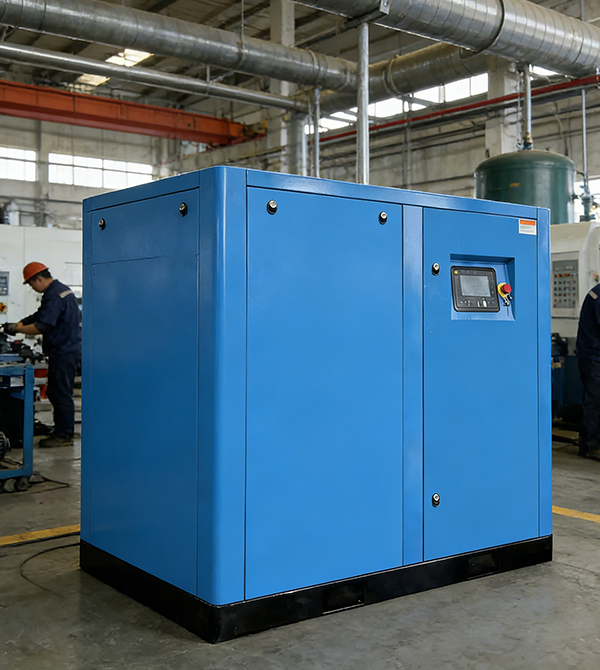
Compressed air accounts for 12–30% of industrial electricity consumption globally. For mining, tunneling, and large-scale construction, replacing a standard-duty unit with an energy efficient air compressor can cut annual power bills by tens of thousands of dollars. However, true efficiency is not measured by nameplate power alone—it requires analyzing specific power (kW per m³/min), part-load performance, pressure drop recovery, and heat reuse. This guide provides engineering methodologies and real-world data to help procurement teams, plant managers, and project engineers make a technically sound decision. We also examine how Aivyter designs its rotary screw and VFD compressor ranges to meet ISO 50001 requirements and reduce lifecycle emissions.
1. Defining True Efficiency: Specific Power and ISO 1217/CAGI Data
When evaluating any energy efficient air compressor, the single most reliable metric is specific power—the electrical input power (kW) divided by the free air delivery (m³/min or CFM) at a given discharge pressure. Lower specific power means less energy to produce each cubic meter of compressed air.
- Industry benchmark: A premium 75 kW rotary screw compressor operating at 7 bar should achieve specific power between 6.2 and 6.8 kW/(m³/min) (approximately 18–20 kW/100 CFM). Older units often exceed 7.5 kW/(m³/min).
- Verification: Always request CAGI (Compressed Air & Gas Institute) data sheets or ISO 1217 Annex C performance curves. These third-party verified documents show specific power at 100%, 70%, and 40% load.
- Real impact: Improving specific power from 7.2 to 6.4 kW/(m³/min) on a 300 kW compressor running 7,000 hours/year saves 168,000 kWh annually—roughly $16,800 at $0.10/kWh.
2. Variable Speed Drive (VSD) vs. Fixed Speed: Matching Load Profile
An energy efficient air compressor with variable frequency drive (VFD) adjusts motor RPM to match real-time air demand. This eliminates unloaded running losses, which can consume 15–35% of full-load power even when producing zero air. However, VSD is not always optimal.
When VSD delivers maximum payback
- Demand varies by more than 30% across shifts or process cycles (e.g., pneumatic tools used intermittently, blasting schedules, aggregate processing).
- Average load factor between 40% and 85%.
- Pressure fluctuations are unacceptable (VSD maintains ±0.1 bar stability).
Fixed-speed compressors still make sense for:
- Continuous base loads (>90% load factor) – for example, a concentrator plant air supply running 24/7.
- Applications requiring very high pressure stability where VSD resonance is a concern.
- Lower capital budget; however, TCO often favors VSD even with higher initial investment.
Modern industrial air compressor systems from Aivyter integrate both VSD and fixed-speed units in a master controller, sequencing them to keep the VSD unit in its most efficient range (typically 50–80% of max speed) while base-load units handle the remainder.
3. Seven Hidden Energy Losses That Destroy Efficiency
Even a high-spec energy efficient air compressor can waste 20–30% of its input power due to system-side issues. Below are the most frequent culprits found during on-site audits at mines and construction yards.
- Pressure drop across undersized or clogged filters/dryers: Every 0.5 bar of unnecessary pressure drop forces the compressor to discharge 0.7 bar higher, increasing energy by 4–5%. Target total pressure drop from dryer inlet to point of use below 0.3 bar.
- Leakage network: In a typical mining operation, leaks account for 15–25% of total compressed air flow. A 3 mm hole at 7 bar wastes approximately 40 CFM—equivalent to 10 kW of continuous load.
- Oversized compressors operating at part load: A fixed-speed 250 kW unit running at 40% load will have specific power 25–40% worse than a correctly sized 132 kW unit. Right-sizing is a fundamental efficiency driver.
- Incorrect lubricant viscosity: Using standard mineral oil instead of synthetic in a rotary screw compressor increases friction losses by 2–4%. Synthetics also extend change intervals from 2,000 to 8,000 hours.
- High inlet air temperature: Drawing intake air from a hot machinery room (45°C vs. 20°C) reduces air density and increases power consumption by roughly 1% per 5°C rise. Duct external air to the compressor intake.
- Inefficient motor technology: IE3 premium efficiency is now minimum; IE4 (super-premium) or synchronous reluctance motors (SynRM) offer additional 3–6% savings, especially with VSD.
- No heat recovery: Up to 85% of electrical input energy becomes heat in the cooling system. Retrofitting an air-to-air or air-to-water heat exchanger can pre-heat building spaces or process water, recovering 50–70% of waste heat.
4. Sector-Specific Efficiency Challenges and Engineered Solutions
Different heavy industries impose distinct constraints on achieving energy efficiency. Below we address mining, tunneling, and remote construction.
Mining (underground and open-pit)
Pain points: High ambient dust loads, altitude derating, and long distribution lines. A standard compressor may run 10–15% less efficiently at 2,500m altitude due to reduced air density, unless derated correctly.
Solutions: Specify compressors with oversized cooling packages and two-stage filtration. Use synthetic lubricants for high-altitude heat dissipation. Install flow controllers at multiple points to reduce required system pressure. Aivyter offers high-altitude optimized airends that maintain specific power within 5% of sea-level performance up to 4,000m.
Tunneling and underground construction
Pain points: Poor ventilation raises inlet air temperature; confined spaces limit heat recovery options; frequent relocation of portable compressors leads to undersized piping.
Solutions: Use VSD-driven units with remote monitoring to adjust flow as tunnel boring machine (TBM) demand changes. Install ring mains with gradual slope for condensate drainage. One Scandinavian tunnel project reduced energy cost by 28% after replacing three fixed-speed units with two energy efficient air compressor units from Aivyter, integrating a 450 kW heat recovery system that warmed the worker access shaft.
Remote construction camps
Pain points: Diesel-powered compressors have poor part-load efficiency and high idle fuel consumption. Solar hybrid options are emerging but require careful sizing.
Solutions: Deploy electric VSD compressors where grid or generator power is available, with an appropriately sized air receiver (10–15 gallons per CFM) to minimize motor starts. For off-grid sites, consider a battery-buffered VSD compressor that runs the engine at optimal speed, reducing fuel use by 30–40% compared to conventional load/unload diesel units.
5. Total Cost of Ownership (TCO) Model for Energy Efficient Compressors
When you procure an energy efficient air compressor, the initial premium is typically 15–25% above a standard-efficiency unit. However, the payback period in industrial settings ranges from 8 to 22 months. Use the following calculation template.
- Baseline annual energy cost = Motor power (kW) × Load factor × Annual hours × Electricity rate ($/kWh) ÷ Motor efficiency.
- Example: 200 kW fixed-speed, 85% load factor, 7,000 hours, $0.11/kWh, IE3 efficiency 95% → Cost = 200 × 0.85 × 7000 × 0.11 / 0.95 = $138,421.
- Upgraded VSD + IE4 motor: Specific power improved from 7.0 to 6.2 kW/(m³/min) → 12.5% energy reduction → new cost = $121,118 → annual saving = $17,303.
- Additional savings from leakage reduction (10% of flow) and pressure drop correction (3% energy): combined 13% further saving → total saving ~$27,000/year.
- With a $45,000 premium for the high-efficiency package, payback is 20 months. Over 10 years, net saving exceeds $200,000.
Request an energy audit from your supplier. Aivyter provides a site-specific TCO calculator that factors in altitude, duty cycle, and existing leakage levels to produce a guaranteed energy savings projection.
6. Procurement Checklist: How to Specify and Buy an Energy Efficient Air Compressor
Follow these steps to avoid common specification mistakes and ensure you receive verifiable efficiency.
- Measure existing compressed air demand with a data logger over a full production week. Record pressure, flow, and motor current every 10 seconds.
- Calculate your load profile: percentage of time at 100%, 70%, 40%, and 0% load.
- Set a target specific power based on CAGI data for your pressure (e.g., ≤6.5 kW/(m³/min) at 7 bar for a 100–200 kW unit).
- Require VSD if load factor is <85% and demand varies >25%. Insist on a minimum speed limit to avoid inefficient low-speed operation (typically 20–30% of max speed).
- Select air treatment (dryers, filters) with pressure drop below 0.2 bar at full flow. Specify zero-loss drains for condensate.
- Design a ring main with proper slope and receiver tanks to reduce pressure drop and allow the compressor to operate in a more efficient band.
- Include a heat recovery feasibility study – if exhaust air or cooling water can be reused, specify a unit with integrated heat exchanger ports.
- Request a performance test report from the manufacturer, showing specific power at three load points (ISO 1217).
7. Frequently Asked Questions (FAQs) about Energy Efficient Air Compressors
Q1: What is the difference between IE3 and IE4 motors in an energy efficient air compressor?
A1: IE3 (premium efficiency) and IE4 (super-premium) refer to motor efficiency classes defined by IEC 60034-30. For a 132 kW motor, IE4 reduces losses by roughly 10–15% compared to IE2, and 3–6% compared to IE3. The additional cost of IE4 is often recovered in less than 12 months in continuous-duty applications. Many VSD compressors now use IE5 synchronous reluctance motors for even higher part-load efficiency.
Q2: Can I retrofit an existing fixed-speed compressor to variable speed to make it energy efficient?
A2: Yes, but with caveats. Retrofitting a VFD onto an older rotary screw requires checking the motor insulation (must be inverter-duty rated), installing an EMC filter, and reprogramming the controller. The airend’s minimum speed limit must be respected. Typical retrofit cost is 20–35% of a new VSD compressor, with payback 12–18 months. However, a new purpose-designed energy efficient air compressor often delivers better part-load specific power and comes with a warranty.
Q3: How much energy can I save by adding a central sequencer to multiple compressors?
A3: In installations with three or more compressors, a smart sequencer can reduce energy consumption by 8–15% by ensuring only the necessary capacity is active, running the most efficient units, and maintaining a narrow pressure band. For a 500 kW compressor room, that translates to 40,000–75,000 kWh/year savings.
Q4: What is the typical pressure dew point penalty on energy consumption?
A4: Every 10°C lower pressure dew point increases dryer energy consumption significantly. A refrigerated dryer producing +3°C PDP consumes about 2–3% of compressor power. A desiccant dryer producing -40°C PDP consumes 12–18% of compressor power for regeneration. Only specify low dew point when absolutely necessary (e.g., outdoor winter pipelines or instrumentation in freezing climates).
Q5: Does an energy efficient air compressor also reduce carbon footprint?
A5: Directly, yes. Every 1,000 kWh saved avoids approximately 0.4–0.5 metric tons of CO2e depending on grid mix. A compressor that saves 200,000 kWh/year reduces emissions by 80–100 tons CO2e annually. Additionally, heat recovery can displace natural gas or electric heating, further cutting Scope 1 or Scope 2 emissions.
Q6: How often should I perform a compressed air leak audit?
A6: For heavy industries like mining and construction, a full ultrasonic leak survey every 6 months is recommended. Between surveys, install a flow meter on the main header and monitor overnight (zero production) flow – if flow exceeds 5% of full capacity, leaks are excessive. Some plants achieve 50% leakage reduction within one year through continuous monitoring.
8. Take Action: Request a Site-Specific Efficiency Proposal
Selecting an energy efficient air compressor requires more than reading datasheets—it demands system-level thinking and verified performance data. Aivyter provides full engineering support: on-site flow logging, specific power guarantees, and post-installation verification. Our compressed air systems are built for 24/7 mining, tunneling, and heavy construction environments, with IE4-ready motors, integrated VSD, and heat recovery options.
Contact our industrial team today for a free TCO analysis and customized efficiency proposal. Include your site altitude, average CFM demand, pressure requirement, and current electricity rate. We will return a detailed comparison of fixed-speed vs. VSD options, projected energy savings, and payback schedule within 48 hours.
👉 Send your inquiry now — reference “Efficiency Guide” to receive priority engineering support and a datasheet package for our most energy-efficient compressor series.
© 2026 Aivyter. Engineering compressed air efficiency for heavy industry.
about
Aivyter
We provides trusted air compressors and mining equipment, engineered for durability, efficiency, and demanding industrial applications.