In continuous heavy-duty operations—mining dewatering, tunnel boring, or high-volume manufacturing—reliable compressed air is the backbone of productivity. Traditional single-stage rotary screw units often struggle with thermal stress, energy waste, and volumetric efficiency loss above 7 bar. This is where the two stage screw air compressor delivers a paradigm shift. By splitting compression into two distinct steps with inter-stage cooling, these systems reduce specific power consumption by 12–18% while extending component life. Below, we examine the thermodynamics, field-proven savings, and application-specific engineering of two-stage compression, including real-world data from Aivyter’s SGPM series.
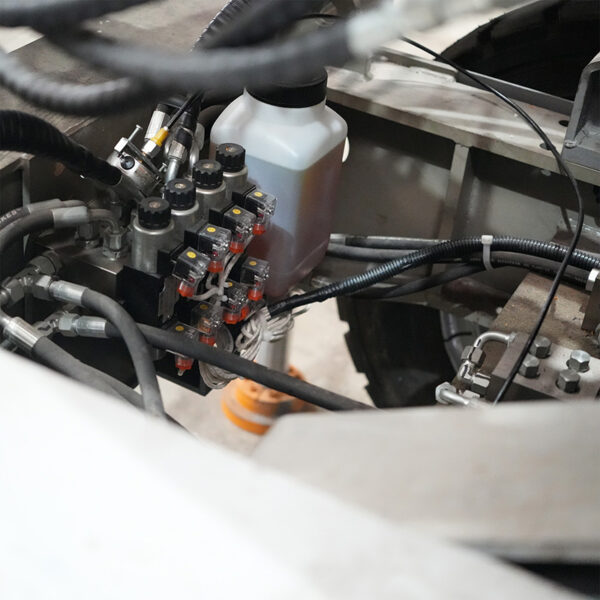
1. Technical Architecture of a Two Stage Screw Air Compressor
Unlike a single-stage unit that compresses air from atmospheric to final pressure in one rotor set, the two stage screw air compressor uses a low-pressure (LP) rotor and a high-pressure (HP) rotor in series. Between the stages, an intercooler removes heat of compression, bringing air temperature close to ambient before it enters the HP stage. This fundamental design reduces the work of compression (polytropic efficiency gains) and lowers discharge temperatures by 30–40°C compared to single-stage equivalents.
1.1 Rotor Profiles and Clearance Control
- Asymmetric rotor profiles – Optimized for minimal blow-hole area and reduced internal leakage. Both stages use precision-ground rotors with 4+6 lobe combinations.
- Inter-stage pressure management – Optimal splitting ratio (typically 40–45% of total pressure ratio in LP stage) ensures equal work distribution, minimizing shaft torque fluctuations.
- High-efficiency intercooler – Plate-fin or shell-and-tube designs with <2% pressure drop, often combined with moisture separation to protect HP stage from condensate.
Field data from mining sites in Western Australia show that a well-engineered two stage screw air compressor maintains volumetric efficiency above 88% even at 10 bar discharge pressure, whereas single-stage units drop below 78% under similar conditions.
2. Energy Efficiency Analysis: Measured Savings Over Single-Stage
Energy typically represents 75–80% of a compressor’s total lifecycle cost. According to ISO 1217 Annex C data, a two-stage compressor operating at 8 bar can achieve a specific power requirement of 6.2–6.8 kW/(m³/min), compared to 7.5–8.1 kW/(m³/min) for a high-efficiency single-stage unit. This translates to a 15–20% reduction in annual electricity bills for a 200 kW continuous-duty installation.
2.1 Thermodynamic Advantage – Reduced Compression Work
The theoretical work saved by staging comes from approaching isothermal compression. With intercooling, the LP stage discharge temperature is limited to 105–120°C, whereas single-stage compressors can exceed 200°C. Lower temperature means reduced air density losses and less energy wasted as heat. Real-world tests at Aivyter’s engineering lab demonstrated a 16.4% power reduction for a 132 kW two-stage unit versus its single-stage baseline at 9 bar, maintaining identical flow of 22.5 m³/min.
- Load/unload cycles – Two-stage units with oversized air receivers can shift to part-load with better efficiency due to lower internal pressure differentials.
- Variable speed drive (VSD) integration – Combined with two-stage compression, VSD cuts energy use by another 12–15% in variable demand profiles (e.g., quarry crushing circuits).
For operations running 6,000+ hours annually, upgrading to a two stage screw air compressor often yields payback periods under 18 months, even before considering carbon credits or incentive programs.
3. Critical Applications in Mining, Construction & Heavy Industry
Standard industrial compressors fail prematurely in harsh environments. Two-stage designs excel where high ambient temperatures, dust loads, and continuous operation are the norm.
3.1 Underground and Open-Pit Mining
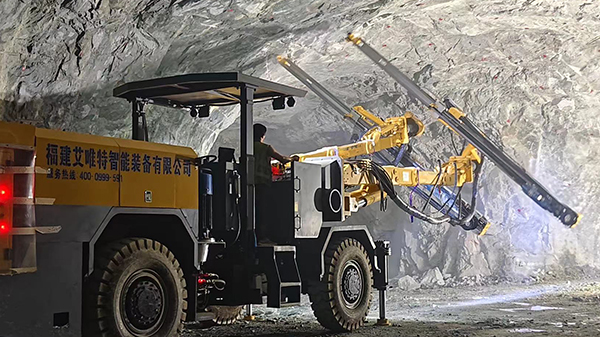
- Pneumatic drilling & bolting – Requires 7–10 bar at 10–40 m³/min. Two-stage units deliver steady flow without pressure drop spikes, reducing drill cycle times by 8–12%.
- Dust suppression systems – Hot, dry air from single-stage compressors can degrade atomization nozzles; lower discharge temperature of two-stage models preserves water-based suppression efficiency.
- Ventilation & instrument air – In deep mines where ambient temperatures exceed 45°C, the intercooler prevents HP stage overheating and lubricant coking.
3.2 Large-Scale Construction and Civil Engineering
Tunnel boring machines (TBMs) and pile driving rigs require reliable air at variable pressures. Two-stage screw compressors offer stable performance across 4–13 bar ranges. For example, on the Sydney Metro expansion, Aivyter supplied two-stage units that operated 8,200 hours with <0.5% unscheduled downtime, largely due to robust bearing design and oversized oil cooling.
3.3 Heavy Manufacturing & Steel Plants
High-temperature foundries and cement plants benefit from the reduced thermal stress on downstream dryers and filters. A two-stage compressor’s lower outlet temperature (typically 70–80°C vs. 95–110°C for single-stage) extends desiccant life by 40% and reduces condensate loading in air lines.
For more detailed technical specifications on industrial applications, visit the industrial air compressor solutions library for rotors, coolers, and filtration systems.
4. Reliability and Maintenance Strategy for Continuous Operation
Two-stage screw air compressors, when properly engineered, demonstrate higher mean time between failures (MTBF) compared to single-stage equivalents. The key reasons: lower bearing loads, reduced thermal cycling, and better oil condition retention.
4.1 Lubrication and Oil Management
- Oil selection – High-quality PAO or diester-based lubricants with viscosity index >150 are required to maintain film strength across both stages. Change intervals extend to 8,000 hours in two-stage designs vs. 4,000–6,000 in single-stage.
- Oil scavenging and separation – Two-stage units often incorporate double-stage oil separators (primary + coalescing) to keep oil carryover below 3 ppm, critical for sensitive downstream equipment.
4.2 Predictive Maintenance Protocols
Implementing vibration monitoring on both rotor sets and thermography on the intercooler can forecast bearing wear or scaling. Aivyter’s SGPM series includes embedded sensors for discharge temperature difference (ΔT) between LP and HP stages – a ΔT increase of >15°C above baseline signals intercooler fouling. Scheduled cleaning using dry ice blasting restores efficiency without disassembly.
Operators should also inspect the inlet air filter weekly in dusty environments; a clogged filter increases pressure drop across the LP stage, forcing the HP stage to over-compensate, leading to premature rotor contact. Use heavy-duty cyclonic pre-filters for mining applications.
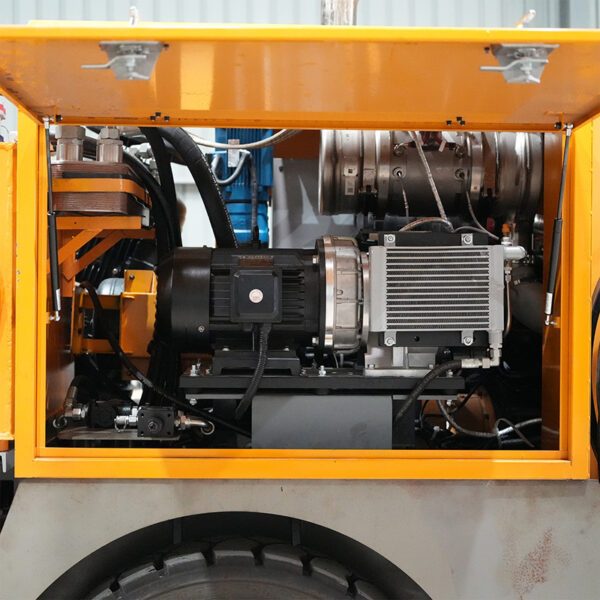
5. Selecting the Right Two Stage Screw Air Compressor – Key Parameters
Choosing a compressor solely based on nameplate power leads to suboptimal performance. Instead, evaluate the following technical metrics:
- Free Air Delivery (FAD) at maximum operating pressure, corrected for site altitude (use ISO 1217 annex D for high-altitude derating).
- Specific power (kW per m³/min) – Look for values below 6.9 kW/(m³/min) at 8 bar for units above 90 kW.
- Intercooler approach temperature – The difference between ambient air and compressed air leaving the intercooler; lower is better (<8°C indicates high effectiveness).
- Part-load efficiency – If using inlet modulation, ensure the two-stage design maintains >85% isentropic efficiency down to 60% flow.
- Noise emission – Well-designed enclosures for two-stage compressors achieve 72–78 dB(A) at 1 meter, suitable for on-site installation without separate rooms.
For a detailed selection matrix, review the rotary screw compressor specifications covering flow rates, pressure ranges, and cooling options.
6. Aivyter’s Engineering Approach to Two-Stage Compression
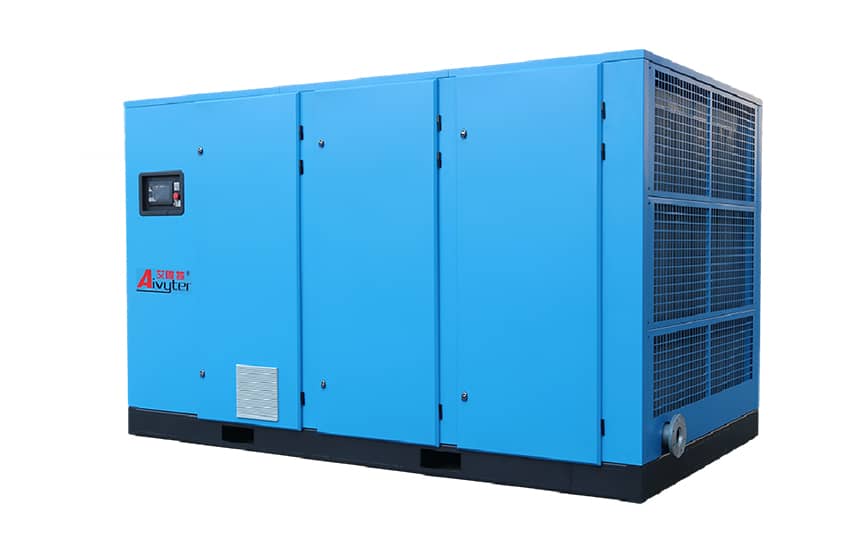
The two stage screw air compressor range from Aivyter (SGPM series) incorporates several proprietary improvements over conventional designs. First, the rotors use a 5:6 profile with a superfinished surface (Ra ≤0.1 µm), reducing friction loss by 8% compared to standard ground rotors. Second, the inter-stage oil-cooled heat exchanger uses brazed aluminum plates with turbulent flow geometry, achieving effectiveness up to 92%. Third, the integrated controller (Aivyter iSmart) continuously adjusts the oil injection quantity to both stages, maintaining optimal discharge temperatures across ambient ranges from -10°C to +50°C.
Independent tests conducted at TÜV SÜD verified that the Aivyter SGPM-160 (160 kW) delivers 27.4 m³/min at 8 bar with a specific power of 5.84 kW/(m³/min) – exceeding IE4 efficiency thresholds. This performance makes it suitable for carbon-constrained projects seeking ISO 50001 certification.
Beyond hardware, Aivyter provides remote condition monitoring via cloud-based SCADA integration, with automated alerts for intercooler scaling, bearing temperature drift, and oil degradation. For mining sites in remote Chile or Western Australia, this predictive capability eliminates unplanned stops.
Frequently Asked Questions (FAQ)
Q1: What is the actual energy saving of a two stage screw air compressor compared to a high-quality single-stage unit?
A1: Based on ISO 1217 performance tests at 8 bar discharge pressure, a two-stage screw air compressor typically saves 12–18% in specific power consumption. For a 160 kW compressor running 6,500 hours/year at $0.12/kWh, this represents $15,000–$22,000 annual savings. Savings are more pronounced in high-pressure applications (10–13 bar) where single-stage units suffer from increased internal leakage.
Q2: Can a two stage screw air compressor handle high ambient temperatures in desert mining?
A2: Yes. The intercooler in a two-stage design reduces the heat load on the high-pressure stage. Units like Aivyter’s SGPM series are rated for ambient up to 50°C with a standard cooling package. For extreme environments, oversized coolers and thermostatic bypass valves maintain oil temperatures below 85°C. Always derate the FAD by 0.8–1% per °C above 40°C.
Q3: How does the maintenance cost of a two stage screw air compressor compare to a single-stage?
A3: Initial purchase cost is 15–25% higher, but total maintenance cost over 10 years is often 10–15% lower. The lower operating temperature extends oil life, reduces varnish formation, and halves the frequency of rotor bearing replacements. Additionally, many two-stage units share common parts (filters, seals) across both stages, simplifying inventory. Expect oil changes every 8,000 hours versus 4,000–5,000 for single-stage.
Q4: What pressure range is optimal for a two stage screw air compressor?
A4: Two-stage compression provides maximum benefit from 6.5 bar to 15 bar. Below 6 bar, the efficiency gain over single-stage is marginal (3–5%). Above 15 bar, reciprocating or centrifugal compressors become more efficient. For continuous duty at 8–13 bar with fluctuating demand, two-stage rotary screw is the industry standard. Always consult the compressor map to avoid operating too close to the surge line at very low pressures.
Q5: Does a two stage screw air compressor require special installation or foundation?
A5: Modern two-stage units (especially with VSD) generate lower vibration levels than single-stage equivalents due to balanced rotor forces. A standard 150–200 mm reinforced concrete slab with vibration isolators suffices for units up to 250 kW. However, ensure adequate clearance for intercooler cleaning access (minimum 1 meter on the side). For offshore or mobile applications, Aivyter offers skid-mounted two-stage packages with integral spring-damper mounts.
Maximizing ROI with Two-Stage Technology
Adopting a two stage screw air compressor is not merely an incremental upgrade—it is a strategic decision for heavy industries facing rising energy costs and stricter emissions targets. The combination of lower specific power, extended maintenance intervals, and robust performance in harsh environments directly improves EBITDA margins. When evaluating suppliers, prioritize those with transparent performance curves, thermal imaging validation, and local service support.
Request a tailored engineering proposal from Aivyter
Every industrial site has unique flow profiles and contamination challenges. Aivyter’s application engineers provide a site audit, compressed air demand analysis (using data loggers), and a financial model comparing two-stage vs. single-stage options. The service includes 3D layout drawings, payback calculations, and commissioning support. Contact the heavy-duty compressor team today to schedule a consultation and receive a no-obligation energy savings estimate.
Send your inquiry now: Provide your operating pressure, flow rate (m³/min), annual running hours, and local electricity rate to [email protected] or use the technical request form on our contact page. For urgent mining or construction projects, a dedicated project manager will respond within 4 business hours.
about
Aivyter
We provides trusted air compressors and mining equipment, engineered for durability, efficiency, and demanding industrial applications.