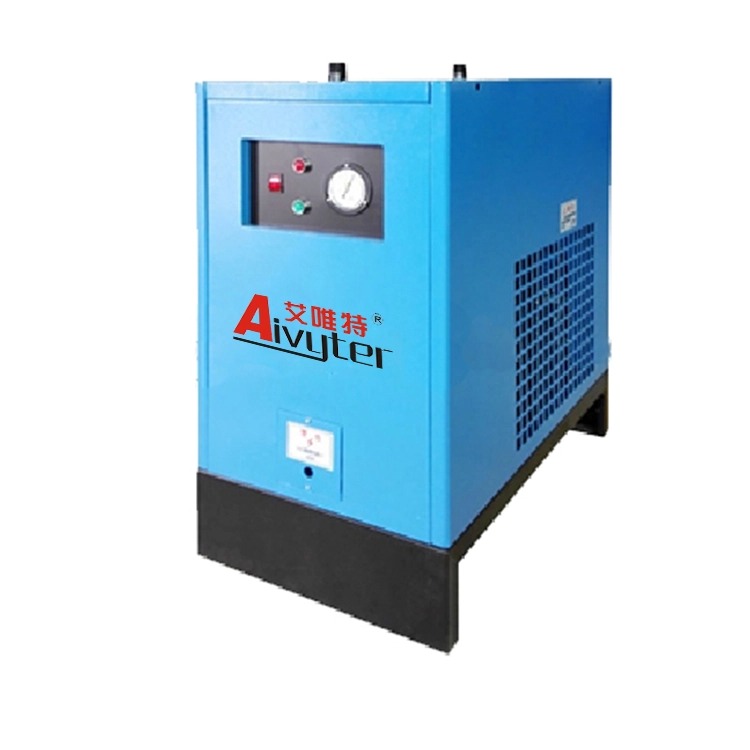
Compressed air acts as a primary power source across countless industrial sectors, including heavy manufacturing, chemical processing, civil engineering, and underground mining. However, ambient air pulled into a compressor intake naturally contains moisture in the form of water vapor. Under compression, this moisture condenses into liquid water, presenting a major risk to downstream piping, pneumatic valves, and precision instrumentation. To mitigate this risk, industrial operators rely on refrigerated air dryers to lower the temperature of the compressed air stream and force the moisture to condense out of the air. At the heart of this process lies the dryer refrigerant, a substance engineered to transfer heat efficiently and maintain stable operating conditions.
Selecting, maintaining, and understanding this fluid is a key factor in ensuring optimal air quality and protecting production machinery. Equipment manufactured by specialists like Aivyter utilizes specific thermodynamic designs to achieve continuous dew point suppression, demonstrating the importance of matching mechanical configurations with the correct chemical properties of the refrigerant.
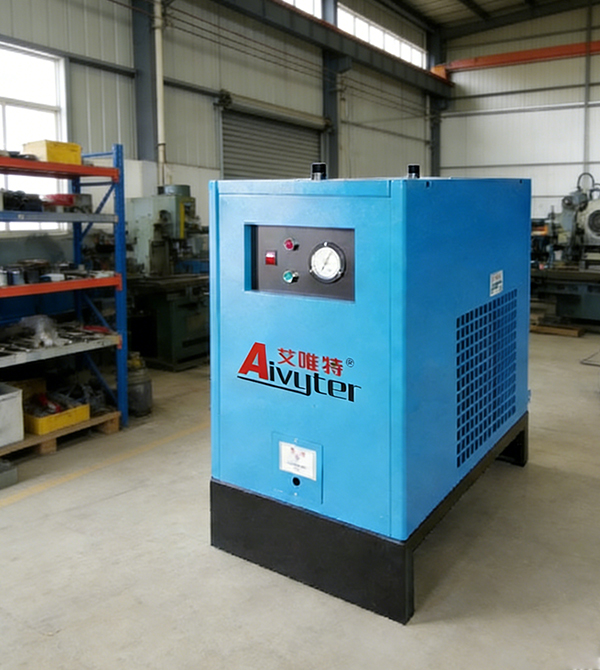
The Thermodynamic Principles of Refrigerated Air Drying
How the Refrigeration Cycle Removes Moisture
The operation of a refrigerated air dryer is governed by the laws of thermodynamics, specifically focusing on heat exchange and phase change. The primary goal is to cool the compressed air to a specific dew point temperature—typically around 3°C to 10°C (37°F to 50°F)—which causes gaseous water vapor to condense into liquid droplets that can be separated and discharged.
The process begins with the air-to-air heat exchanger (pre-cooler). Warm, saturated compressed air entering the dryer is pre-cooled by the cold air exiting the dryer. This design minimizes the thermal load on the refrigeration circuit, allowing for a smaller compressor footprint.
Next, the pre-cooled air enters the air-to-refrigerant heat exchanger, commonly referred to as the evaporator. Here, the liquid dryer refrigerant absorbs heat from the compressed air, causing the refrigerant to evaporate into a gas while lowering the air temperature to the target dew point.
The Vital Role of the Evaporator and Heat Exchanger
In the evaporator, the physical contact between the compressed air tubes and the refrigerant passage must be highly efficient. The heat transfer rate determines how quickly the air can be cooled to its dew point. If the evaporator is undersized or if the refrigerant charge is incorrect, the dew point will rise, allowing moisture to slip past the dryer into the factory air lines.
Dew Point Control and Stability
The stability of this phase change is vital. If the evaporator temperature drops below 0°C (32°F), the condensed water will freeze on the heat exchanger surfaces, blocking the air flow and drastically reducing system efficiency. To prevent this, a hot gas bypass valve is integrated into the refrigeration loop. This mechanical valve diverts hot refrigerant gas from the compressor discharge back to the evaporator inlet when the load decreases, maintaining a stable evaporator temperature above freezing.
Comparative Analysis of Common Dryer Refrigerants
Industrial air dryers utilize several distinct chemical compounds as heat-transfer fluids. Historically, chlorofluorocarbons (CFCs) and hydrochlorofluorocarbons (HCFCs) dominated the market. However, due to environmental protocols, contemporary systems use hydrofluorocarbons (HFCs) or hydrofluoroolefins (HFOs).
R134a is a widely used medium-pressure dryer refrigerant. It is highly valued for its excellent thermal stability and lower operating pressures. R134a operates efficiently even at elevated ambient temperatures, making it a reliable choice for manufacturing environments situated in warm climates or within poorly ventilated compressor rooms.
For larger industrial capacities, R407C is frequently selected. As a zeotropic blend of R32, R125, and R134a, R407C exhibits a temperature glide—meaning it evaporates and condenses over a range of temperatures rather than at a single constant point. This characteristic must be carefully accounted for during the design of the evaporator coils to ensure uniform heat transfer.
R410A is another option utilized in high-efficiency systems. Operating at significantly higher pressures than R134a or R407C, R410A requires robust piping and compressor structures. Its high volumetric cooling capacity allows manufacturers like Aivyter to build more compact dryer units with high heat-transfer coefficients, optimizing the physical footprint in crowded facilities.
Operational Challenges and Troubleshooting in Industrial Environments
Maintaining a balanced refrigeration loop in an industrial setting requires constant vigilance. Industrial environments—especially in mining, quarrying, and heavy assembly—often expose drying equipment to harsh conditions, including ambient dust, vibration, and temperature extremes.
Refrigerant Leaks and Detection Methods
One of the most frequent operational challenges is the detection and mitigation of leaks within the refrigeration loop. A loss of dryer refrigerant leads to a drop in suction pressure, causing the evaporator temperature to fluctuate and eventually leading to moisture carryover into the downstream distribution network. Common detection methods include:
- Electronic halogen leak detectors that trace specific chemical ions.
- Bubble solutions applied to joint connections and valves for localized inspection.
- Ultraviolet dyes introduced into the lubricant oil to locate micro-fractures under UV light.
Thermal Overload and Compressor Issues
Thermal overload of the refrigerant compressor is another common failure mode. When ambient temperatures exceed the design limits of the condenser, or if the condenser fins become clogged with airborne debris, the refrigerant cannot reject heat effectively. This leads to high discharge pressures, increased power consumption, and thermal shutdown of the compressor. Regular maintenance inspections are required to clean the air-cooled condenser coils or to ensure proper water flow in water-cooled designs.
Pressure Drop and Flow Rate Variances
A well-designed air dryer must balance heat exchange efficiency with minimal pressure drop. A high pressure drop through the air dryer forces the main air compressor to operate at a higher discharge pressure, consuming more energy across the entire facility. Ensuring the heat exchangers are designed for low flow resistance while maximizing thermal contact with the cooling medium is a hallmark of high-quality engineering.
Regulatory Compliance and Environmental Standards
Environmental regulations heavily influence the choice and management of industrial dryer refrigerant. The Kigali Amendment to the Montreal Protocol mandates a global phase-down of HFCs due to their high Global Warming Potential (GWP). In regions such as the European Union (under F-Gas regulations) and North America (via EPA SNAP regulations), operators face strict guidelines regarding the containment, recovery, and recording of refrigerant usage.
For plant managers, this means that older dryers utilizing R22 or high-GWP HFCs must eventually be retired or retrofitted with compliant alternatives. Modern dryer designs focus on low-GWP refrigerants and optimized charge volumes, reducing the overall environmental footprint while maintaining high drying efficiency. Partnering with forward-thinking manufacturers ensures that newly installed air treatment systems remain compliant with evolving international standards.
Best Practices for System Maintenance and Lifespan Extension
Maximizing the service life of an industrial air dryer requires a structured preventative maintenance protocol. This program should focus on both the compressed air path and the refrigeration circuit.
- Daily Monitoring: Inspect the dew point indicator to ensure it remains within the green zone (typically 3°C to 5°C). Verify that the automatic drain valves are discharging condensate correctly; a stuck drain valve will cause water carryover regardless of refrigerant performance.
- Weekly Cleaning: Blow down air-cooled condenser coils with compressed air or wash them to remove dust and oil film, ensuring optimal heat dissipation.
- Monthly Inspection: Check the sight glass in the liquid line for bubbles, which can indicate a low refrigerant charge or a restriction in the filter drier.
- Semi-Annual Checks: Measure compressor operating currents and verify the superheat and subcooling settings of the expansion valve to ensure the system is operating within its designed envelope.
By implementing these systematic checks, plant engineers can prevent premature component failure, maintain dry air for manufacturing processes, and extend the overall lifespan of their compressed air treatment investment.
Frequently Asked Questions
Q1: What is the optimal pressure dew point for a refrigerated air dryer, and how does the refrigerant help achieve it?
A1: The optimal pressure dew point for most standard industrial applications is 3°C to 5°C (37°F to 41°F). The refrigerant achieves this by boiling in the evaporator at a temperature just above freezing (typically around 1°C to 2°C). This temperature gradient allows the compressed air to cool sufficiently without risking ice formation on the heat exchanger surfaces.
Q2: How can I tell if my air dryer is low on refrigerant without connecting pressure gauges?
A2: Common indicators of a low charge include a rising dew point on the control panel, continuous running of the refrigerant compressor without cycling, and frost forming on the suction line or evaporator inlet. Additionally, if the unit has a liquid line sight glass, bubbles or foaming during operation often suggest a low charge.
Q3: Can I replace R22 with R134a or R407C directly in an existing air dryer?
A3: No, direct replacement is not recommended without substantial modifications. R22 systems typically use mineral oils, whereas modern alternatives like R134a and R407C require synthetic Polyolester (POE) lubricants. Furthermore, different refrigerants operate at different pressures, requiring specific expansion valve configurations and compressor designs.
Q4: Why does high ambient temperature cause my refrigerated dryer to trip or stop working?
A4: High ambient temperatures reduce the temperature differential between the condenser and the surrounding air. This makes it difficult for the condenser to reject heat. Consequently, the refrigerant pressure rises, triggering the high-pressure safety switch to protect the compressor from thermal damage.
Q5: How does a hot gas bypass valve prevent the evaporator from freezing?
A5: When the flow of compressed air decreases, the heat load on the evaporator drops, which would normally cause the refrigerant pressure and temperature to fall below freezing. The hot gas bypass valve senses this pressure drop and opens, diverting hot, high-pressure refrigerant gas directly into the low-pressure evaporator circuit to keep the temperature above 0°C.
Drive Operational Reliability with Expert Engineering
Achieving stable dew points and maintaining clean, dry compressed air requires a deep understanding of thermodynamics, regular system maintenance, and high-performance equipment. If you are experiencing moisture in your air lines, unexpected pressure drops, or require guidance on selecting compliant drying solutions, our team is ready to assist.
Contact Aivyter today for a professional consultation and discover how our engineered systems can bring long-term reliability to your industrial infrastructure.
about
Aivyter
We provides trusted air compressors and mining equipment, engineered for durability, efficiency, and demanding industrial applications.