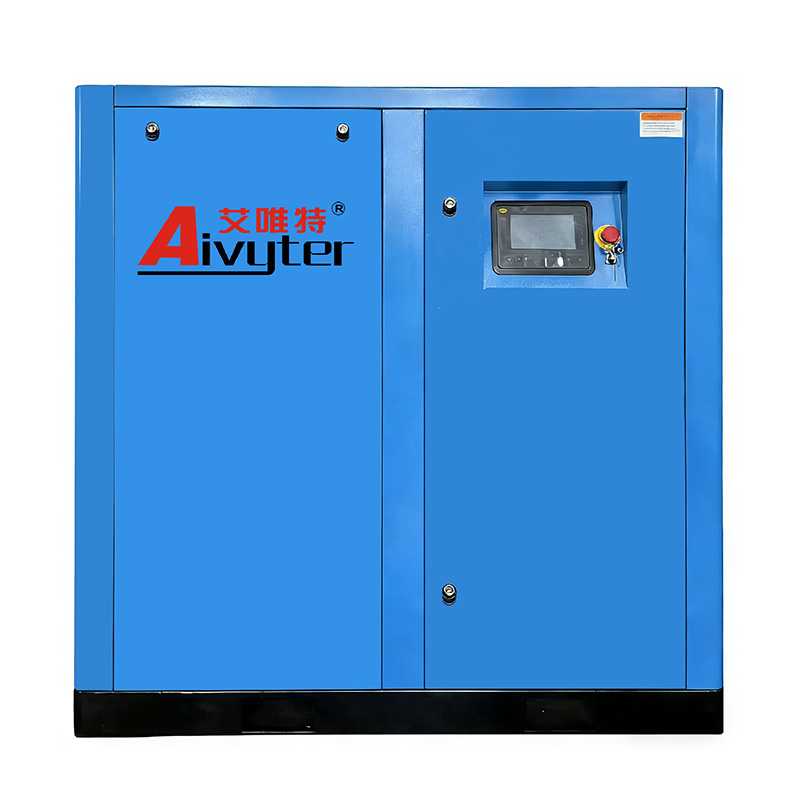
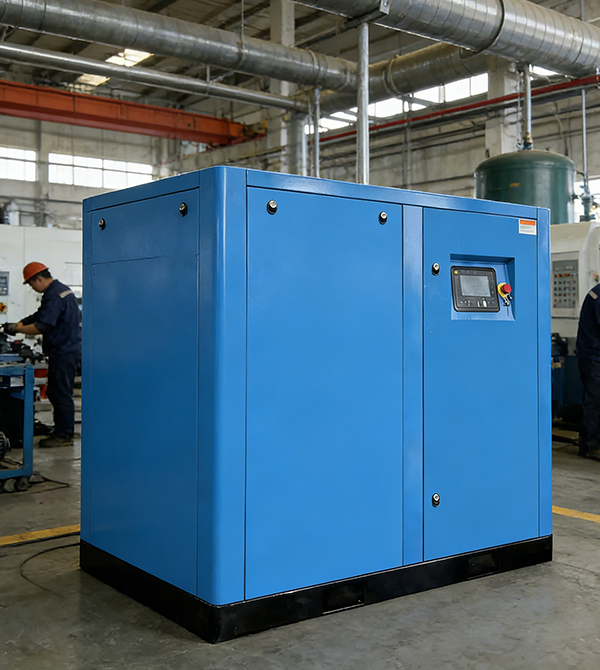
Many industrial processes — pneumatic conveying, flue gas desulfurization, lagoon aeration, and cement fluidization — require compressed air at pressures between 1.5 and 4.0 bar(g). Standard industrial compressors rated for 7–10 bar deliver excessive pressure, leading to wasted energy, higher maintenance costs, and unnecessary thermal stress. The engineered solution is a dedicated low pressure screw compressor, designed specifically for high flow rates at moderate discharge pressures. This article examines rotor geometry, volumetric efficiency, application-specific pitfalls, and provides a selection framework for plant operators and engineering contractors. Aivyter supplies complete low-pressure packages with integrated controls and aftercoolers for continuous operation in cement, mining, and chemical sectors.
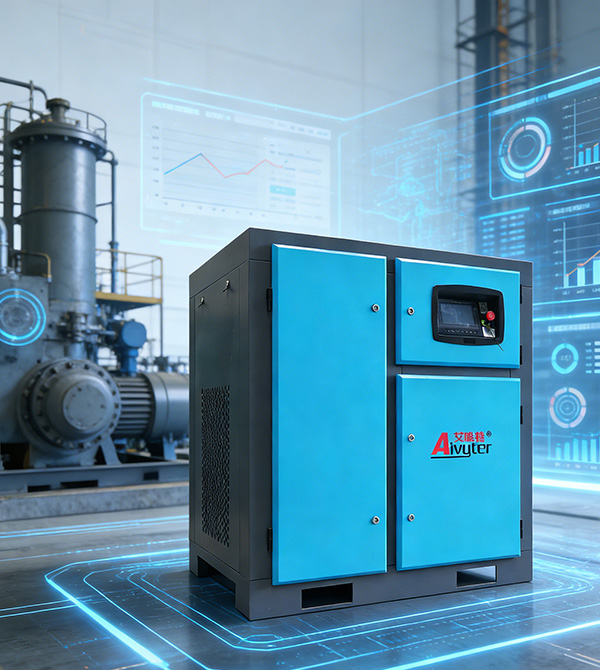
1. Technical Definition: What Defines a Low Pressure Screw Compressor?
Unlike a conventional rotary screw unit that compresses to 7–10 bar, a low pressure screw compressor operates with a lower built-in volume ratio (Vi typically 1.6 to 2.2). Key characteristics include:
- Discharge pressure range: 1.5 to 5 bar(g) – ideal for dilute phase conveying, aeration grids, and filter pulse cleaning.
- Larger rotor diameters: For a given flow rate (e.g., 40–120 m³/min), the rotor length/diameter ratio decreases, reducing internal leakage.
- Oil-flooded design: Uses lubricant for cooling and sealing; however, low differential pressure allows lower oil injection rates compared to high-pressure units.
- Direct drive or gearbox: Many low-pressure models run at 1500–3000 rpm, avoiding high-speed bearings and extending service life.
These machines often replace inefficient positive displacement blowers (roots-type) or centrifugal fans. A properly selected low pressure screw compressor delivers 25–35% better specific power (kW per m³/min) than a roots blower in the 0.6–1.5 bar range, with significantly lower noise (75 vs 95 dBA).
2. Primary Applications in Mining, Construction & Bulk Handling
Operations that demand high volume at moderate pressure benefit most from this technology. Real-world installations show measurable productivity gains:
2.1 Cement and Fly Ash Pneumatic Conveying
Systems moving powder from silos to bag filters require stable pressure between 0.8 and 2.5 bar. A low pressure screw compressor handles dense-phase or dilute-phase conveying with pulsation-free flow. Compared to lobe blowers, screw units maintain constant air volume regardless of backpressure fluctuations, preventing line blockages.
2.2 Wastewater Aeration & Flotation
Medium-size treatment plants (1000–5000 m³/day) use fine bubble diffusers that need 0.5–0.8 bar backpressure. While roots blowers remain common, their efficiency drops sharply at higher pressures. Low-pressure screw compressors maintain 70–75% adiabatic efficiency across a 0.4–1.2 bar range, reducing electricity bills by €8,000–€15,000 annually for a 75 kW unit. Aivyter’s integrated aeration packages include variable speed drive (VSD) to match diurnal flow variations.
2.3 Mining: Reverse Air Baghouses & Dust Collection
Underground and surface mines use pulse-jet bag filters to control particulate emissions. Each pulse requires 0.5–0.6 MPa (5–6 bar) but the average demand per filter is low. However, many mines oversize high-pressure compressors, wasting 30% energy. A dedicated low pressure screw compressor set at 2.5–3 bar with a small receiver tank provides the pulse air more efficiently, and also serves dry sprinklers, VAV dampers, and tool flushing.
2.4 Chemical & Food Fermentation
Bioreactors and fermenters need sterile, oil-free air at 0.3–1.0 bar. Oil-flooded low-pressure screws combined with catalytic converters or carbon filters achieve ISO 8573-1 Class 1 oil content at a fraction of the cost of dry screw or centrifugal compressors.
3. Energy Performance Metrics and Lifecycle Cost Analysis
Selecting a low pressure screw compressor requires verifying specific power according to ISO 1217 annex C. For a unit delivering 50 m³/min at 2.5 bar, a well-designed machine achieves ≤ 3.8 kW/(m³/min). Compare this:
| Technology | Pressure (bar) | Specific power (kW/m³/min) | Relative energy cost (per year, 6000h) |
|---|---|---|---|
| Roots blower (3 lobe) | 0.8 | 5.6 | € 28,000 |
| Low pressure screw (oil-flooded) | 0.8 | 3.9 | € 19,500 |
| Old 7-bar screw (throttled to 2.5bar) | 2.5 | 7.2 | € 43,200 |
| Low pressure screw (optimized) | 2.5 | 3.8 | € 22,800 |
Beyond energy, low-pressure designs reduce oil carryover because coalescing separators operate at lower velocity. Annual oil consumption often stays below 0.5% of the sump volume. For a mine or processing plant, the payback period when replacing an oversized high-pressure compressor with a dedicated low-pressure unit typically ranges from 12 to 24 months, depending on local electricity tariffs.
4. Engineering Details: Rotor Profiles and Clearance Management
Low-pressure screw compressors utilize asymmetric N-profile or SRM type rotors with larger discharge ports. To achieve high volumetric efficiency (>88%) at low pressure ratios, manufacturers apply:
- Reduced rotor length/diameter ratio (L/D ≤ 1.2): Minimizes blow‑hole area and friction losses.
- Fine surface coating: PTFE or MoS₂ on rotor flanks reduces internal shear and allows tighter clearances (0.02–0.05 mm) without risk of contact.
- Integrated suction throttle valve: Modulates flow from 25% to 100% with minimal pressure drop (Δp < 30 mbar at full load).
- Direct flange-mounted motor: Eliminates coupling misalignment, a frequent cause of premature bearing wear.
When a low pressure screw compressor operates continuously at 2–3 bar, the airend bearings (roller or angular contact) experience lower radial loads than high-pressure equivalents. Field data from aggregate quarries show that routine bearing replacement intervals extend to 50,000 hours with proper synthetic oil (Aivyter recommends ISO VG 46 full-synthetic PAO).
5. Operational Pain Points and Technical Solutions
Even well-designed low-pressure systems encounter issues. Below are four frequent problems and their root-cause corrections:
- Sudden pressure drops during peak conveying: Often caused by undersized air receiver or inadequate pipe diameter. Solution: Add a 2–5 m³ buffer vessel and increase main headers by one nominal size (e.g., DN150 to DN200). Pressure fluctuations reduce by 60%.
- High oil temperature (>95°C) at low ambient: The thermostatic bypass valve might be stuck or oil cooler fins blocked. Clean cooler with non-corrosive detergent and verify the mixing valve opens at 70°C.
- Moisture condensation in separator tank: Occurs when the unit runs unloaded for extended periods. Install a WSD (water separator drain) or program a minimum load cycle (5 minutes loaded every 2 hours).
- Increased noise and vibration after overhaul: Rotors may have been re-coated improperly. Check with a vibration analyzer – velocity above 4.5 mm/s RMS at 1000 Hz indicates rotor imbalance. Factory reconditioning is advised.
Proactive monitoring using IoT gateways (pressure, temperature, vibration) allows predictive maintenance. Aivyter offers remote telemetry packages that trigger alerts when specific power rises above 4.2 kW/(m³/min).
6. Selection Criteria: Sizing a Low Pressure Screw Compressor for Your Process
Unlike standard compressors where flow is the primary variable, low-pressure selection requires analyzing the system curve. Follow these steps:
- Define peak and average free air delivery (FAD) in m³/min at site altitude. For a cement plant using 5″ conveying lines, typical demand is 30–40 m³/min at 2.2 bar.
- Measure backpressure profile. Use a data logger at the point-of-use over one week. Many applications see 0.3–0.5 bar variation due to filter clogging or product density changes.
- Choose between fixed-speed and VSD. If your demand deviates more than ±20% from average, a VSD low pressure screw compressor saves 20–30% energy. For stable loads like continuous aeration, fixed-speed with load/unload control is more cost-effective.
- Specify discharge temperature requirement. If downstream components (plastic pipes, bag filters) cannot tolerate 90°C air, order an integrated water-cooled aftercooler to drop to ambient +10°C.
Always request a performance curve showing specific power versus both pressure and flow. Avoid “universal” machines that claim high efficiency across a wide pressure range — they often compromise rotor geometry.
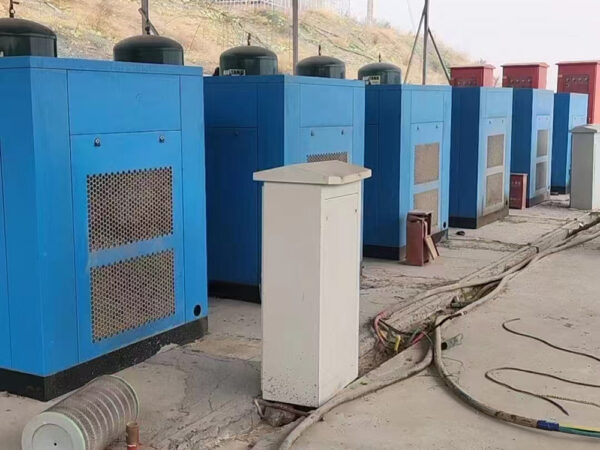
7. Maintenance Standards for Low-Pressure Rotary Screw Units
Because low-pressure compressors operate with lower delta P, some maintenance intervals differ from standard units. Recommended schedule:
- Oil and filter change: Every 3,000–4,000 hours (compared to 2,000 hours for high-pressure). Use oil analysis to validate extension up to 6,000 hours with synthetic lubricants.
- Air filter inspection: Every 500 hours in dusty environments (mining, cement). Replace when differential pressure exceeds 25 mbar.
- Separator element replacement: Annually or when pressure drop over separator reaches 0.35 bar. Low-pressure designs produce less oil mist, extending separator life by 30%.
- Thermal valve check: Test annually; ensure oil bypass temperature is within ±5°C of specification.
Records from a copper mine in Chile show that following these guidelines increased mean time between failures (MTBF) from 8,000 to over 14,000 hours for their low pressure screw compressor fleet.
8. Frequently Asked Questions (FAQs)
Q1: Can a standard screw compressor be de-rated to operate as a low pressure unit?
A1: Not recommended. A high-pressure airend has a small discharge port and high built-in volume ratio, causing over-compression and excessive heat when run below 4 bar. This leads to oil coking and bearing failure. Always use a rotor and housing designed for low pressure ratio.
Q2: What pressure dew point can I expect with a low pressure screw compressor + refrigerated dryer?
A2: Typically +3°C to +10°C pressure dew point at full flow. For low-pressure applications (2 bar), a cycling or variable-speed dryer maintains stable performance. Lower dew points (e.g., -20°C) require desiccant dryers with purge control, but they add 15–20% energy penalty.
Q3: How does altitude affect low pressure screw compressor performance?
A3: At 2000m altitude, ambient pressure drops to about 0.8 bar. The compressor inlet density reduces proportionally, lowering mass flow. For a given flow requirement in m³/min (FAD), you must upsize the motor or select a larger displacement airend. A rule of thumb: derate capacity by 3% per 300m above sea level.
Q4: Is oil-free necessary for low pressure applications like cement aeration?
A4: No. Most bulk materials (cement, fly ash, grains) tolerate small amounts of oil (≤5 ppm). Oil-flooded low-pressure screws are standard. For food contact or sensitive catalysts, install an activated carbon filter downstream. The cost of a dry low-pressure screw is 2–3 times higher with marginal efficiency gain.
Q5: How do I calculate energy savings when replacing a roots blower with a low pressure screw compressor?
A5: Compare shaft power at same operating point. For example, a 55 kW blower delivering 35 m³/min at 0.8 bar consumes 55 kW. A low-pressure screw delivering the same flow at the same pressure consumes ~38 kW. Savings = 17 kW × 6,000 h/year × €0.10/kWh = €10,200/year. Include additional savings from reduced noise abatement (no enclosure needed).
9. Optimize Your Low Pressure System – Request an Engineering Review
Selecting the correct low pressure screw compressor requires accurate flow data, pressure profiles, and a clear understanding of your process’s sensitivity to oil and moisture. Aivyter provides:
- On-site or remote airflow measurement (using thermal mass flow meters) for seven days.
- Comparative lifecycle cost analysis between blowers, modified high-pressure screws, and purpose-built low-pressure units.
- CAD integration of compressor package including optional heat recovery (up to 75% of input energy reclaimable as hot water).
- Performance guarantees validated by third-party tests per Pneurop/CAGI standards.
Ready to reduce your plant’s compressed air energy bill and improve reliability? Submit your process parameters (pressure, average/peak flow, operating hours, electricity tariff) to receive a customized proposal. Our engineers will respond within 48 hours with system specifications and projected ROI.
→ Send Inquiry to Aivyter Low-Pressure Team ←
For urgent requests or to discuss a retrofit of existing blower stations, use the online form or contact our regional sales directly via the website.
about
Aivyter
We provides trusted air compressors and mining equipment, engineered for durability, efficiency, and demanding industrial applications.