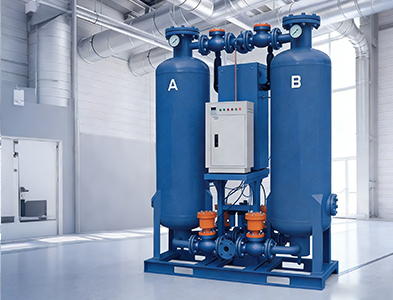
When compressed air systems exceed 50 m³/min and require pressure dew points (PDP) below -40°C, the heated desiccant air dryer becomes the most energy-rational choice. Unlike heatless designs that sacrifice 15-20% of dry air for regeneration, a heated dryer uses electric heaters and minimal purge flow (typically 5-7% of rated capacity). This technical guide explores where and why heated regeneration dominates—from offshore platform instrumentation to high-altitude mine ventilation—while outlining selection criteria and operational best practices anchored in real field data.
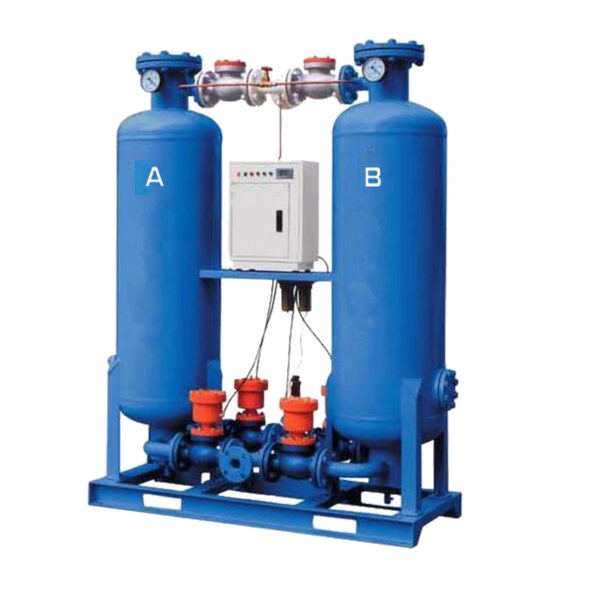
1. Operating Cycle of a Heated Desiccant Air Dryer
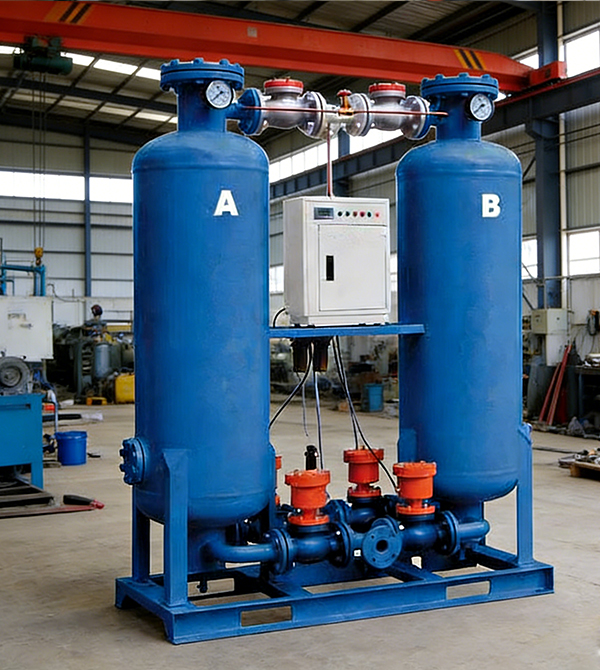
The heated desiccant air dryer also operates on dual-tower pressure swing adsorption (PSA), but replaces the high purge flow with externally supplied thermal energy. Process sequence:
- Adsorption phase: Wet compressed air passes through the online desiccant bed (activated alumina or molecular sieve) at line pressure (4-16 bar). Water vapour adsorbs, producing outlet PDP down to -70°C for critical applications.
- Heating & regeneration phase: The offline tower is depressurised to near atmospheric. A small purge flow (5-7% of full flow) is preheated by electric heaters to 120-200°C and directed through the saturated desiccant. Heat desorbs moisture, which is carried away by the purge air and exhausted.
- Cooling phase: After heating, the desiccant remains too hot for efficient adsorption. The same low purge flow (now unheated or ambient) passes through the bed until it returns to near inlet temperature. The tower then repressurises and awaits switchover.
Cycle times are longer (4-12 hours) compared to heatless dryers, but the net energy balance favours heated designs above 5-6 bar inlet pressure and flow rates exceeding 40 m³/min. Aivyter integrates programmable logic controllers (PLC) that optimise heating duration based on real-time humidity sensors, reducing electricity use by up to 22% compared to fixed timers.
2. Critical Applications Where Heated Technology Outperforms Heatless
Selecting a heated desiccant air dryer is justified by specific operational parameters:
- Large compressed air flows (>80 m³/min): At 100 m³/min, a heatless dryer would waste 15-20 m³/min as purge air. A heated model uses only 5-7 m³/min, saving compressed air equivalent to a 75 kW compressor.
- Low ambient temperatures combined with high moisture load: Mining operations in Canada or Siberia see inlet air at +35°C and 100% RH after aftercoolers. Heated regeneration effectively regenerates desiccant without increasing purge rate, maintaining stable PDP.
- Hydrocarbon-laden environments (natural gas compression, biogas): Elevated temperature helps volatilize light hydrocarbon residues that would otherwise poison the desiccant, extending service life.
- Installations with waste heat availability: Aivyter’s energy recovery packages can use exhaust heat from gas engines or hot water loops to preheat the regeneration air, cutting electric heater consumption by over 60%.
Case evidence: A copper concentrator in northern Chile replaced two heatless dryers (total 120 m³/min) with a single heated desiccant air dryer from Aivyter. Annual energy savings (compressed air loss + electric heating) exceeded 218,000 kWh, with PDP consistently below -52°C for their flotation cell actuators.
3. Technical Parameters & Efficiency Levers
For procurement engineers, three interrelated metrics determine lifecycle cost:
3.1 Pressure Dew Point (PDP) Stability
Heated designs achieve Class 1 to Class 3 per ISO 8573-1 (-70°C to -20°C). The key advantage is stability under varying flow: because regeneration is thermally driven, even 120% flow surges do not cause dew point spikes—unlike heatless dryers that rely on purge-to-flow ratio. Verify that the desiccant bed depth and heater sizing match your peak demand profile.
3.2 Purge & Heater Power Trade-off
Lower purge rate (5%) requires higher regeneration temperature (180-200°C) and longer cycle times. Higher purge (7-8%) allows lower temperature (120-150°C). Optimisation depends on electricity cost vs. compressed air cost. Aivyter’s selection tool calculates break-even point; for most industrial sites with electricity at $0.08/kWh and air at $0.03/m³, the 6% purge / 160°C setting yields lowest 10-year TCO.
3.3 Inlet Air Pre-treatment
Heated dryers are intolerant to liquid water and excessive oil. Required upstream components: centrifugal separator (removes bulk liquid), coalescing filter (≤0.01 ppm oil, ≤0.01 µm solids), and a refrigerated dryer if inlet temperature exceeds 45°C. Neglecting pre-filtration doubles desiccant replacement frequency—a costly error in heavy industry.
4. Industry Pain Points & Engineered Solutions
Plant operators often hesitate to adopt heated technology due to perceived complexity. Below are real-world objections and Aivyter’s direct answers:
- Pain point: Electric heaters fail in dusty/ humid electrical rooms. → Solution: Aivyter supplies NEMA 4X / IP66 heater enclosures with integrated thermal fuses and redundant elements. Heater replacement can be performed without depressurising the dryer.
- Pain point: High maintenance cost of multiple thermocouples and contactors. → Solution: Solid-state relay (SSR) driven heaters with digital temperature controllers reduce cycling wear. Mean time between failures (MTBF) exceeds 120,000 hours in Aivyter’s field records.
- Pain point: Desiccant degradation from thermal cycling. → Solution: Use high-grade activated alumina (low attrition, >98% Al₂O₃) rated for 500 thermal cycles. Aivyter includes a 5-year desiccant performance warranty when using recommended pre-filtration.
- Pain point: Long cooling period reduces net adsorption time. → Solution: Incorporate a closed-loop cooling circuit that circulates cool purge air through the regenerated tower while the online tower continues drying. This shortens cycle times by 30%.
5. Comparative Energy Analysis: Heated vs. Heatless & Blower Purge
Three major regeneration technologies exist for adsorption dryers. The heated desiccant air dryer occupies the middle ground:
- Heatless (pressure swing): Purge 15-20%, no heater. Lowest capital cost, highest compressed air loss. Best for small flows (<20 m³/min) or remote sites without reliable power.
- Heated (electric or steam): Purge 5-8% + electrical load (2-4 kW per 10 m³/min). Optimal for medium to large flows (30-200 m³/min) where electricity is available and humidity is moderate to high.
- Blower purge (externally blowed air): Purge 2-4% but requires a blower motor (5-15 kW) and heater. Lowest compressed air loss, highest capital cost. Suitable for very large installations (>200 m³/min) or when compressed air is extremely valuable (e.g., nitrogen generation).
For most construction, mining, and engineering firms, the heated dryer provides the best ROI: 30-50% lower operating cost than heatless, with only 15-20% higher initial investment. Aivyter’s modular heated dryer series allows future upgrade to blower purge by adding a blower skid—protecting the initial investment.
6. Selecting a Heated Desiccant Air Dryer: 6 Engineering Criteria
When drafting a procurement specification, demand evidence on these six points:
- Validated PDP at maximum flow and worst inlet conditions – request factory acceptance test (FAT) reports.
- Regeneration heater type: Incoloy-sheathed elements with low watt density (>6 W/cm² leads to premature failure).
- Control system redundancy: Dual thermocouples and automatic switch to backup heater if primary fails.
- Pressure vessel certification: ASME Section VIII, PED 2014/68/EU, or GB/T 150 for mining sites.
- Desiccant loading port accessibility: Top manway with 45° elbow to simplify replacement without vessel removal.
- Energy monitoring package: Real-time display of heater power, purge consumption, and downstream dew point. Aivyter’s IoT-ready controllers log data for predictive maintenance.
Always request a lifecycle cost simulation using your actual hourly load profile. Many vendors oversize heaters, leading to unnecessary capital expense and energy waste.
7. Maintenance Protocols to Maximise Service Life
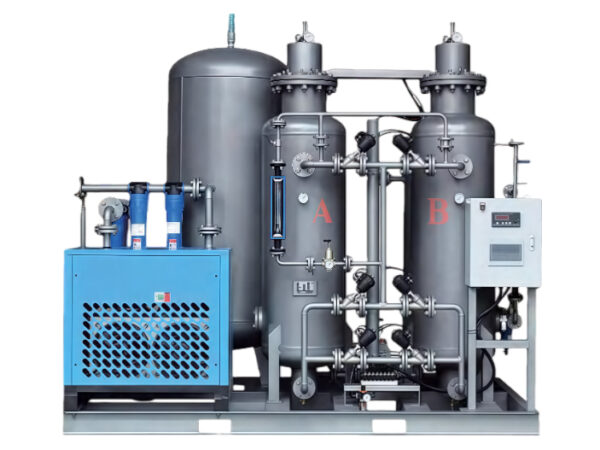
A well-maintained heated desiccant air dryer provides 15+ years of reliable service. Establish this schedule:
- Weekly: Visual inspection of heater contactors and silencers; record heater current draw.
- Monthly: Test safety thermal cutout switches; blow out electrical cabinet with dry instrument air.
- Quarterly: Measure desiccant bed temperature during regeneration (should reach setpoint ±10°C across entire bed).
- Biannually: Replace coalescing filter elements; inspect internal tower diffuser for clogging.
- Annually: Calibrate dew point transmitter; perform heater insulation resistance test (>2 MΩ).
- Desiccant replacement: Every 25,000-40,000 operating hours, depending on inlet oil contamination. Aivyter’s desiccant reload exchange program completes replacement in under 8 hours on most models.
Proactive operators also install a vibration monitor on the regeneration blower (if fitted) and trend bearing temperatures.
8. Why Industry Leaders Trust Aivyter for Heated Drying Solutions
With installations at over 400 heavy industrial sites across six continents, Aivyter has refined the heated regeneration process for maximum uptime. Our heated desiccant air dryer range includes:
- AHD series: 20-300 m³/min, integrated electric heater with SSR control, dew point down to -70°C.
- AHS series: 50-600 m³/min, steam heated version for facilities with waste heat or cogeneration.
- All units feature heavy-duty poppet valves rated for 2 million cycles and a 5-year structural warranty.
Each dryer is delivered with a site-specific energy audit and remote monitoring setup. Aivyter’s engineering team supports you from specification through to commissioning and operator training.
Frequently Asked Questions (FAQ)
Q1: Can a heated desiccant air dryer run continuously in freezing outdoor environments (-30°C)?
A1: Yes, but install the dryer inside a weatherproof enclosure or heated shelter. The electric heater and control panel require protection from direct snow/ice accumulation. For extreme Arctic conditions, Aivyter supplies insulated cabinets with a 200 W thermostatically controlled space heater. Also use glycol-jacketed drain valves on pre-filters to prevent condensate freezing in the separator.
Q2: How does the purge flow of a heated dryer compare to a heatless dryer at 100 m³/min?
A2: A heatless dryer would consume 15–20 m³/min as purge (15,000–20,000 m³/day). The heated desiccant air dryer consumes only 5–7 m³/min, saving 10–13 m³/min of compressed air. Over a year (8,000 hours), that translates to 4.8–6.2 million m³ of saved air—enough to power an additional 250 kW air compressor. The electric heating cost is typically 15-20% of the value of saved compressed air.
Q3: What desiccant type works best with heated regeneration for oil-contaminated air (e.g., mining compressors with oil carryover)?
A3: Standard activated alumina degrades quickly with >0.1 ppm oil. Use high-silica molecular sieve or an oil-resistant grade of activated alumina treated with hydrophobicity agents. Aivyter offers oil-tolerant desiccant blends that withstand up to 5 ppm oil ingestion, with periodic hot regeneration (200°C) that burns off light hydrocarbons. However, install a high-efficiency coalescing filter upstream to extend bed life beyond 30,000 hours.
Q4: Can I retrofit my existing heatless dryer to a heated dryer?
A4: Partial retrofit is possible but rarely economical. You would need to add electric heaters, a control panel with temperature regulation, and increase tower insulation. Existing vessels typically lack heater mounting flanges. Aivyter recommends a full replacement; however, we provide a trade-in credit for heatless dryers, recycling the vessels and valves. A complete heated dryer installation pays back the investment within 18-30 months through purge savings.
Q5: How does a heated desiccant air dryer perform with variable flow (e.g., weekend shutdowns)?
A5: Modern controllers include an “eco-offline” mode: when flow drops below 20% of rating for more than 2 hours, the dryer stops regeneration, heats the tower only when needed, and restarts fully automatically. Aivyter’s PLC monitors inlet flow via a dedicated orifice or signal from the compressor master controller. This feature reduces heater cycling and can cut electrical consumption by 40% during low-demand periods like night shifts or weekends.
Q6: What safety certifications are required for a heated dryer in an underground coal mine?
A6: Explosive atmospheres (methane dust) mandate ATEX Zone 2 / IECEx Zone 2 or MSHA (US) approval. The entire electrical system—heaters, thermocouples, control panel—must be housed in flameproof enclosures. Surface temperature must not exceed 150°C for Group I mining. Aivyter builds ATEX-certified heated desiccant dryers with automatic heater shutdown if enclosure temperature exceeds 135°C. Always consult with local mining safety authorities before installation.
Need a detailed lifecycle cost analysis for your specific flow and humidity profile? Our application engineers provide free technical assessments and complete proposal packages.
Contact Aivyter now to discuss your compressed air drying requirements. Request a quote, performance datasheets, or an on-site survey. For large projects, we offer pilot rental units to validate dew point performance before purchase. Send an inquiry →
about
Aivyter
We provides trusted air compressors and mining equipment, engineered for durability, efficiency, and demanding industrial applications.