Industrial operations in mining, tunneling, and large-scale construction depend on compressed air for pneumatic tools, control systems, material handling, and dust suppression. A stand-alone compressor supplies volume, but without effective moisture removal, condensate causes corrosion, freeze damage in cold climates, and erratic instrument performance. The engineering solution is a screw compressor with dryer — an integrated package where a rotary screw air-end and a drying stage (refrigerated or desiccant) work under unified control.
This article provides specification-level guidance for procurement and engineering managers selecting a screw compressor with dryer for sites with high dust loading, variable ambient temperatures, and continuous-duty requirements. We examine air-end geometry, dryer type selection (refrigerated vs. adsorption), pressure dew point (PDP) targets, filtration stages, and integration considerations for mobile and stationary setups.
Understanding the Integrated System: Rotary Screw Air-End + Drying Section
A screw compressor with dryer combines two functional blocks within a single frame or as a closely coupled skid:
- Rotary screw air-end: Two intermeshing helical rotors (male and female) trap air, reduce volume, and discharge compressed air. For heavy industrial duty, direct-drive or gear-driven configurations with asymmetric rotor profiles (e.g., 4:6 or 5:6 lobe counts) offer volumetric efficiency of 85-92% at 7-10 bar discharge pressure. Bearing design — roller or hydrodynamic — determines service intervals. Heavy-duty sites prefer air-ends with tapered roller bearings and forced lubrication.
- Integrated drying stage: Installed after the aftercooler and moisture separator. Two principal technologies:
- Refrigerated dryer: Cools compressed air to +3°C to +5°C, condensing water vapor. Achieves pressure dew point (PDP) of +3°C to +10°C. Suitable for general industrial pneumatic tools and non-critical instrumentation where freezing is not a risk.
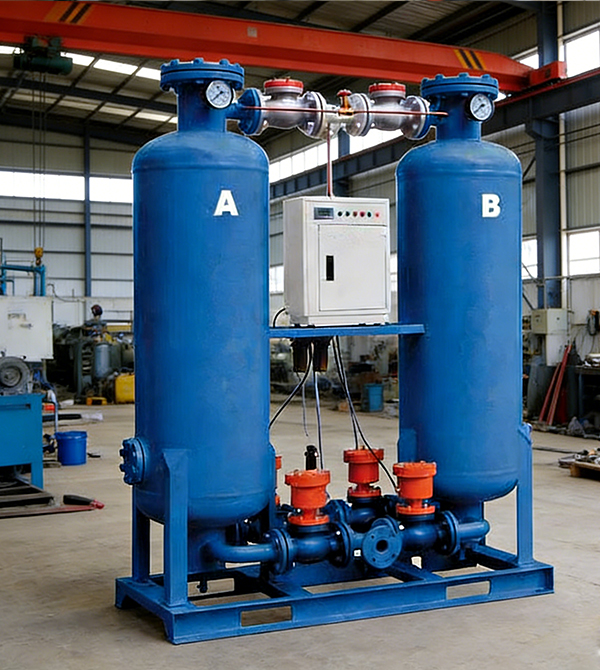
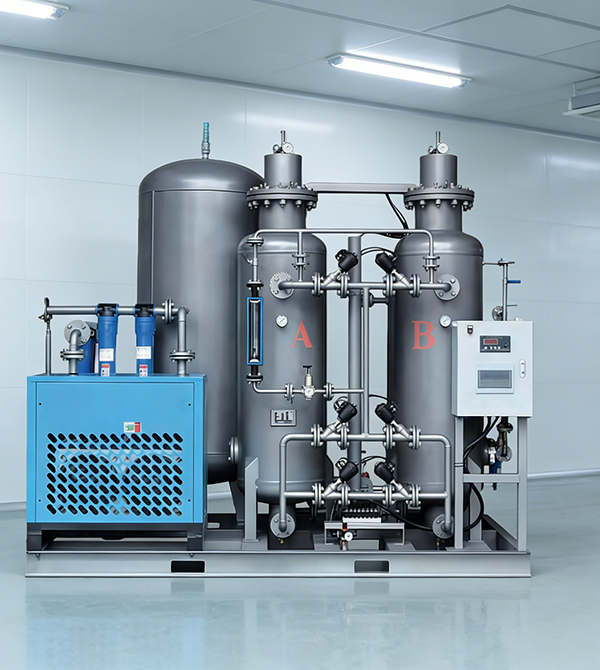
- Desiccant (adsorption) dryer: Uses silica gel or activated alumina towers to reduce PDP to -40°C or lower. Required for outdoor pipelines in sub-zero climates, pneumatic control systems with sensitive valves, and processes where ice formation blocks orifices. Heatless, heated, or blower-purge regeneration methods affect energy consumption and purge air loss.
- Control and monitoring: A central controller coordinates load/unload cycles, dryer regeneration timing (for desiccant types), and dew point alarms. For mining and construction, vibration-resistant controllers with IP54 or higher rating are standard.
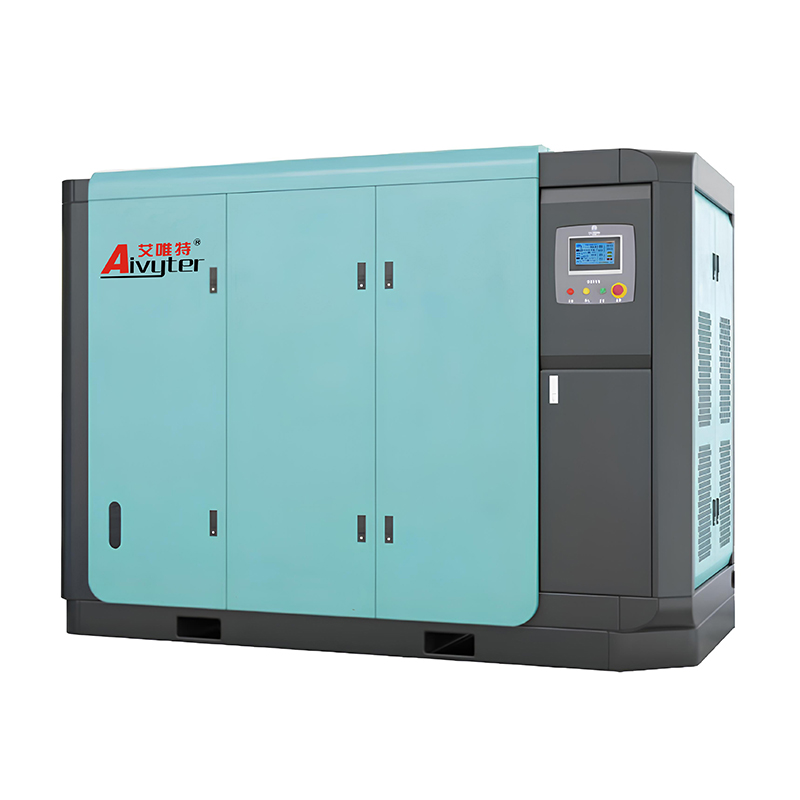
Manufacturers like Aivyter offer modular packages where the dryer section can be selected based on application PDP requirement, allowing the same base compressor to serve different site conditions.
Key Technical Parameters for Selecting a Screw Compressor With Dryer for Heavy-Duty Sites
Engineering managers must evaluate these parameters beyond simple flow and pressure ratings:
- Ambient temperature range: Sites in desert, arctic, or tropical conditions affect both compressor efficiency and dryer performance. Refrigerated dryers lose capacity above +45°C ambient; below +2°C, condensate can freeze in the dryer. For extreme ambient, a desiccant dryer with heated regeneration or an external shelter is necessary.
- Inlet air filtration: Mining and construction sites have high concentrations of silica dust, coal dust, or cement particles. Two-stage air intake filters (cyclone pre-separator + primary filter element) with efficiency rating MERV 15 or higher extend air-end life. Differential pressure monitoring alerts for filter change.
- Pressure dew point (PDP) requirement:
- +3°C to +10°C PDP: Sufficient for workshop air, impact wrenches, rock drills (above freezing conditions).
- -20°C PDP: Required for overhead piping in unheated buildings or tunnels where ambient can drop below 0°C.
- -40°C PDP: Mandatory for outdoor pipelines in winter climates (e.g., northern mining sites) and for instrument air used in electronic controls.
- Integrated or downstream dryer: A true screw compressor with dryer may have the dryer mounted on the same tank or frame, reducing pressure drop and installation footprint. Separated dryers add flexibility but require interconnecting piping and additional pressure drop (0.2-0.4 bar), which increases energy consumption.
- Lubricant selection: Food-grade or standard mineral oil? For mining with potential contamination of water discharge, biodegradable lubricants may be specified. The dryer section must handle any oil carryover — coalescing filters (0.01 ppm residual oil) are standard before desiccant dryers to prevent adsorbent fouling.
Industry-Specific Applications and Pain Points Addressed
Underground mining and tunneling
In underground operations, compressed air powers roof bolters, jumbo drills, and ventilation control dampers. Challenges include high humidity (often 90-100% RH at intake), confined spaces, and strict noise limits. A screw compressor with dryer in a flameproof or explosion-proof enclosure (ATEX / MSHA) with a desiccant dryer set to -40°C PDP prevents ice blockages in long horizontal pipes where condensate can freeze. Maintenance access is simplified when the dryer is integrated on the same skid — no additional floor space required.
Large-scale construction (road, dam, and bridge projects)
Mobile compressor fleets move every few weeks. Integrated screw compressor with dryer configurations reduce setup time and component loss. For jackhammer and pavement breaker applications, a refrigerated dryer (+5°C PDP) is sufficient. However, when site offices use compressed air for pneumatic controls, a small desiccant dryer on a branch line provides instrument-grade air without affecting the main flow.
Industrial manufacturing in dusty environments (cement, aggregate, foundries)
Air compressors placed near crushers or mills ingest abrasive dust. Pre-filtration is critical. A rotary screw compressor with integrated dryer and a high-efficiency particle filter (1 micron) after the dryer ensures that pneumatic conveying lines do not suffer from clogging due to wet dust adherence. The dryer’s condensate drain — electronic or timer-controlled — must resist blockage from sludge.
Aivyter provides site configuration support to match dryer type, filtration grade, and compressor displacement to specific dust loads and operating hours.
Operational Considerations: Maintenance and Reliability
To maintain performance of a screw compressor with dryer in remote or harsh environments, facility engineers should implement:
- Daily checks: Condensate drain operation (no clogging), filter differential pressure, oil level, and dryer dew point reading (if equipped with a display).
- Weekly: Inspect aftercooler and dryer heat exchanger fins for dust accumulation. For desiccant dryers, verify that regeneration cycles complete and that outlet air has no desiccant dust (check downstream particle filter).
- Quarterly: Replace coalescing pre-filter elements on desiccant dryers (typically 1,000-2,000 hours). Sample lubricant for water contamination — integrated systems with high PDP may still see some moisture if aftercooler is undersized.
- Annual overhaul: Air-end bearing condition check via vibration analysis, dryer valve rebuilds (pneumatic or solenoid actuated), and pressure vessel inspections per local codes.
A common failure mode is bypassing the dryer during low demand periods. Integrated controllers should lock out bypass valves or provide alarms. Some packages include a dew point sensor that automatically diverts flow through the dryer if moisture exceeds setpoint.
Selection Checklist for Procurement Engineers
- Required free air delivery (FAD) at specified pressure (e.g., 10 m³/min at 7 bar).
- Maximum and minimum ambient temperatures at installation site.
- Pressure dew point requirement (based on lowest expected pipe temperature).
- Electrical supply: voltage, phase, frequency, and motor starting method (DOL or star-delta). For mobile units, diesel engine drive with integrated dryer control.
- Physical footprint and weight for skid mounting or containerization.
- Noise limit — underground mining often requires <85 dB(A) at 1m.
- Remote monitoring capability: MODBUS, CAN, or relay outputs for site SCADA.
Need a screw compressor with dryer engineered for your specific operational conditions? The technical team at Aivyter assists with application reviews, dew point calculations, and filtration design. Submit an inquiry to receive a configuration proposal and specification sheet tailored to your project.
Frequently Asked Questions (FAQs)
Q1: What is the typical pressure dew point achieved by a refrigerated dryer integrated with a screw compressor?
A1: A properly sized refrigerated dryer delivers a pressure dew point (PDP) of +3°C to +10°C at full flow. This is suitable for ambient temperatures above freezing. For any application where compressed air pipes pass through areas below 0°C, a desiccant dryer is required.
Q2: Can a screw compressor with dryer operate in ambient temperatures above 45°C?
A2: Yes, but with modifications. Refrigerated dryers lose capacity above +45°C ambient; high-temperature options (designed for +55°C) are available. Desiccant dryers are less affected by ambient heat, but the compressor itself requires adequate ventilation and possibly a larger aftercooler. Consult the manufacturer’s ambient derating curves.
Q3: How does an integrated dryer affect the overall energy consumption of the compressed air system?
A3: A refrigerated dryer adds about 5-8% to the total power consumption of the compressor skid. A heatless desiccant dryer consumes 12-18% of the compressor’s rated flow as purge air, which increases running hours. For large systems, a heated desiccant or blower-purge dryer reduces purge loss to 5-7% but adds electrical heater power. The integrated configuration can be more energy-efficient than separate dryers because piping pressure drops are minimized.
Q4: What maintenance intervals are typical for the dryer section of a screw compressor with dryer?
A4: For refrigerated dryers: clean condenser coils every 500 hours in dusty environments; replace dryer filter elements annually. For desiccant dryers: change pre-filters every 1,000-2,000 hours; desiccant beads last 1-3 years depending on oil carryover and humidity load. Electronic condensate drains should be serviced every 6 months.
Q5: Can a screw compressor with dryer be used for breathing air applications in construction or mining?
A5: No, not without additional treatment. Standard integrated dryers remove water but not carbon monoxide, oil vapor, or other contaminants. Breathing air requires a dedicated purification system including CO monitoring, catalytic converters, and high-efficiency activated carbon filters. Use certified breathing air compressors only.
© Technical Resource for Industrial Compressed Air. For project-specific inquiries and engineering support, contact Aivyter application engineers.
about
Aivyter
We provides trusted air compressors and mining equipment, engineered for durability, efficiency, and demanding industrial applications.