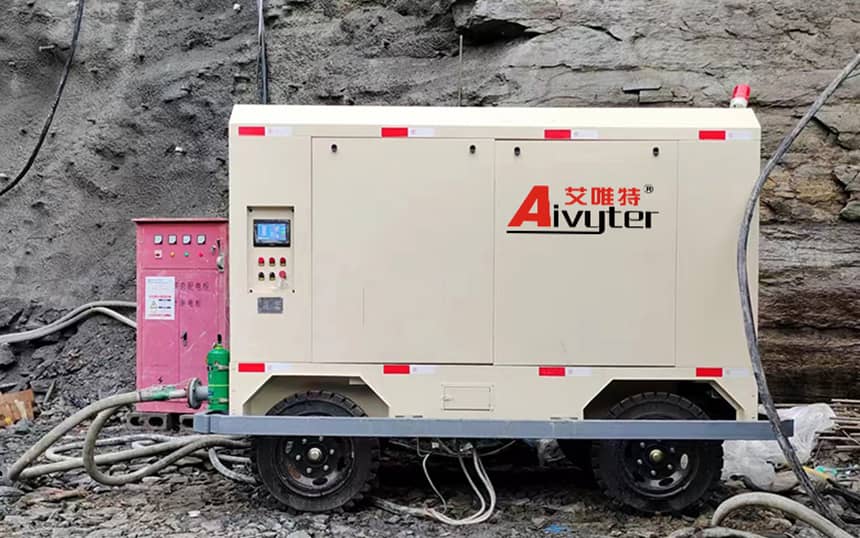
In off-grid industrial operations, construction sites, mining facilities, and utility maintenance, access to reliable electrical grid infrastructure is rarely guaranteed. In these environments, heavy-duty pneumatic equipment relies on autonomous power generation. Selecting an industrial diesel air compressor requires a systematic evaluation of thermodynamic performance, volumetric efficiency, engine fuel curves, and site-specific operational parameters.
Mismatched compressed air equipment leads to operational inefficiencies, severe fuel waste, accelerated mechanical wear, and unscheduled downtime. This guide breaks down the engineering fundamentals, application sizing criteria, total cost of ownership (TCO) calculations, and preventative maintenance strategies necessary to optimize high-pressure mobile air delivery systems.
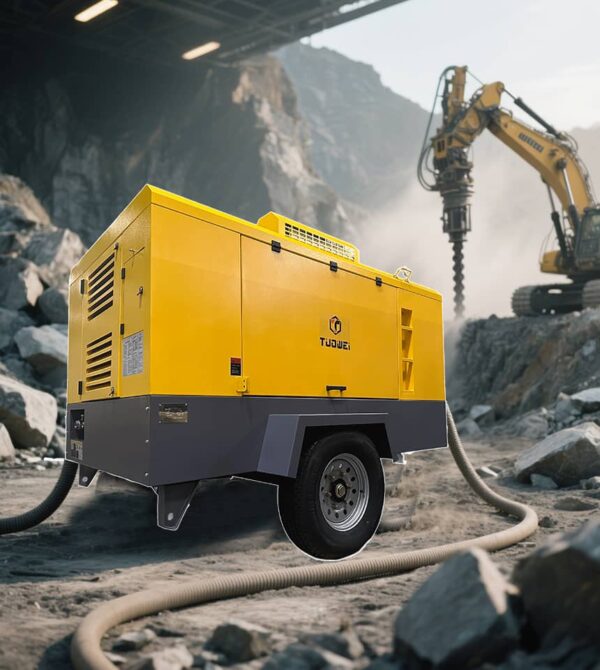
Technical Classification: Rotary Screw vs. Reciprocating Compressors
The core compressing mechanism dictates performance characteristics, thermal limits, and maintenance cycles under continuous heavy load.
1. Diesel Rotary Screw Air Compressors
Rotary screw configurations represent the industry standard for medium-to-high airflow requirements (above 100 CFM or 3 m³/min). The system utilizes two meshing helical rotors (male and female) housed within a precision cylinder to progressively reduce the volume of trapped air.
- Duty Cycle: 100% continuous operation without thermal degradation.
- Airflow Output: Delivers non-pulsating, stable volume ranging from 100 CFM to over 1,500 CFM (3 to 45 m³/min).
- Mechanical Vibration: Extremely low rotational imbalance, reducing structural stress on chassis trailers.
- Efficiency: High volumetric efficiency powered by direct-drive or gearbox coupling to the diesel engine.
For heavy industrial applications, the rotary screw diesel air compressor delivers continuous airflow without duty-cycle restrictions, making it ideal for sandblasting, deep-hole drilling, and large-scale pneumatic tooling.
2. Diesel Reciprocating (Piston) Air Compressors
Reciprocating compressors utilize a crankshaft-driven piston inside a cylinder to compress air. Air intake and discharge are regulated by reed or ring valves.
- Duty Cycle: Intermittent duty (typically 60/40 duty cycle) to allow air-cooled thermal dissipation.
- Airflow Output: Low-to-medium airflow (typically under 100 CFM / 3 m³/min).
- Pressure Capabilities: Capable of achieving high pressures in multi-stage configurations at low volumetric flow rates.
- Primary Applications: Service trucks, emergency tire inflation, and small-scale intermittent pneumatic tool usage.
Core Engineering Parameters: Beyond Basic CFM and PSI
Accurate sizing requires quantifying four crucial mechanical parameters to ensure the air plant handles instantaneous load spikes while minimizing idle fuel consumption.
Free Air Delivery (FAD) Calculation
Free Air Delivery (FAD) measures the actual volume of air compressed and discharged, converted back to ambient inlet air conditions (temperature, pressure, and humidity). Buying based on theoretical displacement rather than rated FAD leads to underpowered operations.
- Step 1: Sum the maximum concurrent CFM requirement of all connected pneumatic tools.
- Step 2: Apply an operational load factor (typically 1.20 to 1.35) to account for simultaneous usage peaks, tool wear, and system leakage.
- Step 3: Calculate pipeline distribution losses (add 0.1 to 0.2 bar / 3-5 PSI per 30 meters of distribution hose).
Calculating the net required volume before investing in a high-capacity diesel air compressor ensures operational stability during peak load conditions.
Environmental Derating Factors
Diesel engine horsepower and air inlet density decline at elevated altitudes and extreme ambient temperatures. Standard factory ratings are calibrated to ISO 1217 standards (20°C, 1 bar, 0% relative humidity).
- Altitude Derating: Diesel engines lose approximately 3% of rated power per 300 meters (1,000 feet) above 1,000 meters elevation due to lower air density.
- Ambient Temperature Derating: Internal engine and intercooler efficiencies drop by roughly 1% for every 5°C increase above 40°C.
- High-Altitude Mining Package: Requires two-stage turbocharging or electronic variable-speed control to compensate for atmospheric pressure loss.
Application-Specific Selection Matrix
Selecting the correct operating pressure (bar/PSI) and discharge treatment depends heavily on the end-use process.
1. Construction and Demolition
- Target Parameters: 7 to 10 bar (100–145 PSI); 175 to 600 CFM (5–17 m³/min).
- Primary Uses: Paving breakers, rock drills, shotcrete sprayers, and handheld pneumatic tools.
- Key Features: Towable trailer chassis, heavy-duty bump guards, and mechanical speed governors for rapid throttle response.
2. Geological Drilling and Mining
- Target Parameters: 17 to 35 bar (246–507 PSI); 750 to 1,300 CFM (21–37 m³/min).
- Primary Uses: Down-the-Hole (DTH) drilling, rotary blast hole drilling, and subterranean ventilation.
- Key Features: Two-stage rotary screw air-ends, heavy-duty dual-stage air intake filters, and high-pressure oil separation manifolds.
3. Abrasive Sandblasting and Surface Preparation
- Target Parameters: 8.6 to 12 bar (125–175 PSI); 375 to 900 CFM (10.5–25.5 m³/min).
- Primary Uses: High-velocity media blasting, pipe coating preparation, and shipyard maintenance.
- Key Features: Built-in aftercoolers and water separators. Moisture in sandblasting air causes media clogging and equipment corrosion; discharge air dew point must be controlled via integrated heat exchangers.
Total Cost of Ownership (TCO) Analysis
Initial purchase cost represents only 15–20% of a diesel air compressor’s lifecycle expenditure over 5,000 operating hours. Fuel consumption constitutes the largest ongoing expense, accounting for up to 70% of TCO.
Manufacturers like Aivyter engineer systems with optimized rotor profiles and electronic load matching, significantly lowering operational costs over the unit’s service life.
- Fuel Economy Curves: Modern engines operating with Electronic Control Units (ECUs) automatically match engine RPM to air demand via stepless load regulation, cutting idle fuel burn by 15% to 25%.
- Emissions Compliance: EU Stage V / US Tier 4 Final / China IV engines utilize Diesel Particulate Filters (DPF) and Selective Catalytic Reduction (SCR) to lower emissions, requiring high-grade ultra-low sulfur diesel (ULSD) and DEF fluid management.
- Resale Value and Frame Rigidity: Galvanized, powder-coated steel enclosures protect internal components against salt spray and impact, retaining capital asset value over long service lifespans.
Evaluating modern diesel air compressor options on a fuel-per-m³ basis reveals significant long-term savings over lower-cost, unmanaged mechanical units.
Preventative Maintenance Protocol and Operational Reliability
Strict maintenance schedules prevent premature air-end failure and engine seizure under harsh environmental conditions.
- Daily Checks (Pre-Start Routine): Inspect engine oil level, compressor oil sight glass, coolant levels, air filter restriction indicators, and drain condensate from air receiver tanks.
- 500-Hour Service Interval: Replace engine oil, engine oil filter, fuel primary and secondary filters, and compressor fluid filters. Clean radiator cooling fins with compressed air or low-pressure water wash.
- 2,000 to 3,000-Hour Service Interval: Replace the air-oil separator element. Oil carryover should remain below 3 PPM (parts per million); elevated oil carryover indicates separator saturation or thermal degradation of the compressor fluid.
- Extreme Cold Operations: Install 24V cold-start packages, block heaters, and synthetic low-viscosity compressor lubricants designed for sub-zero flowability.
High-efficiency systems designed by Aivyter feature integrated multi-stage filtration to prevent dust ingress from destroying screw rotor tolerances in desert and mining installations.
Frequently Asked Questions
What causes elevated oil consumption in a diesel air compressor?
High oil consumption (oil carryover into the discharged air) is typically caused by a saturated or damaged air-oil separator element, an obstructed oil return/scavenge line, operating the unit below rated pressure, or overfilling the compressor oil sump.
Why is Free Air Delivery (FAD) preferred over displacement CFM?
Displacement CFM measures theoretical volume based purely on cylinder or rotor dimension multiplied by speed, ignoring thermal expansion, pressure losses, and mechanical clearances. FAD measures actual usable compressed air delivered under specific inlet conditions, making it the accurate metric for sizing tools.
Can a diesel air compressor run continuously at zero load?
Prolonged idling at zero air load leads to engine “light-loading” or “wet stacking”—unburned fuel building up in the engine exhaust system. Modern units utilize automatic auto-start/stop or electronic speed modulation to reduce engine RPM to idle while venting air-end pressure.
How does altitude impact high-pressure drilling compressors?
At high altitudes, thinner air reduces air mass intake into both the diesel engine and the compressor air-end. This results in reduced engine horsepower output and lower discharged CFM. High-altitude operations require oversized engine displacement or turbo-charged altitude compensation packages.
What is the difference between single-stage and two-stage rotary screw air-ends?
Single-stage air-ends compress atmospheric air to final working pressure in one step, ideal for pressures up to 10 bar (145 PSI). Two-stage air-ends split compression across two successive rotor sets with inter-stage cooling, drastically improving energy efficiency and mechanical reliability at pressures above 14 bar (200 PSI).
Optimize Your Field Operations with Industrial Compressed Air Solutions
Selecting the ideal compressed air plant requires balancing working pressure, air delivery rates, fuel efficiency, and ambient durability. Choosing an engineered system tailored to your specific application prevents downtime and maximizes daily site yield.
Consult with Aivyter application specialists today to analyze your site parameters, configure custom chassis setups, and receive technical specifications for your next heavy-duty project.
about
Aivyter
We provides trusted air compressors and mining equipment, engineered for durability, efficiency, and demanding industrial applications.