Mining at depths exceeding 1,000 meters or operating at high altitudes exposes machinery to intense structural stress. Standard catalog machinery rapidly breaks down under these loads. Equipment failures stall production cycles, run up massive repair expenses, and risk crew safety.
Selecting the right equipment partner requires looking past generic product brochures. You need an engineering partner that builds machines specifically for high-stress rock mechanics, sweltering ambient temperatures, and confined drifts. Manufacturers like Aivyter design customized drill packages tailored to these harsh geological environments.
Are you planning to upgrade your fleet or tackling a challenging geological deposit? Contact our technical team today to request a custom rig assessment and an operational readiness audit.
Defining Extreme Underground Mining Conditions
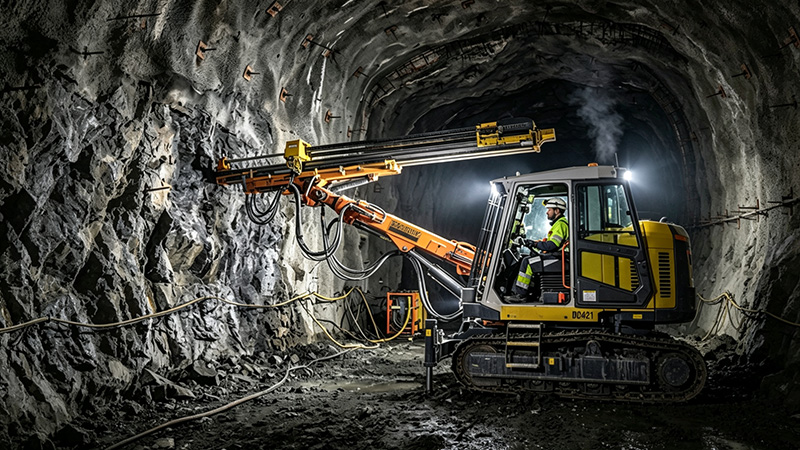
Mining operations rarely face ideal conditions. When geological and environmental factors cross specific thresholds, standard equipment quickly becomes unreliable.
True extreme conditions involve several compounded operational challenges:
- Extreme Rock Hardness: Formations with a Protodyakonov hardness scale rating above f=12 or f=14, particularly high-quartzite ores, rapidly wear down standard drill rods and drill heads.
- High Geothermal Gradients: Virgin rock temperatures exceeding 45°C stress hydraulic cooling units and degrade electronic components.
- Confined Working Profiles: Narrow vein deposits require equipment that can turn sharply within cross-sections smaller than 2.5 x 2.5 meters.
- High Ground Stress and Rockburst Risk: Seismic energy in deep-level shafts demands reinforced operator shelters and fast bolting cycles.
- Corrosive Water Inflow: Saline or acidic mine water quickly corrodes electrical harnesses, hydraulic cylinder rods, and chassis joints.
Why the Manufacturer Matters More Than the Spec Sheet
On paper, many underground mining jumbos look identical. They list comparable percussion outputs, engine ratings, and feed lengths. However, spec sheets hide the differences in steel selection, hydraulic circuit engineering, and practical service layouts.
An assembly plant merely bolts third-party sub-assemblies onto a purchased chassis. In contrast, an authentic underground drill rig manufacture specialist engineers the structural dynamics from the ground up. They understand how torsional vibration moves from the drill bit through the boom and into the center articulation joint.
Choosing a dedicated underground drill rig supplier for hard rock mining ensures your machinery can absorb intense operational shocks. A true manufacturer will customize structural geometry, design heat-dissipation systems, and adapt drilling hydraulics to match your mine’s exact rock mechanics.
Evaluating Engineering and Customization Capabilities
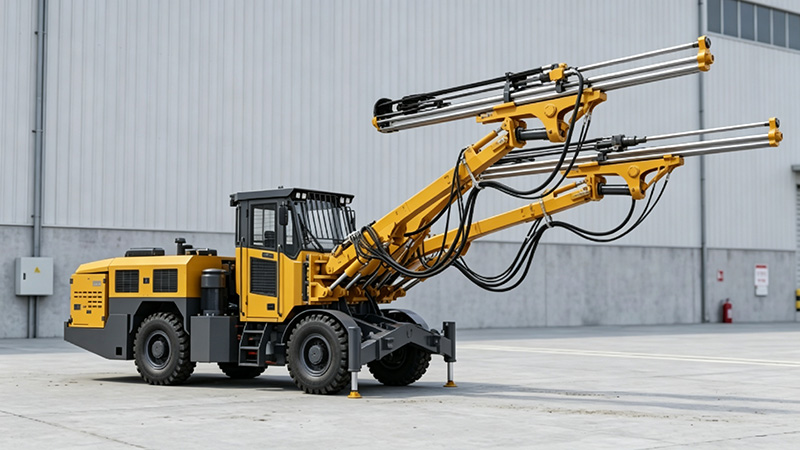
Off-the-shelf equipment rarely delivers peak performance in deep-level mines or complex deposits. When screening manufacturers, examine their ability to build a custom underground drilling jumbo suited to your specific site parameters.
Power System Adaptation and Heat Management
Heat dissipation is a critical failure point in deep underground mines. Standard air-cooled engines often overheat when ambient drift temperatures climb past 40°C. You must evaluate how the manufacturer keeps fluids within safe working limits.
Top-tier builders provide heavy-duty water-cooled packages or oversized multi-core radiators designed for ambient air choked with drill dust. Furthermore, investigate their Battery Electric Vehicle (BEV) and electric-hydraulic options. Electric rigs generate virtually zero diesel emissions and minimal waste heat, which significantly lowers your underground ventilation costs.
Chassis Integrity and Structural Steel Grade
Extreme percussion drilling causes high-frequency stress fractures in low-grade steel. Ask the engineering team what materials they use in their chassis and boom fabrications. Leading manufacturers like Aivyter build high-stress areas using high-yield structural steel, such as Hardox or Weldox plates.
Look closely at boom designs. Heavy box-section boom profiles with induction-hardened pivot pins and oversized bronze bushings prevent joint slop. This structural stiffness preserves drilling accuracy, prevents rod jamming, and extends the operational life of your consumables.
Narrow Vein Mobility and Footprint Optimization
Vein mining demands compact footprints without sacrificing drilling stability. As a result, you should verify if the narrow vein drilling equipment manufacturer uses heavy-duty, center-articulated oscillating chassis designs.
A short turning radius and minimal outer clearance allow operators to tram safely through tight declines. Check that vulnerable parts like steer cylinders, brake lines, and transfer cases sit recessed within the frame structure to prevent impact damage against drift walls.
Scrutinizing Core Mechanical and Hydraulic Components
Extreme mining conditions quickly expose weak spots in sub-assemblies. A single blown hydraulic hose or cracked drifter body stops the entire extraction cycle.
The Drifter (Rock Drill): Proprietary vs. Sourced
The rock drill is the productive core of the machine. You need to know if the manufacturer designs their own rock drills or sources them from independent suppliers.
If they build their own drifters, evaluate their heat-treatment processes and dampening systems. Effective dual-damping mechanisms absorb reflected shock waves from ultra-hard rock faces. This protection prevents recoil energy from damaging internal seals, the drill feed, and the supporting boom joints.
If the manufacturer integrates third-party rock drills, confirm they have established genuine supply lines for parts. The drifter mounting plates, hydraulic flow lines, and lubricating circuits must match the chosen drill head perfectly. Avoid manufacturers that alter basic hydraulic flows to make unmatched components work together.
Hydraulic Component Architecture
Custom hydraulic manifolds offer far better field reliability than maze-like networks of loose hoses. Check that the manufacturer uses high-pressure pumps and proportional valves from trusted global brands like Bosch Rexroth, Danfoss, or Parker.
Standardizing key hydraulic components simplifies inventory management. More importantly, it guarantees the hydraulic valves can handle continuous 250-bar working pressures without blowing internal spool seals when oil viscosity drops in hot drifts.
Safety Compliance and Underground Automation
Personnel safety is non-negotiable. Deep-level mining operations face unpredictable rockbursts and unstable roofs. The way a manufacturer handles safety compliance reveals their engineering priorities.
Cabin Certification: FOPS / ROPS Standards
Never consider an underground rig without verified ISO certifications. The operator cabin or protective canopy must hold verified FOPS (Falling Object Protective Structures) and ROPS (Roll-Over Protective Structures) certifications under ISO 3449 and ISO 3471.
For deep, high-stress operations, look for enclosed, noise-attenuated, and climate-controlled cabins. Cabins with active carbon air filtration protect operators from diesel soot and silica dust, while vibration-dampened sub-frames prevent driver fatigue over long shifts.
Teleremote Control and Autonomous Drilling
The safest way to drill through unstable geological zones is to remove the operator from the unsupported face entirely. Check whether the manufacturer supports line-of-sight radio remote control or digital teleremote operation from a surface control room.
Advanced manufacturers equip their rigs with semi-autonomous drilling systems. These packages use hole-depth instrumentation, anti-jamming automation, and pre-programmed drilling patterns. These digital controls yield straighter blast holes, reduce drill string wear, and eliminate over-break in your stopes.
Total Cost of Ownership, Field Reliability, and After-Sales Support
The initial purchase price accounts for only a fraction of an underground rig’s total lifecycle cost. Production losses caused by missing replacement parts will quickly eclipse any upfront savings on equipment price.
Deep-level mining equipment reliability depends directly on the speed of maintenance support. When screening builders, focus on their field maintenance infrastructure:
- SLA for Critical Spares: What is their guaranteed dispatch timeline for high-wear components like feed slides, hydraulic seals, rotation motors, and drifter spare kits?
- Field Service Dispatch: Can the manufacturer send certified mechanical and electrical field engineers to remote mine locations on short notice?
- MTBF and MTTR Data: Demand operational data demonstrating Mean Time Between Failures (MTBF) and Mean Time To Repair (MTTR) achieved in actual hard-rock mines.
- Technical Training Programs: Does the supplier provide structured, on-site commissioning and training for your local operators and maintenance staff?
Reputable firms offer deep mining jumbo manufacturer after-sales support. They help you build on-site consignment spare parts inventories, ensuring you have the right components stored right at your drift head.
The Extreme Mining Due Diligence Checklist
Before issuing a formal tender or signing a purchase contract, guide your technical team through this evaluation matrix:
| Verification Area | Key Requirement to Audit | Pass / Fail Criteria |
|---|---|---|
| Structural Integrity | High-tensile steel plates used in high-stress chassis and boom areas | Verified steel certifications (e.g., Hardox equivalent) |
| Cooling Capacity | Oversized hydraulic coolers and auxiliary water heat-exchangers | Continuous operation validated at >45°C ambient air |
| Hydraulic Reliability | Closed-loop, load-sensing variable displacement piston pumps | Standardized Tier-1 valves (Danfoss, Rexroth, etc.) |
| Drifter Technology | Dual-damping shock protection systems | Demonstrated performance in f>12 hardness ground |
| Safety Standards | Certified protective operator structures | Current ISO 3449/3471 compliance certificates |
| Factory Testing | Full-load factory acceptance testing before shipping | Documented dynamic hydraulic and pressure test logs |
Making the Final Decision
Procuring underground drilling machinery for extreme mining conditions is a long-term strategic partnership. A low purchase price often hides poor engineering choices that lead to persistent breakdowns, expensive consumable wear, and dangerous face conditions.
Prioritize manufacturers that run active engineering departments, utilize verified structural materials, and maintain dependable field service networks. Suppliers like Aivytercombine rugged chassis designs with proven hydraulic components, keeping your mining cycles on schedule under severe underground conditions.
Contact our mining engineering team today to discuss your site challenges, review technical schematics, or request a fast-response quotation for your next drill rig fleet.
Frequently Asked Questions (FAQ)
Q1: Why do standard surface or soft-rock underground drill rigs fail in deep hard-rock mines?
A1: Deep hard-rock mines present high ground stresses, abrasiveness from quartz-heavy rock, and high ambient temperatures. Standard rigs lack the high-yield structural steel required to absorb severe vibrational shock, and their standard cooling packages overheat quickly. This mismatch causes frame cracking, premature hydraulic seal failure, and frequent drifter breakdowns.
Q2: How does rock hardness (f-rating) influence the selection of an underground drill rig?
A2: Formations with an f-rating above 12 demand drifters with high-frequency percussion and advanced dual-damping mechanics. Without balanced dampening, high-energy shock waves rebound back through the feed cradle and boom assembly. This rebound damages internal components, shears mounting bolts, and dramatically accelerates wear on the drill string.
Q3: Should I choose a Battery Electric Vehicle (BEV) or diesel-hydraulic rig for deep mining?
A3: If your mine experiences high ambient temperatures and limited ventilation airflow, electric or BEV rigs offer huge advantages. They produce zero diesel particulate emissions and emit far less waste heat. However, if your electrical infrastructure is constrained or you need frequent tramming across distant declines, diesel-hydraulic rigs remain the more practical operational choice.
Q4: What role does drill boom rigidity play in reducing operating costs?
A4: Stiff, well-engineered boom profiles prevent mechanical deflection during hole collaring. A flexing boom causes blast holes to deviate from the planned drill pattern. This deviation leads to uneven fragmentation, dangerous undercuts, loose roof profiles, and unnecessary damage to drill rods and couplings.
Q5: What is the typical lead time for a custom underground drilling jumbo?
A5: Manufacturing timelines for customized underground drill rigs generally span from 16 to 28 weeks, depending on the required level of customization. Lead times depend on specific boom extensions, custom chassis dimensions, specialized cooling options, and automated tele-remote system integrations. Plan your procurement cycle well ahead of your drift development milestones.
about
Aivyter
We provides trusted air compressors and mining equipment, engineered for durability, efficiency, and demanding industrial applications.