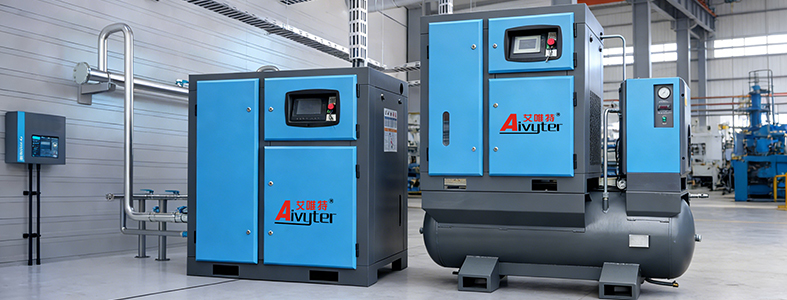
In mining, tunnel construction, pipeline maintenance, and quarrying, access to a reliable compressed air source often determines project pace. Unlike stationary plants, an industrial air compressor portable must deliver consistent pressure and volume across varying altitudes, ambient temperatures, and duty cycles – all while withstanding dust, vibration, and transport over rough terrain. Selecting the wrong unit leads to pressure drops, tool inefficiency, and unplanned downtime. This technical reference covers compressor types (rotary screw vs. reciprocating), cfm/psi requirements for pneumatic tools, fuel consumption data, and maintenance strategies. Aivyter has deployed over 3,000 portable units across six continents; this guide aggregates field data to help engineers and fleet managers make evidence-based decisions when procuring an industrial air compressor portable.
1. Defining the Portable Industrial Air Compressor: Key Parameters
An industrial air compressor portable is typically a diesel-driven rotary screw unit mounted on a two- or four-wheel chassis with towing provisions. Critical performance metrics include:
- Free air delivery (FAD) – Measured in cfm (cubic feet per minute) or m³/min at a reference pressure (typically 100 psig / 7 bar). Units range from 100 cfm to 1,600 cfm for heavy civil works.
- Operating pressure – 100–150 psig for most construction tools; high-pressure variants (up to 350 psig) for water well drilling or jetting.
- Duty cycle – Industrial units are rated for 100% continuous operation at ambient up to 45°C.
- Fuel tank capacity – Typically 100–300 liters, providing 8–24 hours of runtime at full load.
- Noise level – Sound pressure at 7 m should be ≤ 80 dBA for site compliance (OSHA / EU directives).
Selecting an industrial air compressor portable begins with calculating total cfm demand: sum the air consumption of all tools likely to operate simultaneously, then add 20–30% for leakage and future expansion. For a fleet of five rock drills consuming 80 cfm each, a 500–600 cfm unit is appropriate. Aivyter provides a free air demand worksheet with each consultation.
2. Technology Comparison: Rotary Screw vs. Reciprocating Portable Compressors
Two technologies dominate the industrial air compressor portable market. The choice affects maintenance frequency, pulsation, and initial cost.
2.1 Oil-Injected Rotary Screw (Most Common)
Uses two intermeshing rotors to compress air continuously. Advantages:
- 100% duty cycle, minimal pulsation – ideal for sandblasting and continuous drilling.
- Higher efficiency at full load: specific power 18–22 kW/(m³/min).
- Longer service intervals (1,000–2,000 hours between oil changes).
Disadvantages: Higher initial cost; requires periodic oil analysis. Most heavy-duty industrial air compressor portable units use rotary screw technology.
2.2 Reciprocating (Piston) Portable
Fewer moving parts, lower first cost for small cfm (<150 cfm). Suitable for intermittent use (e.g., tire inflation, light demolition). Limits:
- Duty cycle typically 50–60% (requires cooldown periods).
- Higher vibration and pulsation – can damage sensitive downstream equipment.
- Shorter maintenance intervals (250–500 hours).
For continuous industrial applications, rotary screw is strongly preferred.
3. Industry Pain Points and Engineering Solutions for Portable Compressors
Even robust industrial air compressor portable systems face recurring field failures. Below are four documented issues with root causes and countermeasures.
3.1 Overheating in High-Ambient or High-Altitude Sites
Compressor discharge temperatures exceeding 110°C trigger automatic shutdown. Causes: undersized cooling package, clogged radiator, or altitude derating (air density drops 3% per 300 m above sea level). Solutions:
- Specify a unit with a large finned-tube cooler and electric fan (not belt-driven) for reliable airflow at low engine RPM.
- For altitudes >1,500 m, request a high-altitude kit (adjusted fuel injection and compressor airend ratio).
- Implement daily radiator cleaning using compressed air (reverse blow).
Field data: A 750 cfm industrial air compressor portable operating at 2,500 m elevation loses 18% of its cfm capacity unless derated. Aivyter units include a derating chart on the control panel.
3.2 Excessive Oil Carryover in Discharge Air
Oil content >5 ppm contaminates downstream tools, clogs aftercoolers, and stains surfaces. Common causes: worn separator element, overfilling oil, or operating at low load for extended periods. Mitigation:
- Replace coalescing filter every 1,000 hours or when differential pressure exceeds 0.8 bar.
- Maintain oil level at the midpoint of sight glass; never overfill.
- If unit idles >30% of the time, install a variable displacement (VSD) compressor to avoid low-load conditions.
A well-maintained industrial air compressor portable from Aivyter achieves residual oil content <3 ppm, meeting ISO 8573-1 Class 3.
3.3 Fuel Contamination and Injector Plugging
Diesel-powered portable compressors operating in dusty environments often suffer fuel tank condensation and algae growth, leading to injector failure. Prevention:
- Specify a water-separating fuel filter (10 µm + 2 µm stages).
- Add biocide treatment to bulk fuel storage.
- Drain fuel tank sump weekly.
Telemetry-equipped units can alert operators when water level in the fuel/water separator reaches 50%.
3.4 Towing and Undercarriage Damage on Rough Terrain
Many industrial air compressor portable units suffer axle bending, tire sidewall cuts, or frame cracks when pulled over unimproved roads. Solutions:
- Choose units with heavy-duty leaf springs (rated for 1.5× gross weight), 16-ply tires, and a reinforced drawbar.
- Add a shock-absorbing hitch (pintle hook with rubber isolator).
- For extremely rough sites (mining haul roads), specify a skid-mounted unit that is loaded/unloaded by crane rather than towed.
Aivyter offers an off-road package with 50 mm raised ground clearance, rock guards, and a telescopic drawbar.
4. Technical Specifications: Selecting the Right Industrial Air Compressor Portable
When evaluating an industrial air compressor portable, request the following datasheet parameters:
- FAD at rated pressure – Ensure it is stated per ISO 1217 (inlet conditions 20°C, 1 bar). Beware of inflated “displacement” figures.
- Specific fuel consumption – g/kWh or liters per hour at full load. A modern Tier 4 Final engine should consume ≤ 220 g/kWh.
- Sound level – LpA at 7 m, with enclosure type (acoustic hood). For residential areas, request <75 dBA.
- Air outlet quality – Residual oil, particulate, and water dew point (ISO 8573-1 class).
- Cold start capability – Minimum ambient temperature for starting (with block heater option).
- Service intervals – Engine oil, compressor oil, air filter, separator element.
Aivyter provides a full technical dossier, including performance curves at varying altitudes, for each industrial air compressor portable model.
5. Application-Specific Configurations
Different industries require tailored features from an industrial air compressor portable. Below are common use cases.
5.1 Mining (Underground and Open Pit)
Requirements: High cfm (900–1,600 cfm) at 100–150 psi, flame-resistant components, and canopy design that allows for overhead lifting. Additional needs:
- Air intake pre-filter with automatic dust dump valve.
- Emergency shutdown on high exhaust temperature (for underground diesel use).
- 24V electrical system compatible with mine vehicle jump-start points.
Aivyter offers MSHA-compliant units for coal mining applications.
5.2 Pipeline and Cross-Country Construction
Mobile operations along pipeline right-of-ways demand towable units with high ground clearance and low center of gravity. Features:
- Dual-axle with braking system (air over hydraulic).
- Integrated tool storage boxes and hose reels.
- Remote monitoring via satellite (for fleet tracking).
Typical size: 600–900 cfm for running pneumatic boring tools and sandblasting equipment.
5.3 Well Drilling and Geothermal
Requires high-pressure variants (250–350 psig) to operate down-hole hammer drills. Additional considerations:
- Aftercooler and cyclone separator to reduce moisture for sensitive electronics.
- Fuel tank capacity for 24+ hours of continuous operation.
- Stainless steel piping to resist corrosion from drilling fluids.
For these applications, a single-stage oil-flooded screw industrial air compressor portable with pressure up to 350 psig is standard.
6. Fuel Economy and Total Cost of Ownership (TCO) Analysis
A higher-priced but fuel-efficient industrial air compressor portable often delivers lower TCO. Based on 2,000 annual operating hours and diesel at $1.10/liter:
| Model | FAD (cfm) | Fuel consumption (L/hr @ full load) | Annual fuel cost | 5-year fuel + maintenance cost |
|---|---|---|---|---|
| Standard efficiency (Tier 3) | 600 | 26 | $57,200 | $325,000 |
| High efficiency (Tier 4 Final, VSD) | 600 | 20 | $44,000 | $260,000 |
The high-efficiency unit saves $65,000 over five years, justifying a 20–30% higher purchase price. Aivyter provides a TCO calculator for each industrial air compressor portable proposal.
7. Maintenance Best Practices for Portable Compressors in Harsh Environments
To achieve 15,000+ operating hours before major overhaul, follow this schedule:
- Daily – Check oil level (compressor and engine), drain condensate from air receiver and fuel/water separator, inspect air filter restriction gauge.
- Weekly – Clean radiator fins and oil cooler core with compressed air. Grease towbar pivot and wheel bearings.
- Every 500 hours – Change engine oil and filter; replace fuel filter; inspect belts.
- Every 1,000 hours – Change compressor airend oil (if synthetic) and oil filter; replace air filter primary element; check safety valves.
- Every 2,000 hours – Replace separator element; inspect airend bearings (vibration analysis).
Remote fleet managers can use telematics (GPS + CAN bus) to schedule maintenance automatically. Aivyter units come with a standard telemetry gateway.
8. Case Study: Portable Compressor Fleet for a Mountain Tunnel Project
A civil contractor faced a 3 km tunnel through hard granite. They required four industrial air compressor portable units to power rock drills and ventilation fans. Site conditions: altitude 1,800 m, ambient temperature -5°C to 35°C, severe dust. Aivyter supplied 900 cfm Tier 4 Final units with high-altitude derating compensation and electric pre-heaters. After 18 months of operation:
- Average availability: 97.5% (downtime only for scheduled service).
- Fuel consumption: 18% lower than previous fleet (due to VSD on two units).
- Zero overheating incidents, even during summer peak.
The contractor standardized on Aivyter for all future remote projects. Detailed project data is available on request.
Frequently Asked Questions (FAQ) About Industrial Air Compressor Portable Systems
Q1: What cfm do I need for a jackhammer and two rock drills?
Q2: Can a portable compressor be used indoors or in confined spaces?
Q3: How do I reduce noise from a portable compressor on a residential jobsite?
Q4: What is the typical lifespan of a rotary screw portable compressor?
Q5: How to request a custom quotation for a portable compressor from Aivyter?
Need a rugged, fuel-efficient industrial air compressor portable for your next project? Aivyter engineers units with Tier 4 Final engines, high-capacity coolers, and telematics. Request a free sizing consultation, total cost of ownership analysis, and a demo unit evaluation. Fill out the form below to receive a customized proposal within one business day.
Send Portable Compressor Inquiry →
© 2026 Aivyter – Industrial air solutions. Performance data based on field tests and customer production records.
about
Aivyter
We provides trusted air compressors and mining equipment, engineered for durability, efficiency, and demanding industrial applications.