Core Technologies Driving Modern Industrial Air Compression
Three architectures dominate heavy-duty fixed and mobile applications: oil-injected rotary screw, oil-free centrifugal, and two-stage reciprocating designs. Each exhibits unique thermodynamic characteristics and maintenance footprints.
- Rotary screw air ends: Ideal for continuous 24/7 operation at 70–100% load. Typical discharge pressures 7–13 bar (g). Modern asymmetric rotor profiles reduce internal leakage, achieving specific power as low as 6.2 kW/(m³/min) at 8 bar.
- Oil-free centrifugal compressors: Required for processes demanding ISO 8573-1 Class 0 air (e.g., pneumatic instrumentation in sensitive electronics or food-grade adjacent zones in mining camps). They operate efficiently above 80% load but suffer from surge limitations below 40%.
- Two-stage reciprocating units: Still selected for high-pressure applications (25–35 bar) for blast hole drilling or water well development. Their intermittent duty cycle aligns with blasting patterns.
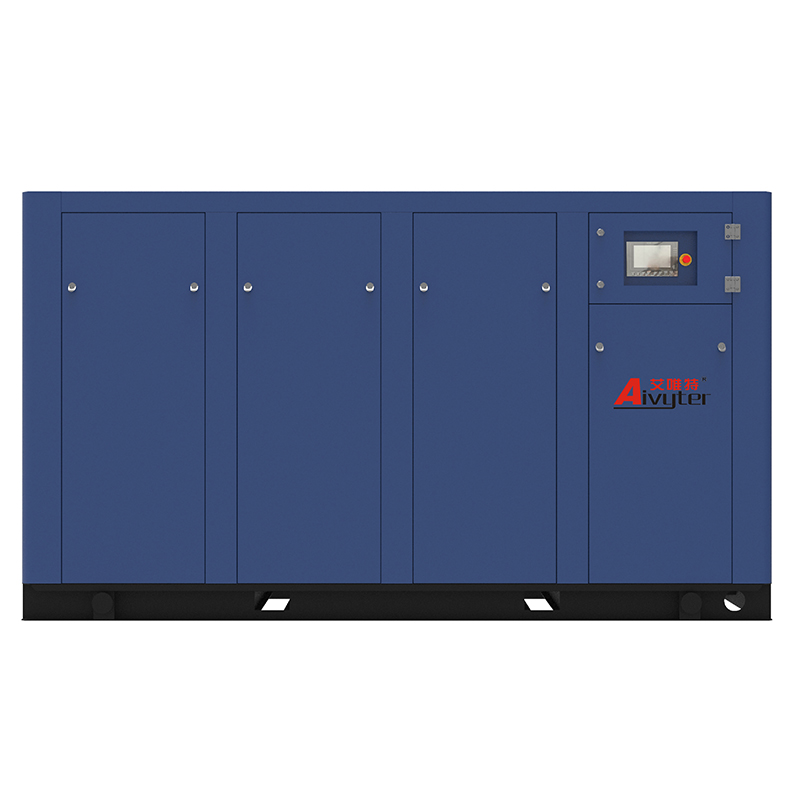
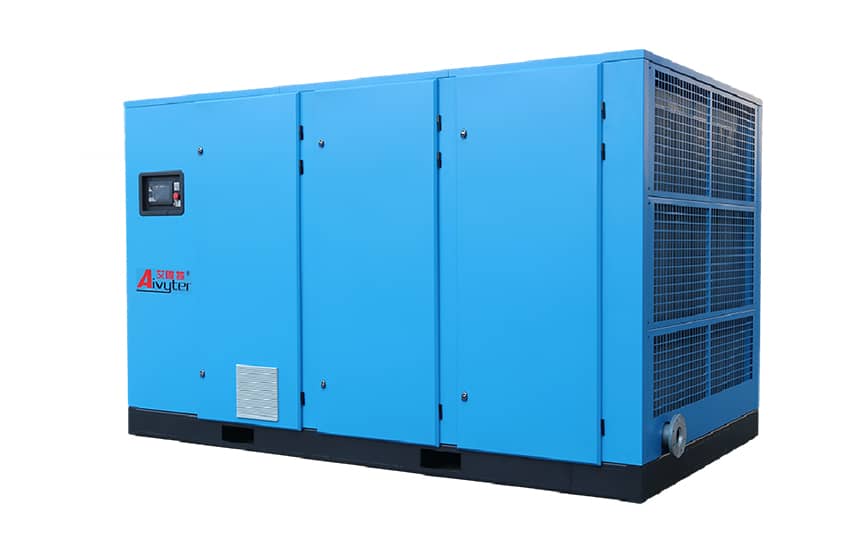
For most mining and tunneling operations, the industrial air machine compressor of choice is a variable frequency drive (VFD) rotary screw with a heavy-duty air intake filter (MERV 15 or higher) and an integrated refrigerant or desiccant dryer. This combination directly addresses the three leading failure modes: particulate ingestion, lubricant degradation from moisture, and energy waste during partial loads.
Key Performance Indicators for Heavy-Duty Applications
Before specifying any unit, engineers must define the following parameters, validated against site altitude and ambient temperature extremes:
- Free air delivery (FAD) at reference conditions (1 bar(a), 20°C, 0% RH) – corrected for site altitude. For every 1000m above sea level, output derates 3–4%.
- Pressure dew point (PDP) – mandatory for sub-zero environments or pneumatic control circuits. PDP of +3°C for general use, -40°C for outdoor instrumentation in winter climates.
- Residual oil content – for downstream processes like aeration tanks or abrasive blasting, oil carryover ≤ 0.01 ppm requires coalescing filters and activated carbon towers.
- Sound pressure level – underground mining restricts equipment to ≤ 85 dB(A) at 1m. Acoustic enclosures and low-speed fans become critical.
A well-specified industrial air machine compressor will include a sequenced controller that manages multiple units (lead/lag) to maintain discharge pressure within ±0.1 bar, reducing average load by 15–25% compared to fixed-speed single units.
Selecting an Industrial Air Machine Compressor for Mining Operations
Mining environments present distinct challenges: corrosive water ingress (acid mine drainage), conductive dust (coal or sulfide ore), and physical shock from blasting. Key specification adjustments:
- Corrosion protection: Aftercoolers and intercoolers with epoxy-coated fins or 316L stainless steel tubes. Standard copper-brass coolers fail within 18 months in sulfide ore zones.
- Filtration stages: Cyclonic pre-filter (efficiency >95% for particles >10µm) followed by a self-cleaning pulse-jet cartridge filter. This reduces differential pressure build-up in high-silica dust environments (e.g., gold, lithium hard rock).
- Oil formulation: Use PAO (polyalphaolefin) or PAG-based synthetic lubricants with high viscosity index (VI > 150) to maintain film strength at 110°C sump temperatures common in tropical mines.
- Portable configurations: For exploration drilling or short-term development, trailer-mounted diesel-driven rotary screw compressors with acoustic attenuation are preferred. Fuel tank capacity should support 24-hour operation without refueling.
Case reference: A copper mine in northern Chile replaced two aging reciprocating units (total 45 m³/min at 7.5 bar) with a single VFD rotary screw industrial air machine compressor rated at 52 m³/min. The new system reduced energy consumption by 31% and eliminated unplanned stops caused by valve failures, achieving an ROI in 14 months.
Solutions for Large-Scale Civil Engineering and Tunneling
Tunnel boring machines (TBMs) and drill-and-blast cycles require compressed air for multiple functions: spiling, ground freezing (in soft ground), ventilation doors, and shotcrete spraying. Specifications diverge from mining:
- Modularity: Tunnel compressors are often installed in containerized stations that move every 500–800m as the TBM advances. Quick-connect high-pressure hoses (DN100, PN16) and distributed buffer receivers (3–5 m³ each) stabilize pressure at the face.
- Safety systems: Automatic condensate drains with explosion-proof valves (ATEX Zone 2) and CO monitoring because compressed air may be used to feed breathing apparatus in emergency refuge chambers.
- Heat recovery: Air-cooled compressors discharge 80–85% of electrical input as heat. In Nordic tunnel projects, this heat is ducted to pre-heat ventilation air, preventing ice formation on inlet filters and reducing diesel heater usage by 60%.
Contractors working on the Mumbai Coastal Road tunnel project deployed six skid-mounted oil-free screw compressors from Aivyter to supply Class 0 air for control valves and dry-jet mixing grout pumps. The integration of remote telemetry allowed real-time monitoring of discharge temperature and filter saturation, cutting maintenance response time from 8 hours to 45 minutes.
Reducing Total Cost of Ownership: Energy and Maintenance Strategies
Electricity typically accounts for 75–80% of a compressor’s lifecycle cost over 10 years. Four proven strategies to lower TCO:
- VFD retrofitting – Even for compressors without factory VFDs, external drives can be added to control motor speed, provided the airend has sufficient volumetric ratio flexibility. Savings of 20–35% at 60% average load.
- Sequencing controls – Network multiple compressors to operate only the minimum number of units needed. Master controllers using flow prediction algorithms reduce idle running hours by 40%.
- Heat recovery for process water – Recovered energy (up to 90% of shaft power) can pre-heat industrial wash water or boiler feedwater. A 250 kW compressor recovers ~200 kW thermal, worth ~$40,000/year at $0.08/kWh.
- Predictive maintenance using vibration and oil analysis – Monitor bearing envelope acceleration (gE) and ferrous debris particle counts (ISO 4406). Scheduling overhauls based on actual condition rather than calendar time extends life by 30%.
Aivyter provides condition monitoring packages that integrate with standard PLCs (PROFINET, Modbus TCP). These systems automatically flag abnormal temperature gradients across the aftercooler or oil filter delta-P exceeding 0.8 bar, preventing secondary damage.
Aivyter’s Contribution to High-Performance Compressed Air Systems
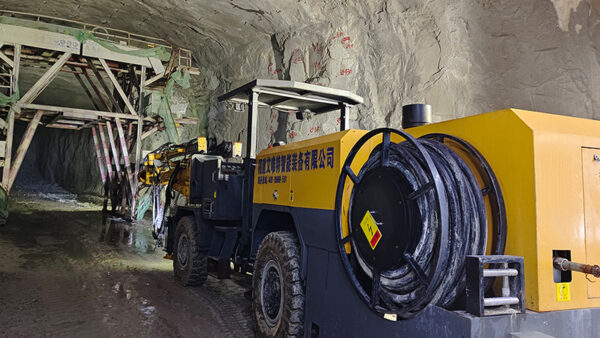
With over two decades of field engineering in abrasive environments, Aivyter has developed a product line specifically addressing the failure modes described above. The AF series rotary screw compressors feature oversized bearings (SKF Explorer class), IP55 motors with tropicalized windings, and a dual-separator oil system that guarantees carryover < 2 ppm. All units are factory tested to simulate 45°C ambient and 90% relative humidity. For remote sites, Aivyter offers air-end exchange programs with 48-hour turnaround, reducing mean time to repair (MTTR) from weeks to days.
In a recent expansion at a Zambian copper-cobalt operation, two industrial air machine compressor units from Aivyter (model AF-250V, 250 kW, 38 m³/min at 8.5 bar) were installed directly adjacent to an acid leach circuit. After 14 months, oil analysis showed TAN (total acid number) increase of only 0.3 mg KOH/g, well below the 2.0 change-out limit, validating the effectiveness of the integrated breather desiccant and crankcase pressurization system.
Case Study Reference: Improving Uptime in a Chilean Copper Mine
Site conditions: Open-pit mine at 3200m altitude, ambient temperatures -5°C to 28°C, silica dust concentration 5–15 mg/m³. The original fixed-speed screw compressor (350 kW) experienced frequent air-end seizure due to dust ingress through standard intake filters.
Solution implemented: Replacement with a industrial air machine compressor (Aivyter AF-300V) equipped with a two-stage cyclonic pre-filter (efficiency 98% at 5µm) and a synthetic ester-based lubricant. Additionally, a 5000L receiver with automatic timed drains and a desiccant dryer achieving -40°C PDP was installed.
Results (12 months data):
- Mean time between failures (MTBF) increased from 1400 to 8700 hours.
- Energy intensity reduced from 0.142 kWh/m³ to 0.109 kWh/m³ (23% reduction).
- Total maintenance cost (parts + labor) dropped 57%.
- Payback period: 11 months.
Frequently Asked Questions (FAQ)
Q1: What is the optimal pressure range for an industrial air machine compressor in underground hard rock mining?
A1: For most applications – jumbo drills, roof bolters, LHD remote controls – 7 to 8.5 bar (g) is standard. For raise boring or in-the-hole (ITH) hammers, pressures of 10–12 bar are required. Select a compressor rated 15% above maximum required pressure to account for line losses (0.3 bar per 100m of 2-inch pipe).
Q2: How often should the lubricant be changed in a rotary screw compressor operating in high-temperature environments (45°C+ ambient)?
A2: With Group IV (PAO) synthetic oil, the standard 8000-hour interval reduces to 5000–6000 hours when sump temperatures exceed 100°C. Use oil analysis every 1500 hours to monitor viscosity change (max ±15%) and oxidation (peak area >30%). For mineral oils, change interval is 2000 hours maximum in hot climates.
Q3: Can a single industrial air machine compressor serve both breathing air and plant air requirements?
A3: Only if the compressor is oil-free certified to ISO 8573-1 Class 0 and includes additional CO/CO₂ monitoring and a catalytic converter for odour removal. Mixing breathing and tool air from the same lubricated screw compressor is prohibited by mining health regulations (e.g., MSHA Part 56.13030). Separate systems or dedicated breathing air purification skids are mandatory.
Q4: What is the realistic energy saving from installing a VFD on an existing 250 kW fixed-speed compressor running at 65% average load?
A4: Assuming 6000 operating hours/year and $0.09/kWh, the fixed-speed unit consumes approx. 1,350,000 kWh/year (250 kW × 6000h × 0.65 load factor). A VFD reduces absorbed power roughly by the cube of speed reduction: at 65% flow, speed ≈ 75% (affinity law), power = 250 × (0.75)^3 ≈ 105 kW. Annual consumption = 630,000 kWh. Savings = 720,000 kWh/year (~$64,800). Payback typically under 18 months including VFD and motor rewind.
Q5: How to size a compressed air receiver for intermittent high-demand events (e.g., shotcrete spraying peaks)?
A5: Use the formula V = (Q × T × Pa) / (P1 – P2), where Q = peak flow demand (m³/min), T = duration (minutes), Pa = atmospheric pressure (1 bar), P1 = minimum receiver pressure (bar), P2 = allowed pressure drop (bar). Example: shotcrete peak 25 m³/min for 3 minutes, from 8 bar to 6.5 bar → V = (25 × 3 × 1) / (8 – 6.5) = 75 / 1.5 = 50 m³ receiver. For mobile applications, consider multiple smaller receivers distributed along the line.
Ready to Optimize Your Compressed Air Infrastructure?
Every mine or tunnel site presents unique constraints—space, power quality, dust chemistry, altitude. Generic compressor packages often fail within the first year, leading to production losses exceeding $10,000 per hour. Aivyter engineering team provides site audits, thermodynamic modeling, and lifecycle cost simulations to specify the correct industrial air machine compressor architecture for your specific duty cycle. Submit your technical inquiry with flow (m³/min), pressure (bar), altitude, and ambient temperature range to receive a detailed proposal including 3D layout drawings, predicted energy savings, and MTBF calculations within 48 hours.
Contact Aivyter now: Send your project specifications and request a quotation →
For immediate assistance, reach our application engineers via the inquiry form on our website. All inquiries receive a technical datasheet package and a complimentary filter sizing calculation for your existing system.
about
Aivyter
We provides trusted air compressors and mining equipment, engineered for durability, efficiency, and demanding industrial applications.