For industries ranging from remote mining operations to large-scale hospitals and wastewater treatment plants, the reliable supply of high-purity oxygen is a critical operational and financial concern. Dependence on traditional delivery methods, such as liquid oxygen (LOX) trucked to site or high-pressure cylinders, introduces logistical vulnerabilities and volatile costs. The engineered alternative—an on-site PSA oxygen concentrator—offers a technically superior solution. By leveraging Pressure Swing Adsorption (PSA) technology, these systems provide autonomy, purity control, and a rapid return on investment. This technical analysis examines the core engineering principles, application-specific configurations, and total cost of ownership considerations for professionals specifying gas generation equipment.
1. The Core Engineering: How PSA Technology Achieves Oxygen Separation
At the heart of every industrial PSA oxygen concentrator lies a physical process driven by zeolite molecular sieves. Understanding this separation mechanism is fundamental to evaluating system performance and reliability. Ambient air, composed of approximately 21% oxygen and 78% nitrogen, is the sole feedstock. The technology exploits the differential adsorption characteristics of these gases.
1.1 The Role of Zeolite Molecular Sieves
The engineered heart of the system is the zeolite molecular sieve. These are synthetic, crystalline aluminosilicates with a highly uniform microporous structure. Under pressure, this structure preferentially adsorbs nitrogen molecules (N₂) over oxygen molecules (O₂). This preference is based on the kinetic diameter of the molecules and the polarity of the zeolite; nitrogen, having a quadrupole moment, is more strongly attracted and retained within the pores. The oxygen, diffusing more rapidly through the bed, is enriched and emerges as the product gas. The efficiency and longevity of these sieves directly dictate the purity and output stability of the PSA oxygen concentrator.
1.2 The Dual-Tower Cycle: Pressure Adsorption, Depressurization Desorption
To deliver a continuous flow of oxygen, the system employs at least two adsorption towers operating in a staggered cycle. While one tower is online, receiving filtered compressed air and adsorbing nitrogen to produce oxygen, the other is offline undergoing regeneration. During regeneration, the pressure in the tower is released to near-atmospheric levels, causing the adsorbed nitrogen to desorb from the zeolite and be vented back into the atmosphere as waste. A precisely controlled PLC program governs the sequence of pneumatic valves, ensuring seamless switching between towers. This continuous, automated cycle is what enables an on-site PSA oxygen concentrator to function as a reliable 24/7 utility.
1.3 Critical Subsystems for Reliable Operation
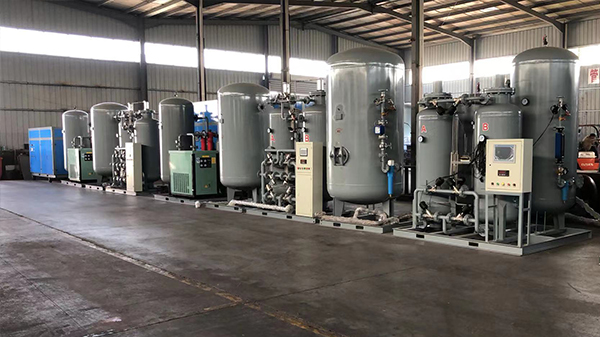
The PSA module itself is only one component of a complete generation system. For a system engineered by a firm like Aivyter, reliability is built into every ancillary component. Key subsystems include:
- Air Compressor & Purification Skid: The feedstock air must be clean, dry, and oil-free. This requires a high-quality compressor followed by refrigeration dryers, coalescing filters, and activated carbon filters to remove contaminants that could permanently damage or “poison” the zeolite sieves.
- Air Receiver Tank: This tank stabilizes pressure fluctuations from the compressor and provides a consistent buffer of compressed air to the PSA skid.
- Oxygen Buffer Tank: Located after the PSA skid, this tank smooths out the minor pressure and purity swings that occur during tower changeovers, ensuring a consistent supply to the end-use application.
- Oxygen Booster & Filling Rack (Optional): For applications requiring cylinder filling, such as remote medical clinics or cutting operations, an oxygen booster compresses the low-pressure oxygen from the buffer tank to fill high-pressure storage cylinders.
2. Critical Applications: Matching Purity and Flow to End-Use Demands
Different industrial processes require vastly different oxygen purity levels and flow rates. The flexibility of the PSA oxygen concentrator allows for precise tailoring.
2.1 Medical Oxygen Generation: Compliance and Redundancy
In healthcare facilities, the oxygen produced is a life-saving drug. Medical-grade PSA oxygen concentrators must comply with stringent pharmacopoeia standards (e.g., USP, EP), typically requiring a purity of 93% ± 3%. The system design must incorporate redundant components—such as dual compressors or a multi-tower PSA skid—to ensure 100% uptime. The ability to generate medical oxygen on-site has proven critical for hospitals in remote regions or during global supply chain disruptions, eliminating dependency on delivered cylinders or liquid oxygen.
2.2 Mining and Gold Recovery: Optimizing Cyanidation
In the mining sector, specifically in gold recovery via the cyanidation process, oxygen is a key reagent. Injecting oxygen into the leaching slurry accelerates the kinetics of gold dissolution, improving recovery rates and reducing cyanide consumption. For a mine in a remote location, trucking in liquid oxygen is prohibitively expensive. An on-site PSA oxygen concentrator, delivering oxygen at 90-95% purity directly into the leach tanks, provides a continuous, low-cost solution that directly impacts the operation’s profitability and environmental footprint by reducing cyanide usage.
Ozonation for disinfection and aeration for biological processes are major energy consumers in water treatment. Supplying oxygen via a PSA oxygen concentrator to an ozone generator or a fine-bubble diffusion system is significantly more energy-efficient than using ambient air. The higher partial pressure of oxygen dramatically increases mass transfer rates, allowing for smaller basins and lower blower energy consumption. This application demands high flow rates at moderate purities (90-95%), a perfect match for PSA technology’s efficiency curve.
3. Addressing Operational Concerns: Purity Stability and Energy Efficiency
When moving from traditional supply to on-site generation, procurement and plant managers often raise concerns about purity stability and power consumption. These are addressed through advanced system engineering and process control.
3.1 Mitigating the Impact of Inlet Conditions
Zeolite performance is sensitive to temperature and pressure. A high-integrity PSA oxygen concentrator compensates for this. For example, in hot, humid environments typical of tropical mining operations, the incoming compressed air temperature must be rigorously controlled by the pre-treatment skid to prevent efficiency loss. Furthermore, the PLC logic can adjust cycle timing to maintain target purity even as ambient conditions fluctuate, ensuring the downstream process receives a consistent oxygen concentration.
3.2 Power Consumption and Specific Energy
The primary operating cost of a PSA oxygen concentrator is electricity for the air compressor. The metric to evaluate is specific energy, typically measured in kWh/Nm³ (kilowatt-hours per normal cubic meter of oxygen produced). Modern systems with advanced sieve materials, optimized valve timing, and efficient screw compressors can achieve specific energy figures below 0.35 kWh/Nm³. When comparing the all-in cost of electricity versus the delivered cost of liquid oxygen (including transportation, storage losses, and rental fees), the economic case for on-site generation using a system from a manufacturer like Aivyter becomes compelling, often yielding payback periods of 18-24 months.
4. Total Cost of Ownership and System Scalability
Beyond the initial capital expenditure (CAPEX), the true value of an on-site gas plant is determined by its total cost of ownership (TCO) over a 10-15 year lifespan. Key factors influencing TCO include:
- Zeolite Lifespan: High-quality sieves, protected by effective pre-filtration, can maintain their adsorption capacity for 8-10 years or more.
- Valve Maintenance: Pneumatic actuated valves are the only moving parts in the PSA skid. Their cycle life and ease of replacement are critical design considerations.
- Compressor Servicing: As the largest moving assembly, the air compressor requires regular oil and filter changes. Selecting a durable, industrial-grade compressor is paramount.
- Modularity: As demand grows, a well-designed system should allow for the addition of parallel PSA skids. This modular scalability prevents over-investment at the initial stage while providing a clear path for future capacity expansion.
5. Future Outlook: Integration and Remote Monitoring
The next generation of PSA oxygen concentrators will be defined by digital integration. Remote telemetry modules now allow manufacturers and operators to monitor purity trends, energy consumption, and component health in real time. Predictive analytics can alert maintenance teams to a failing filter or a drifting valve before it impacts production. This shift from reactive maintenance to condition-based monitoring enhances reliability and further reduces the operational burden on site staff. As industries continue to prioritize supply chain resilience and operational efficiency, the on-site PSA oxygen concentrator will solidify its role not just as an alternative, but as the preferred standard for oxygen supply.
Frequently Asked Questions (FAQ)
Q1: What purity of oxygen can I expect from a standard PSA oxygen concentrator?
A1: A well-designed PSA oxygen concentrator typically produces oxygen at a purity of 90% to 95%. For medical applications, the system is specifically tuned to meet pharmacopoeia standards, usually 93% ± 3%. If higher purity (e.g., 99%+) is required, the PSA unit would need to be coupled with a downstream catalytic deoxo unit or a separate purification process, though this adds significant cost and complexity.
Q2: How does the cost of on-site oxygen generation compare to using liquid oxygen or cylinders?
A2: While the initial capital investment for a PSA oxygen concentrator is higher, the operating cost is significantly lower. The only major ongoing cost is electricity. For a typical industrial user consuming several tons per day, the payback period compared to delivered liquid oxygen is often between 1.5 and 3 years. After that point, the oxygen is essentially produced at the cost of power and routine maintenance, providing decades of savings and price stability.
Q3: How quickly can a PSA system respond to fluctuating oxygen demand?
A3: This is a key design parameter. The system’s response time is determined by the size of the oxygen buffer tank and the control logic. The buffer tank acts as a reservoir to meet instantaneous peak demands. The PSA skid itself operates most efficiently at a steady state. Therefore, the system is designed so the PSA unit runs continuously to replenish the buffer tank, which in turn supplies the variable process demand. Properly sized, this arrangement handles significant fluctuations seamlessly.
Q4: Does altitude or ambient temperature affect the performance of a PSA oxygen generator?
A4: Yes, both factors have a direct impact. At higher altitudes, the lower inlet air pressure reduces the oxygen production capacity. In hot climates, the adsorption efficiency of the zeolite decreases. Reputable manufacturers like Aivyter account for these factors during the design phase. They will request site-specific data (elevation, min/max temperatures) to correctly size the compressor and PSA skid, ensuring the system delivers the guaranteed flow and purity under actual operating conditions.
Q5: What are the main maintenance requirements for a PSA oxygen system?
A5: Maintenance is primarily focused on the pre-treatment components. The air compressor filters and oil need regular changing. The coalescing and activated carbon filters in the purification skid require periodic replacement based on operating hours. The PSA vessel itself, containing the zeolite, is generally maintenance-free for many years, provided it is protected by the upstream filters. The pneumatic valves may eventually need seal replacement after hundreds of thousands of cycles, but this is a long-term, infrequent task.
Q6: Is a PSA oxygen concentrator safe to use in industrial environments?
A6: Absolutely, when properly engineered. The primary risk with any oxygen system is the promotion of combustion. Reputable systems incorporate multiple safety features: oxygen-compatible materials in all wetted components, flash arrestors on the product line, pressure relief valves, and leak detection. Furthermore, because the oxygen is generated at low pressure (typically 3-5 bar) and used immediately or stored in a buffer tank, it avoids the high-pressure hazards associated with cylinder storage. The area around the system should be clearly marked with “Oxygen, No Smoking” signage and kept free of combustible materials.
For detailed technical specifications and an engineering analysis tailored to your specific application, consulting with established gas generation experts is recommended.
about
Aivyter
We provides trusted air compressors and mining equipment, engineered for durability, efficiency, and demanding industrial applications.