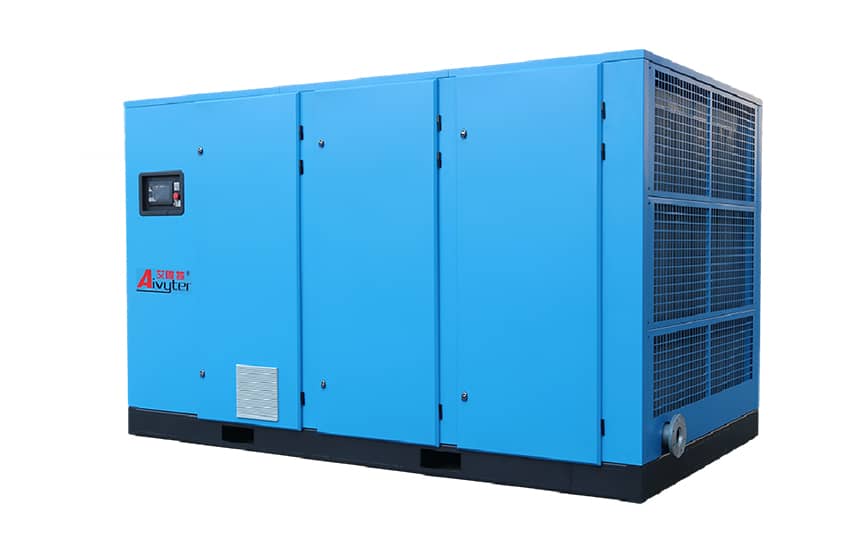
In pharmaceutical manufacturing, semiconductor cleanrooms, food processing, and medical field operations, compressed air must be completely free of oil aerosols, vapors, and liquid carryover. A portable air compressor oil free unit provides the mobility and air purity required for remote maintenance, temporary production lines, and emergency response. However, not all oil-free designs deliver consistent Class 0 air (ISO 8573-1). This article compares scroll, rotary screw, and piston technologies, examines moisture management strategies, and provides a framework for selecting a portable air compressor oil free based on duty cycle, ambient conditions, and downstream sensitivity. Aivyter manufactures a range of oil-free portable compressors with integrated drying and filtration, suitable for applications from dental clinics to offshore drilling platforms.
1. Why Specify a Portable Air Compressor Oil Free?
Standard lubricated compressors introduce oil aerosol (0.1–3 mg/m³) that, even after filtration, can contaminate sensitive processes. A portable air compressor oil free eliminates the risk of oil carryover, reducing product reject rates and maintenance on downstream equipment. Key applications requiring oil-free air include:
- Medical and dental clinics – Air contacting patients must meet ISO 8573-1 Class 0 (oil) and Class 2 (water).
- Food and beverage packaging – Oil-free air prevents flavor tainting and package contamination.
- Electronics assembly – Oil residues cause solder mask adhesion failure and short circuits.
- Pharmaceutical blister packaging – Any trace oil violates GMP standards.
- Painting and coating (remote) – Oil-free air eliminates fisheyes in paint finishes.
Portability adds another dimension: field service crews need units under 80 kg that fit into van lifts, operate on single-phase power (110–240V), and withstand temperature swings from -10°C to 45°C. Industrial portable compressor solutions from Aivyter integrate vibration-damping frames and weather-resistant enclosures.
2. Oil-Free Compression Technologies Compared
When selecting a portable air compressor oil free, the core technology determines reliability, maintenance intervals, and air quality. Three common types:
2.1 Oil-Free Scroll Compressors
Scroll compressors use two interleaving spiral elements (fixed and orbiting). No lubrication enters the compression chamber; bearings are sealed and grease-packed. Advantages:
- Silent operation (65–72 dBA) – suitable for indoor or hospital environments.
- 100% duty cycle at rated pressure (8–10 bar).
- Very low discharge temperature – reduces water condensation.
- Long service intervals (8,000–10,000 hours for scroll set replacement).
Disadvantages: higher initial cost than piston units, limited to 15–30 kW (approx 2–4 m³/min). For portable units up to 2 m³/min, scroll technology is the premium choice.
2.2 Oil-Free Reciprocating (Piston) Compressors
Piston units use Teflon- or carbon-filled rings and cylinder coatings to seal without oil. They are cost-effective for intermittent duty (50% duty cycle). Limitations:
- Higher vibration and noise (75–85 dBA).
- Shorter ring life (2,000–4,000 hours) – requires frequent rebuilds.
- Moisture carryover is higher due to higher discharge temperatures (140–180°C).
Best for backup or light-duty field use (e.g., pneumatic tools, tire inflation). For continuous operation or sensitive air applications, scroll or oil-free rotary screw is preferred.
2.3 Oil-Free Rotary Screw (Dry Screw)
Dry screw compressors use timing gears to maintain clearance between rotors. They produce large flow (2–20 m³/min) but are heavier and require water cooling or air cooling with intercoolers. Portable dry screw units exist but typically exceed 500 kg, limiting true portability. For a portable air compressor oil free under 200 kg, scroll is the dominant technology.
3. Air Purity Certification: ISO 8573-1 Class 0
Many units claim “oil-free” but still emit oil vapor or liquid. ISO 8573-1 defines classes for particles, water, and total oil (aerosol + vapor + liquid). Class 0 means no measurable oil (<0.01 mg/m³). When specifying a portable air compressor oil free, request third-party test reports per ISO 8573-4 (oil measurement). Key points:
- Oil aerosol – measured with laser particle counter + impinger.
- Oil vapor – measured with PID or gas chromatography.
- Total oil – sum of aerosol, vapor, and liquid.
For pharmaceutical or food contact, Class 0 is mandatory. For general industrial (e.g., packaging), Class 1 (0.01–0.1 mg/m³) may suffice. Aivyter portable oil-free compressors are independently verified to ISO 8573-1 Class 0, with certificates provided for each serial number.
4. Moisture Management in Portable Oil-Free Compressors
Oil-free compressors produce the same amount of water vapor as lubricated units. Without downstream drying, condensed water causes pipe corrosion, microbial growth, and spoilage of moisture-sensitive products. Integrated solutions for portable units include:
- Aftercooler (air-cooled or water-cooled) – reduces discharge temperature to +5–10°C above ambient, condensing 60–70% of moisture.
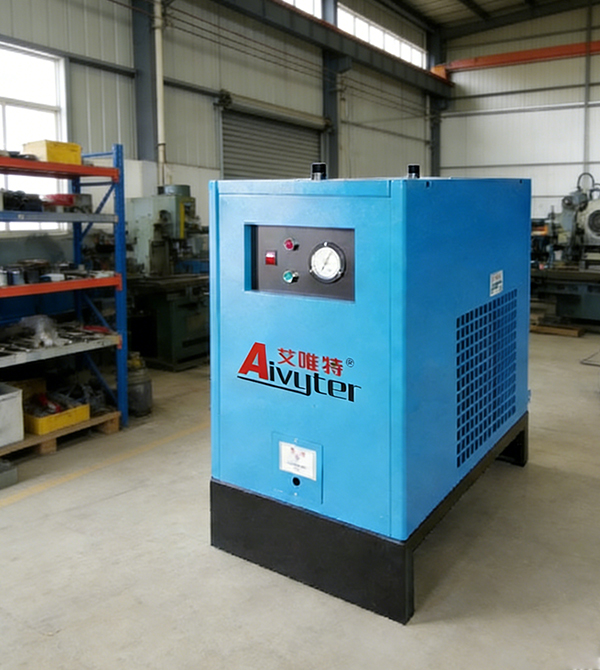
- Refrigerated dryer – dew point +3°C to +10°C. Requires AC power and adds weight (10–20 kg). Suitable for indoor or temperate environments.
- Desiccant dryer (twin tower) – achieves pressure dew point -40°C to -70°C. Uses purge air (15–20% of flow), reducing effective output. For critical applications in cold climates.
- Water separator + particulate filter (1 μm and 0.01 μm) – minimum required for general pneumatic tools.
When selecting a portable air compressor oil free for outdoor use, specify an integrated aftercooler and automatic drain trap to prevent water accumulation. Aivyter’s portable series includes a high-efficiency cyclone separator and electronic drain valve that discharges condensate only when full, reducing air loss.
5. Power Options and Portability Features
Field deployment requires flexible power. Common configurations:
- Electric motor (single-phase 230V) – up to 5.5 kW (7.5 HP), suitable for 2.0 m³/min @ 8 bar. Portable weight 150–250 kg.
- Electric motor (three-phase 400V) – higher power but less available on remote sites.
- Diesel or gasoline engine-driven – truly independent of grid, but adds exhaust handling and noise. Oil-free engine-driven units are rare; typically engine oil must be isolated from compression chamber via belt drive and sealed crankcase.
- Battery-electric (48V DC) – emerging technology for light-duty (0.2–0.5 m³/min). Limited runtime (2–4 hours).
Portability features to evaluate: lifting eyes, forklift pockets, pneumatic tires (solid or foam-filled), foldable handles, and sound enclosure (≤75 dBA at 7 m for outdoor use). Aivyter’s portable oil-free compressors include a reinforced skid base and retractable tow bar for hand maneuvering.
6. Lifecycle Cost Analysis: Oil-Free vs. Oil-Lubricated with Filtration
Many site managers consider purchasing a lubricated portable compressor with external oil removal filters. However, the total cost of ownership (TCO) over 5 years often favors true oil-free units:
- Lubricated + filters – Lower initial cost (30–40% less). But requires: (a) coalescing filter element replacement every 1,000–2,000 hours (cost $80–200 each), (b) activated carbon filter replacement every 500–1,000 hours (cost $60–150), (c) risk of filter bypass during startup/shutdown, (d) disposal of oily condensate (environmental compliance).
- True oil-free (scroll) – Higher upfront cost. No filter element replacements, no oily condensate, lower energy consumption (scroll efficiency 8–10% better than piston). Over 10,000 operating hours, oil-free scroll has lower TCO.
For intermittent use (<500 hours/year), lubricated with filters may be acceptable. For continuous or sensitive applications, a portable air compressor oil free is the technically sound investment.
7. Field Maintenance and Troubleshooting
Even oil-free compressors require periodic checks. Common issues and solutions:
- Low output pressure – Check intake air filter (clean or replace), check for belt slippage (if belt-driven), verify that unloader valve is not stuck.
- Overheating (thermal shutdown) – Clean cooling fins on compressor head and aftercooler. For scroll units, ensure ambient temperature <45°C and fan is operating.
- Moisture in outlet air – Empty condensate trap manually; check if drain valve timer is set correctly; install a higher capacity aftercooler for humid climates.
- Excessive noise or vibration – For piston units, check connecting rod and piston ring wear. For scroll, listen for metallic rubbing indicating scroll set failure (replace scroll kit).
Maintenance schedule for oil-free scroll portable unit: clean intake filter every 500 hours, replace air filter every 2,000 hours, replace scroll set every 10,000 hours or 5 years. Aivyter provides a maintenance log app and remote monitoring option for fleet management.
8. Application Case: Offshore Platform Instrument Air
An offshore drilling platform required a portable air compressor oil free to provide instrument air for pneumatic valves during turnaround maintenance. Ambient conditions: salt spray, 35–40°C, high humidity. A 4 kW scroll-based portable unit with integrated refrigerated dryer was deployed. After 6 months of daily 8-hour operation, air quality tests showed oil content <0.01 mg/m³, pressure dew point +5°C. The unit was moved between three wellheads using a forklift. No filter element changes were needed during the campaign. This case demonstrates the ruggedness of scroll oil-free technology in marine environments.
9. Frequently Asked Questions (FAQ) – Portable Air Compressor Oil Free
Q1: What is the maximum flow rate available in a truly portable oil-free compressor (under 250 kg)?
A1: For units weighing under 250 kg, typical flow rates are 0.5–2.2 m³/min at 7–10 bar. Single-phase electric scroll units cap at about 2.0 m³/min. For higher flows (3–5 m³/min), weight exceeds 400 kg, moving into towable trailer category. Aivyter offers a 2.2 m³/min model weighing 210 kg, meeting “portable” definition (fits in a standard van).
Q2: Can a portable air compressor oil free be used in sub-zero temperatures?
A2: Yes, but with precautions. At temperatures below 0°C, condensate can freeze inside the aftercooler and drain lines, causing blockages and pressure spikes. Use a heated drain valve or a non-freezing coolant (propylene glycol injection) for intermittent operation. For -20°C and below, select a model with an enclosure heater and a desiccant dryer (which operates below freezing without liquid water). Aivyter offers a cold-weather package with thermostatically controlled heater and insulated lines.
Q3: How often should the intake filter be replaced on a portable oil-free compressor?
A3: In dusty environments (construction, mining), inspect weekly and replace every 200–300 hours. In clean environments (laboratory, pharmaceutical), replace every 2,000 hours or annually. A clogged intake filter reduces output and increases energy consumption by up to 15%. Use a filter restriction indicator gauge to schedule replacement.
Q4: What is the difference between oil-free and “oil-less” compressors?
A4: “Oil-free” generally means no oil enters the compression chamber, but bearings may be grease-lubricated (sealed) – this is acceptable for ISO Class 0 air. “Oil-less” implies no lubricant anywhere, often using self-lubricating materials like PTFE rings. Oil-less designs have shorter life (1,000–2,000 hours) and are typically found in small diaphragm compressors. For industrial portable use, choose oil-free scroll or piston with sealed bearings. Aivyter’s oil-free compressors use grease-packed bearings that are sealed for life, eliminating the risk of oil migration.
Q5: How do I verify that a portable air compressor oil free meets ISO 8573-1 Class 0 before purchase?
A5: Request the manufacturer’s test certificate from an accredited laboratory (e.g., TÜV, DNV, Fraunhofer). The certificate must specify the test method (ISO 8573-4:2019), detection limit (<0.01 mg/m³), and the model/serial number range. Some manufacturers claim “Class 0” based on theoretical design – reject those. Aivyter provides batch test certificates for each production run, with results traceable to the serial number of the compressor.
10. Selecting the Right Portable Air Compressor Oil Free for Your Operation
To choose the correct unit, define the following parameters:
- Flow rate (m³/min) at required pressure (bar) – sum of all tools plus 20% margin for leaks.
- Duty cycle – intermittent (20–40%) or continuous (100%). Scroll handles continuous; piston requires 50% duty limit.
- Air purity class – ISO 8573-1 Class 0 for pharma/food; Class 1 for general industry.
- Ambient temperature range – affects aftercooler sizing and dryer selection.
- Power availability – single-phase 230V, three-phase, or engine-driven.
- Portability requirements – weight, dimensions, lifting method, and transportation vehicle.
Work with a supplier that provides on-site air audit and commissioning support. Aivyter engineers can analyze your pneumatic system and recommend the optimal portable air compressor oil free, including dryer type and filtration stage.
Investing in a high-quality oil-free portable compressor reduces product contamination risk, eliminates oil disposal costs, and improves worker safety (no oily surfaces). For industries where compressed air touches the final product, oil-free is not a luxury – it is a specification requirement.
To receive a technical datasheet and a customized quotation for your flow and purity requirements, contact the Aivyter sales engineering team. Provide your maximum flow, operating pressure, ambient conditions, and any industry-specific standards (GMP, FDA, ATEX). We will return a proposal with performance curves, dimensional drawings, and a comparative TCO analysis.
Submit your application details via the Aivyter inquiry form. Receive a recommended model selection, ISO 8573-1 test certificate sample, and a 3D CAD model within 5 business days. Free on-site air quality testing available for qualified industrial accounts.
about
Aivyter
We provides trusted air compressors and mining equipment, engineered for durability, efficiency, and demanding industrial applications.