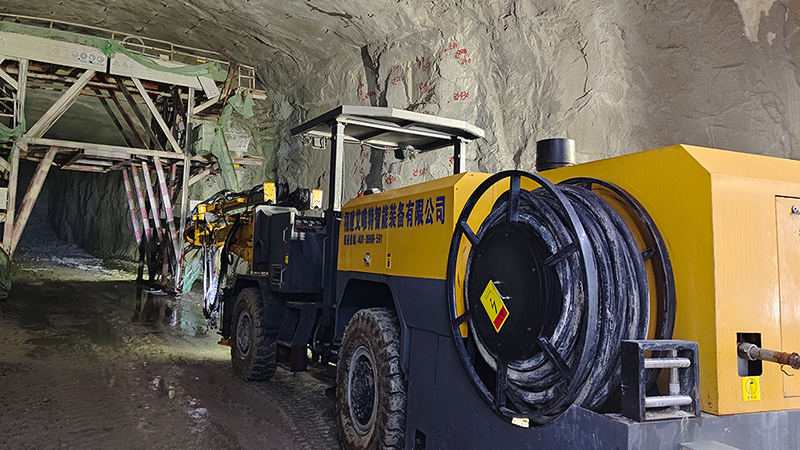
In modern hard rock mining and tunnel excavation, drilling performance dictates the entire pace of the production cycle. Confined working headings, abrasive rock mass conditions, and strict safety standards mean that selecting high-performance underground rock drill rigs is critical for achieving optimal advance rates and minimizing cost per excavated meter.
Whether your operations involve rapid heading development, long-hole stoping, or dedicated ground reinforcement, matching mechanical drilling capacity to your mine’s geological reality is essential. This engineering guide covers the classifications, critical technical parameters, selection methodologies, and maintenance protocols for underground rock drill rigs, featuring industry-leading manufacturing insights from Aivyter.
1. Primary Types of Underground Rock Drill Rigs and Their Applications
Mechanized underground drilling equipment is classified by specific operational duties within the mining cycle. Choosing the correct configuration ensures accurate borehole trajectories and maximizes fleet availability.
1.1 Face Drilling Rigs (Mining Jumbos)
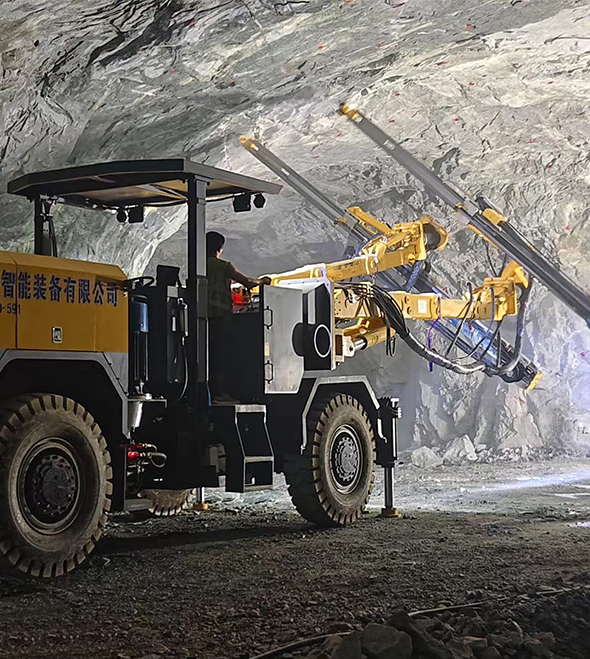
Face drilling rigs are primarily utilized for horizontal and inclined drilling in tunneling, cross-cutting, and ramp development. Configured with one, two, or three heavy-duty hydraulic booms, these units drill blast hole arrays and cut holes with high positioning accuracy. Key features include proportional boom kinematics, anti-jamming automation, and high-frequency hydraulic drifters designed to maintain high penetration rates in varying rock strata.
1.2 Long-Hole Production Drill Rigs
Production drill rigs are engineered for ore extraction in sub-level stoping, VCR (Vertical Crater Retreat), and sublevel caving methods. These specialized underground rock drill rigs drill radial fan patterns and parallel deep holes ranging from 15 to over 40 meters. Minimizing drill hole deviation is paramount in production drilling to ensure uniform fragmentation and reduce costly ore dilution.
1.3 Roof Bolting and Ground Support Rigs
Safety and ground stability depend on systematic rock reinforcement. Mechanized roof bolting rigs automate the installation of friction bolts, resin-grouted rebar, and expansion anchors. By mechanizing rod handling and grout injection under a FOPS/ROPS certified protective canopy, these rigs eliminate the need for operators to stand under unsupported rock faces.
2. Key Technical Specifications: Engineering Evaluation Matrix
When selecting underground rock drill rigs, mine engineers must evaluate component capacities against tunnel dimensions and Rock Mass Ratings (RMR). Aivyter designs its heavy machinery around these critical operational benchmarks:
| Engineering Parameter | Standard Operating Range | Operational Impact on Mine Production |
|---|---|---|
| Drilling Hole Diameter | 38 mm – 127 mm (Top Hammer) | Determines explosive distribution, powder factor, and final rock fragmentation size. |
| Hydraulic Drifter Power | 15 kW – 32 kW (Impact Freq: 45–65 Hz) | Directly governs penetration velocity in hard, competent rock formations (UCS > 160 MPa). |
| Boom Coverage Area | 8 m² – 65 m² | Must match drift cross-sections (width x height) to eliminate unnecessary carrier repositioning. |
| Carrier Drive System | Diesel-Hydraulic 4WD / Electric-Battery | Affects tramming gradeability (up to 14°–18°), travel speed, and underground ventilation requirements. |
| Feed Beam Construction | High-Strength Aluminum / Steel Feeds | Provides bending resistance during high-thrust drilling, preserving hole straightness. |
3. Step-by-Step Selection Guide: Matching Rigs to Mine Conditions
To prevent premature equipment wear and production bottlenecks, follow this four-step engineering evaluation process:
Step 1: Evaluate Rock Hardness and Abrasiveness
Measure the Uniaxial Compressive Strength (UCS) and Cerchar Abrasivity Index (CAI) of your deposit. In extremely hard, abrasive formations (UCS > 180 MPa), select underground rock drill rigs equipped with advanced double-damping hydraulic rock drills. The dampening system absorbs high-frequency reflected shockwaves, protecting the internal drifter components and drill string from premature fatigue.
Step 2: Assess Drift Geometry and Turning Radii
Review the minimum tunnel width, back height, and transport clearances along main haulage ramps. Compact, articulated carrier chassis ensure high maneuverability around sharp corners, while extendable telescopic feed beams allow efficient drilling in restricted roof heights without sacrificing hole depth.
Step 3: Determine Power Infrastructure and Ventilation Limits
Managing underground emissions and ambient heat is a major operating cost. Electro-hydraulic configurations are widely preferred: an efficient diesel engine powers the carrier during tramming between headings, while an electric motor connects to the mine’s power grid during stationary drilling, completely eliminating exhaust emissions at the active face.
4. Preventive Maintenance Best Practices for Maximum Rig Availability
Due to the aggressive dust, water, and vibration present in underground environments, strict adherence to preventive maintenance is essential:
- Hydraulic Fluid Contamination Control: Maintain oil cleanliness to ISO 4406 standards. Micron-level particulate contamination is the leading cause of premature proportional valve and piston pump failures.
- Shank Adapter and Bushing Alignment: Inspect the striking bar, shank adapter, and front-head bronze bushings daily. Operating with worn guide bushings causes off-axis impacts, accelerating wear on both the drifter and drill steel.
- Feed Slide and Tensioner Maintenance: Regularly adjust polyurethane wear pads and stainless steel guide strips along the feed beam to eliminate lateral play during drilling.
5. Why Choose Aivyter for Your Underground Drilling Fleet?
As an experienced manufacturer of heavy mining machinery, Aivyter engineers robust underground rock drill rigs built to thrive in grueling subterranean conditions:
- Heavy-Duty Structural Integrity: Reinforced articulated chassis, heavy-duty booms, and premium-grade hydraulic drifters engineered for continuous, high-load cycles.
- Custom Mine Configurations: Flexible options for boom reach, feed lengths, electric voltage standards (380V to 1000V), and cabin safety certifications tailored to your mine design.
- Dedicated Global Support: Rapid availability of genuine replacement parts, drifter overhaul kits, and expert on-site technical commissioning to ensure maximum uptime.
6. Frequently Asked Questions (FAQ)
Q1: What is the main difference between face jumbos and long-hole production drill rigs?
A1: Face jumbos are optimized for heading development and tunneling, drilling fast, shallow blast hole patterns across the tunnel face to advance the heading. Production drill rigs are designed for stoping and bulk ore extraction, drilling deep radial fan patterns (often 15 to 40+ meters deep) where strict borehole straightness is required to minimize ore dilution.
Q2: How do rock properties influence the choice of hydraulic drifter on underground rock drill rigs?
A2: In hard, competent rock (high UCS), a rock drill with high impact power, high blow frequency, and dual-damping mechanics is required to fracture rock efficiently. In soft, fractured, or layered formations, emphasis shifts to high rotational torque and responsive anti-jamming controls to prevent the drill string from getting stuck.
Q3: What are the advantages of electro-hydraulic power systems in underground drill rigs?
A3: Electro-hydraulic systems utilize electric power from the mine grid for drilling operations while using an onboard diesel engine solely for tramming. This setup drastically lowers underground diesel exhaust emissions, reduces heat generation, and cuts overall mine ventilation costs.
Q4: How do modern underground rock drill rigs maintain hole accuracy?
A4: Modern rigs utilize rigid feed beam designs, heavy guide tubes, precision angle sensors, and computerized boom positioning systems. These features ensure precise alignment with digital drilling plans, eliminating human error, over-break, and under-break.
Q5: How can mining operations order customized underground rock drill rigs from Aivyter?
A5: You can contact the Aivyter engineering team directly with your mine specifications, including drift cross-section dimensions, electrical infrastructure, rock hardness, and target hole diameters. Aivyter provides tailored equipment configurations, technical drawings, and detailed commercial proposals.
Investing in the correct underground rock drill rigs is a strategic decision that drives excavation efficiency, worker safety, and overall mine profitability. By matching machine power, carrier dimensions, and drifter specifications to your unique geological conditions, your operation can establish predictable, high-yield drill-and-blast cycles.
Looking to upgrade your underground drilling fleet? Contact Aivyter today to consult with our technical specialists, download comprehensive product catalogs, or request a customized project quote.
about
Aivyter
We provides trusted air compressors and mining equipment, engineered for durability, efficiency, and demanding industrial applications.