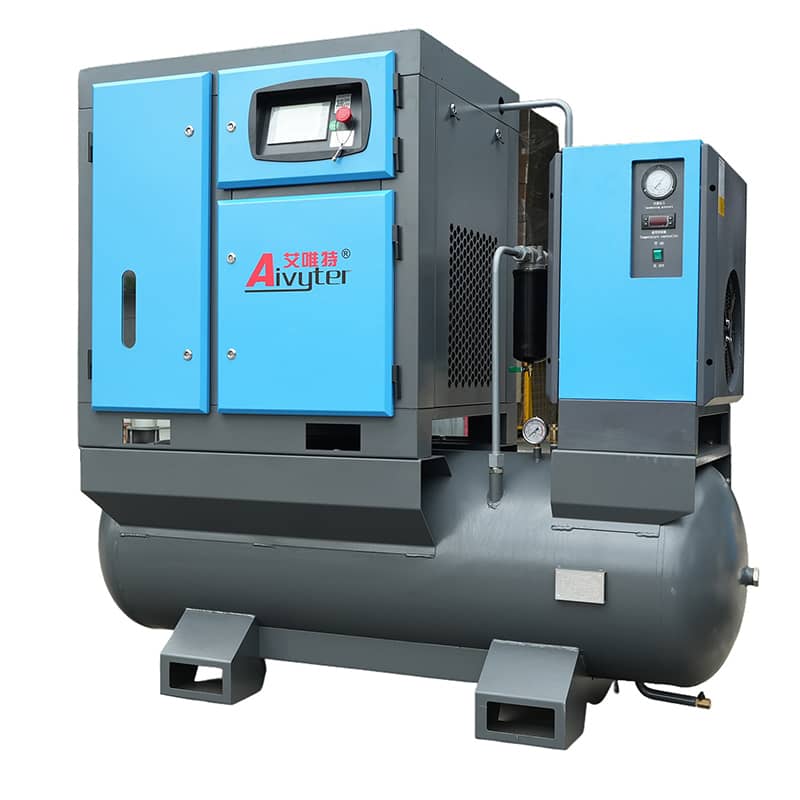
In heavy industrial environments—mining galleries, cement plants, offshore platforms, and high-tonnage fabrication—the industrial air compressor machine is not an accessory; it is a core utility asset. Its reliability directly dictates production uptime, energy budgets, and process quality. This analysis moves beyond basic specifications to examine thermodynamic efficiency, contamination control, site-specific duty cycles, and strategies that reduce total cost of ownership (TCO). Drawing from field data and engineering standards (ISO 8573-1, API 619, PNEUROP), we provide a framework for selecting, operating, and maintaining compressed air systems in harsh, continuous-duty conditions.
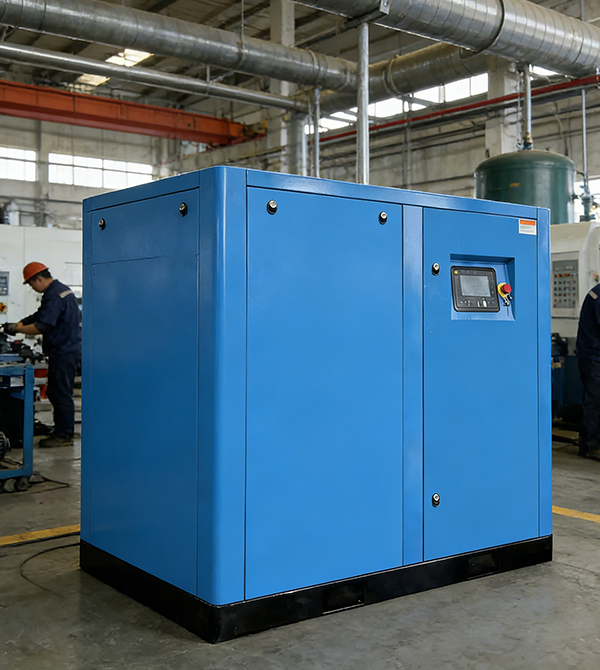
1. Fundamental Technology Classes: Rotary Screw, Centrifugal & Oil-Free Architectures
Selecting an industrial air compressor machine begins with matching the compression principle to flow (m³/min), pressure (bar/psi), and air purity requirements. Each class exhibits distinct part-load efficiency, sensitivity to inlet conditions, and maintenance intervals.
1.1 Rotary Screw (Oil-Injected and Oil-Free)
Rotary screw units dominate the 5–100 m³/min range due to their continuous 100% duty cycle and compact footprint. Oil-injected versions achieve lower discharge temperatures (70–90°C) and higher volumetric efficiency but require fine oil separation to meet ISO 8573-1 Class 2 or better. Oil-free rotary screw (dry type) uses PTFE-coated rotors and labyrinth seals, eliminating contamination risk for sensitive applications such as food packaging or pharmaceutical powder conveying. However, dry screws demand higher rotor tip speeds and generate discharge temperatures up to 200°C, necessitating intercoolers and corrosion-resistant coatings.
1.2 Centrifugal Compressors
For volumes exceeding 150 m³/min at moderate pressures (2–10 bar), centrifugal turbocompressors offer the lowest specific power (kW per m³/min). Their oil-free operation, absence of wearing contact parts, and ability to integrate with waste heat recovery systems make them standard in steel mills and air separation plants. Critical design aspects include surge control (anti-surge recycle valves), inlet guide vane (IGV) modulation, and impeller material selection (17-4PH stainless steel or titanium for corrosive gas streams).
1.3 Reciprocating (Piston) Compressors
Though less common for continuous industrial baseloads, high-pressure reciprocating units (up to 420 bar) serve niche applications—PET bottle blowing, hydrostatic testing, and nitrogen boosting. Their discontinuous duty cycle (typically 60% to 70% load factor) requires careful thermal management and valve plate inspections every 1,000 operating hours.
- Efficiency ranking at full load: Centrifugal > oil-free rotary screw > oil-injected rotary screw > reciprocating.
- Turndown capability: Variable speed drive (VSD) screws achieve 25–100% flow modulation; centrifugals lose efficiency below 70% load.
- Air purity (residual oil): Oil-free screw & centrifugal ≤0.01 mg/m³; oil-injected screw requires downstream activated carbon filters.
2. Critical Performance Metrics: From FAD to Specific Energy
OEM brochures often list “displaced flow” at intake conditions, but the real deliverable is Free Air Delivery (FAD) at rated pressure and reference ambient (ISO 1217 Annex C). For an industrial air compressor machine, a 10% discrepancy between FAD and claimed swept volume can increase energy costs by USD $12,000 annually (at $0.10/kWh, 6,000 hours/year). Key parameters to verify:
- Specific power (kW per m³/min): At 7 bar, modern two-stage screw compressors achieve 6.2–6.8 kW/(m³/min); older single-stage units often exceed 7.5 kW/(m³/min).
- Pressure dew point (PDP): For pneumatic controls and instrumentation, a PDP of +3°C to -40°C is required, achieved via refrigerated or desiccant dryers.
- Particle and oil carryover: ISO 8573-1 classes (e.g., Class 1: ≤0.01 mg oil/m³, ≤0.1 µm particles).
- Acoustic performance: Industrial units with sound enclosures operate at 75–85 dB(A) at 1 meter; open-frame units exceed 95 dB(A), mandating hearing protection.
3. Application-Specific Engineering Challenges & Field-Proven Solutions
Three heavy sectors—mining, construction, and general manufacturing—impose radically different stress profiles on compressed air systems. Below we detail pain points and corrective designs.
3.1 Underground and Surface Mining
Mines demand explosion-proof (ATEX / MSHA) industrial air compressor machine configurations due to methane and coal dust. Common failures include: overheating from restricted ventilation, ingestion of abrasive particulates (rock dust), and corrosion from acidic mine water. Solutions adopted in Australian and Chilean copper mines:
- Heavy-duty pre-filtration: Inertial separators + self-cleaning cyclonic filters remove >95% of 5 µm particles before intake.
- Cooling system redundancy: Oversized radiators with hydraulic-driven backup fans maintain discharge temperature <105°C even at 45°C ambient.
- Corrosion-resistant aftercoolers: Stainless steel 316L tubes and aluminum fin packs to resist acid mist.
3.2 Civil Engineering & Tunnel Boring
In tunnel construction, compressed air powers rock drills, shotcrete pumps, and ventilation doors. The main issue is oil carryover contaminating ground stabilization chemicals. One European tunneling contractor reduced grout failures by 70% after switching to Class 0 oil-free rotary screw units. For remote sites, Aivyter has supplied containerized industrial air compressor machine packages with integrated diesel-drive and acoustic attenuation to meet 65 dB(A) night-time limits.
3.3 Heavy Manufacturing: Automotive Stamping & Foundries
Stamping presses require short-duration high-flow pulses (up to 200% of baseload) for cushion and clutch actuation. A common design flaw is installing a single large compressor that cycles excessively. The proven approach: a master VSD screw unit handling 70% of average demand plus a trim centrifugal unit for peaks. Integrated system controllers (e.g., load-sharing with pressure band ±0.2 bar) cut energy use by 22–28% compared to standalone controls.
4. Energy Efficiency Deep Dive: Reducing Specific Power by 30%
Compressed air accounts for 10–30% of industrial electricity consumption globally. Most sites can reduce energy without sacrificing availability. Technical levers validated in cement and chemical plants:
- Pressure band narrowing: Every 1 bar reduction saves 7% energy. Replace pressure regulators with electronic proportional valves for precise end-use pressure.
- Heat recovery: Oil-injected screw compressors reject 75–85% of input energy as heat. Recover 50–70% for process water preheating (60–80°C) or building heating. Payback period: 6–18 months.
- Leak management: A 3 mm diameter leak at 7 bar wastes 42,000 m³/year (approx. USD $4,500/year). Ultrasonic detection and permanent flow monitoring cut leak rates from 25% to below 8%.
- Storage & network sizing: Add wet receiver tanks after the air dryer to handle transient demand spikes, preventing unloaded running. The formula: Receiver volume (m³) = (Free air demand m³/s × time seconds) / (pressure difference bar).
5. Maintenance Frameworks for High-Uptime Operations
Unplanned downtime of a 250 kW industrial air compressor machine in a continuous process plant can exceed $15,000 per hour. Condition-based maintenance (CBM) outperforms traditional run-hour schedules. Recommended monitoring parameters:
- Vibration analysis: Accelerometers on bearing housings (rotary screw) and thrust bearings (centrifugal). Alarm thresholds per ISO 10816-3.
- Oil analysis: Every 2,000 hours for viscosity, TAN (total acid number), and particle count (ISO 4406). Unexpected silicon spikes indicate air filter failure.
- Thermographic scanning: Check cooler cores, discharge piping, and motor terminals monthly.
- Pressure drop across filters/dryers: A 0.5 bar increase signals clogging; replace coalescing filters at ≤0.8 bar delta P.
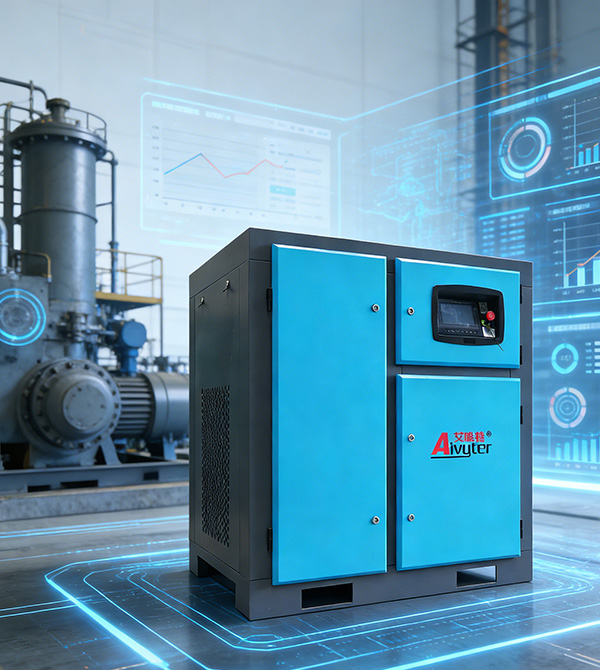
Aivyter provides remote condition monitoring portals (SCADA integration, Modbus TCP/IP) that track specific energy, runtime at part load, and filter status, enabling predictive part replacement before failure. Field data from Southeast Asian cement plants showed 99.5% availability over 24 months.
6. Procurement Criteria: Total Cost of Ownership (TCO) Model
Many buyers focus on initial capital expenditure (CAPEX), but over a 10-year life, energy and maintenance dominate. A realistic TCO calculator for a 45 kW, 7 bar system operating 6,000 hours/year:
- CAPEX: $25,000–$40,000 (compressor + dryer + filtration).
- Energy cost (10 years): $0.10/kWh × 45 kW × 6,000 h × 10 = $270,000. A 15% efficiency improvement saves $40,500.
- Maintenance & parts (10 years): $18,000–$35,000 depending on OEM parts pricing and oil change intervals.
- Downtime risk: Minimum 10% unplanned downtime costs >$90,000 (assuming $1,500/hour lost production).
Therefore, a premium VSD unit with integrated telemetry and extended warranty may add $12,000 to CAPEX but delivers lower lifetime cost through energy and downtime reduction. Always request ISO 1217 C-2009 performance test reports, not theoretical calculations.
7. Compliance & Safety Standards in Hazardous Areas
Mining and petrochemical applications require certified equipment. Key directives:
- ATEX 2014/34/EU: Category 2G for gas zones, 2D for dust. Ensure compressors have Ex h (encapsulation) or Ex d (flameproof) enclosures.
- MSHA (USA): Part 18 – Approval for underground coal mines with flame-resistant belts, no exposed aluminum (to prevent frictional ignition).
- IEC 60079-7: Increased safety “e” for terminal boxes and motors.
- NFPA 85: Boiler and combustion systems code – relevant when using compressed air for atomization in burners.
Reputable suppliers such as Aivyter offer third-party certified units with full documentation (EC Declaration of Conformity, test reports).
8. Future Trends: AI-Driven Compressed Air Optimization
Industrial IoT platforms now apply machine learning to predict demand profiles and adjust compressor sequencing in real time. Edge controllers analyze pressure, flow, and power data to implement model predictive control (MPC). Field results from a South African platinum mine: 23% energy reduction, 50% fewer pressure band violations, and automated leak detection reporting. For new projects, specify open communication protocols (OPC UA, MQTT) rather than proprietary gateways.
Frequently Asked Questions (FAQ) – Industrial Air Compressor Systems
Q1: What is the difference between FAD and displacement in an industrial air compressor machine?
A1: Displacement is the theoretical volume swept by rotors or pistons per minute, while Free Air Delivery (FAD) measures actual compressed air output reduced to inlet conditions (ISO 1217). FAD accounts for internal leakage, pressure losses, and thermal effects. A quality unit will have FAD within 5–8% of displacement; larger gaps indicate poor sealing or inefficient valve design.
Q2: How often should synthetic lubricant be changed in an oil-injected rotary screw compressor?
A2: For mineral oils, change every 2,000 hours. High-performance synthetics (PAO or ester-based) extend intervals to 6,000–8,000 hours under normal conditions (ambient <40°C, non-acidic gas streams). Always follow oil analysis; early oxidation or viscosity drop demands immediate change regardless of runtime.
Q3: Can a VSD (variable speed drive) compressor always save energy compared to a fixed-speed unit?
A3: VSD units excel when average demand is below 85% of full capacity and flow varies widely. However, at near-constant full load (>90% utilization), a fixed-speed compressor with efficient unloaded regulation may have similar or slightly lower specific energy due to inverter losses (3–5%). A hybrid system (one VSD + one fixed-speed) offers the best of both.
Q4: What are the consequences of operating an industrial air compressor machine beyond its rated pressure?
A4: Overspeeding the compressor (e.g., running a 7 bar unit at 9 bar) increases bearing loads, discharge temperature, and risk of rotor contact (for screws). Energy consumption rises by ~7% per extra bar, and volumetric efficiency drops. Moreover, safety relief valves may open, and aftercoolers become undersized, leading to moisture carryover.
Q5: How do I select the correct air dryer type – refrigerated vs. desiccant?
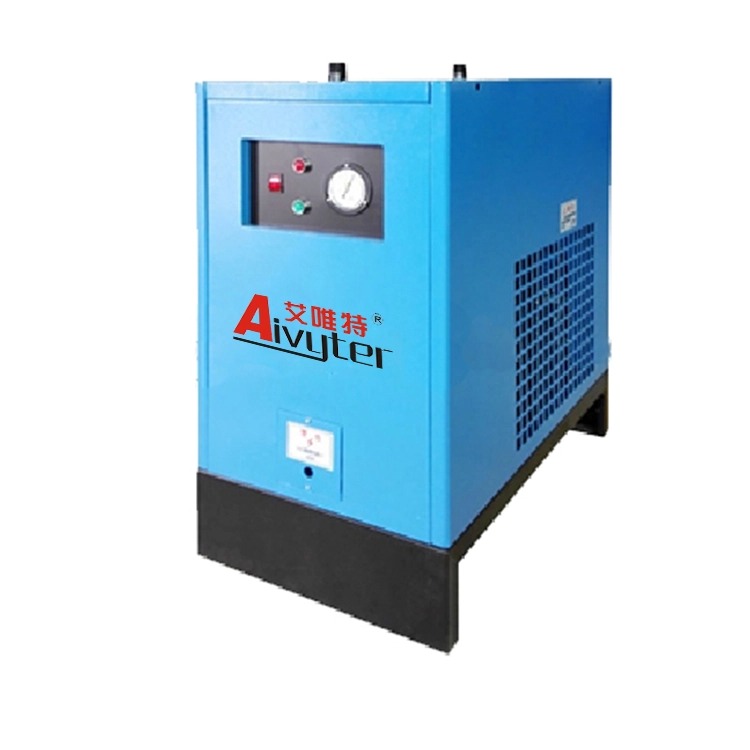
A5: Refrigerated dryers achieve pressure dew points (PDP) of +3°C to +10°C, suitable for general pneumatic tools and blow-off. Desiccant dryers (heat-regenerated or blower-purge) reach PDP of -40°C to -70°C, required for instrument air in freezing climates or moisture-sensitive processes (painting, powder coating). Desiccant dryers consume 10–20% of rated flow for purge air, so oversizing reduces efficiency.
Conclusion & Request for Project Inquiry
Selecting the right industrial air compressor machine requires balancing thermodynamic efficiency, application-specific robustness, and lifecycle cost management. From ATEX-compliant mining units to oil-free Class 0 systems for sensitive manufacturing, the engineering choices discussed above directly impact your bottom line and operational reliability. Aivyter provides engineering consultation, site audits, and custom-packaged compressed air solutions with remote monitoring and global service support. Submit your project parameters (flow, pressure, ambient conditions, and air purity class) for a detailed technical proposal and TCO simulation.
Ready to optimize your compressed air system? Send your inquiry to Aivyter’s engineering team for a needs assessment and quote.
about
Aivyter
We provides trusted air compressors and mining equipment, engineered for durability, efficiency, and demanding industrial applications.