1. Permanent Magnet Motor vs. Induction: Why the Shift Matters
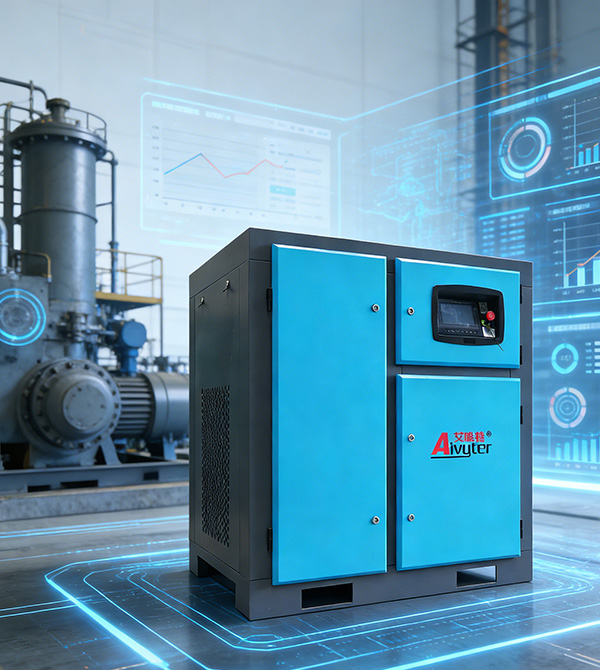
Conventional screw compressors rely on induction motors (IE3 or IE4 class) with a separate drive coupling or belt. The PM screw air compressor uses a rotor with embedded rare-earth magnets, creating a constant magnetic field. Key technical differences include:
- Higher efficiency at low speed – PM motors maintain >90% efficiency down to 20% of rated speed, whereas induction motors drop below 80%.
- Unity power factor – PM motors operate near 0.98–0.99 power factor across the speed range, reducing reactive power draw and transformer load.
- Direct drive construction – No gears or belts; the airend mounts directly on the motor shaft, eliminating mechanical losses (3–5% saved) and reducing bearing wear.
Field measurements from a copper mine in Chile (600 CFM system) showed that replacing an IE3 induction screw unit with a PM screw air compressor reduced specific power from 6.8 kW/m³/min to 5.3 kW/m³/min – a 22% drop. The payback period was 11 months based on 6,000 operating hours per year at $0.12/kWh.
2. Technical Anatomy: Variable Frequency Drive (VFD) Integration & Control Logic
The true intelligence of a PM screw compressor lies in its dedicated VFD (also called a frequency converter). Unlike standard VFDs that may cause torque ripple at low speeds, PM-optimized drives use field-oriented control (FOC) to maintain constant torque down to 10 Hz. This enables three distinct operating modes:
- Constant pressure control – A pressure transducer sends real-time feedback; the drive adjusts motor speed to hold pressure within ±0.2 bar, eliminating the deadband of on/off or load/unload cycles.
- Sleep/wake logic – When air demand drops below 10% of capacity for a set time (e.g., 30 seconds), the motor stops completely. It restarts instantly when pressure falls 0.5 bar below setpoint.
- Dual-pressure setpoint scheduling – Program lower night pressure (e.g., 6 bar) and higher daytime pressure (8 bar) to match process requirements, further reducing energy use.
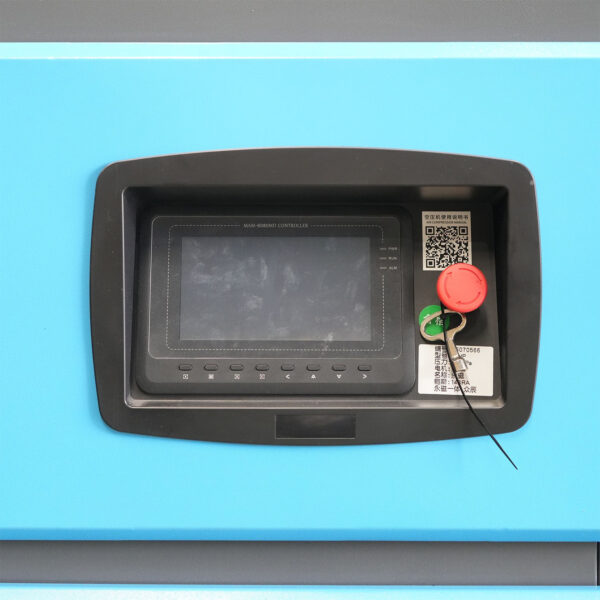
Advanced models from manufacturers like Aivyter include a built-in data logger that tracks energy consumption per cubic meter, allowing plant managers to benchmark performance against ISO 50001 standards.
3. Application-Specific Performance: Mining, Tunneling & Large Workshops
Different industrial environments place distinct demands on the compressed air system. The PM screw air compressor excels where flow fluctuates or pressure stability is mission-critical.
3.1 Underground & Surface Mining
Drilling rigs, DTH hammers, and ventilation bag inflation see rapid changes in air demand as multiple tools cycle on and off. A fixed-speed unit would spend 30–40% of its time unloaded (running but not producing air), wasting fuel in diesel-driven portables or electricity in stationary plants. PM screw technology matches air output to demand in real time. Case study: A Nevada gold mine installed a 200 kW PM screw compressor for its rock drill fleet; unloaded hours dropped from 42% to 7%, saving 340,000 kWh annually.
3.2 Heavy Fabrication & Shipyards
Sandblasting, painting, and pneumatic conveying require stable pressure. Pressure drops below 6.0 bar cause nozzle inefficiency and reject paint finishes. The PM screw compressor’s rapid response (0.2 seconds from 20% to 100% speed) holds setpoint within 0.1 bar, improving coating consistency and reducing rework.
3.3 Tunneling Projects (TBM Support)
Tunnel boring machine auxiliary systems (grout pumps, dust collectors, and shield seals) operate on intermittent cycles. PM variable speed reduces thermal stress on the airend because the compressor runs slower during low-demand periods, extending bearing and lubricant life by up to 30% compared to load/unload operation.
4. Total Cost of Ownership (TCO) Model: Energy, Maintenance & Lifetime Value
Procurement decisions based solely on initial capital often overlook the dominant cost driver – energy. A detailed TCO analysis for a 75 kW (100 HP) system operating 6,000 hours/year at $0.10/kWh reveals:
- Annual energy cost (fixed-speed, 70% average load) – 75 kW × 6,000 h × 0.70 × $0.10 = $31,500
- Annual energy cost (PM VSD, 70% average load) – 75 kW × 6,000 h × 0.70 × $0.10 × (1 – 0.28) = $22,680
- Annual savings – $8,820 (28% reduction)
Over 10 years, this exceeds $88,000 – more than the compressor’s purchase price. Additional savings come from reduced maintenance: PM motors have no rotor bars or end rings that crack; they run cooler at low speeds, lowering oil degradation. Filter and lubricant change intervals can be extended by 20–30%.
Operators working with Aivyter can request a site-specific TCO calculator that accounts for local electricity tariffs, duty cycles, and altitude corrections.
5. Critical Installation & Integration Considerations for PM Screw Compressors
While PM technology offers significant advantages, successful implementation requires attention to a few engineering details:
- Harmonic filtering – The VFD generates harmonic currents (typically 5th, 7th, 11th). For plants with sensitive electronics or power factor correction banks, specify an integrated DC choke or an external 3% line reactor. Many modern PM drives meet IEEE 519 limits without additional filters.
- Ambient temperature rating – PM motors have magnets that lose strength above 150°C. Quality units use thermal protection (PTC sensors) and derate above 45°C ambient. For desert or foundry locations, choose an enclosure with forced ventilation or a water-cooled version.
- Air receiver sizing – Because the VSD can respond quickly, the receiver tank can be 30–40% smaller than for a fixed-speed unit. However, a minimum tank volume of 5–10 gallons per CFM is still recommended to dampen sudden demand spikes.
Electrical contractors should verify that the upstream transformer and cables support the VFD’s peak current (typically 1.2× full load amps). Aivyter’s installation manuals include detailed wiring diagrams and EMC (electromagnetic compatibility) guidelines.
6. Maintenance Protocols for Long-Term Reliability in Harsh Environments
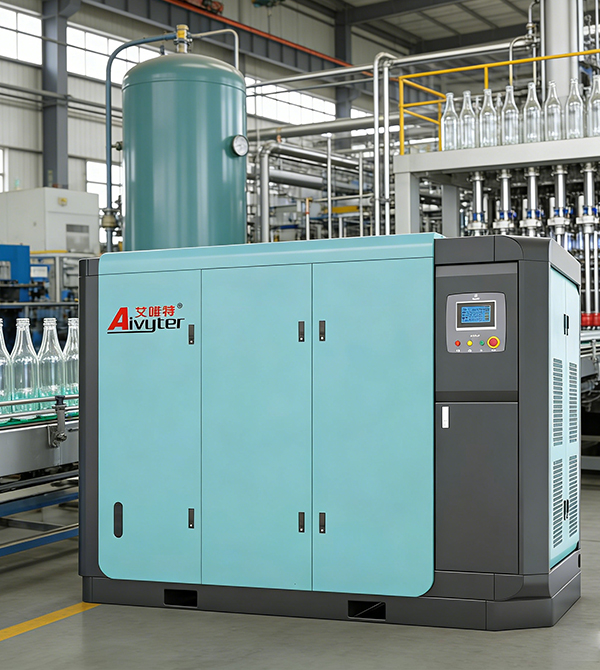
A PM screw compressor contains sensitive electronics and precision magnets. Adopt these best practices to maximize uptime:
- Clean the VFD cabinet regularly – Dust accumulation on heatsinks causes overtemperature faults. Use a vacuum with non-conductive nozzle every 500 hours in cement or mining applications.
- Check motor insulation resistance – PM motors can demagnetize if short-circuited. Measure insulation resistance to ground every 2,000 hours; replace if below 5 MΩ.
- Lubricant analysis – Because the compressor runs at variable speeds, oxidation may occur faster at low speeds (lower oil sump temperature). Semi-synthetic or full-synthetic oils with high viscosity index (ISO VG 46 or 68) are recommended. Change oil when TAN (total acid number) exceeds 1.5 mg KOH/g.
Remote monitoring platforms (Modbus RTU, Profibus, or Ethernet/IP) allow predictive maintenance. One food packaging plant reduced unplanned stops by 67% after installing vibration sensors on the PM motor bearings and trending data through a cloud dashboard.
Frequently Asked Questions (FAQ)
Q1: What is the typical efficiency gain of a PM screw air compressor compared to a standard induction screw compressor?
A1: At full load, the gain is modest (2–4% higher due to lower stator losses). However, the real advantage appears at part-load (40–70% of full flow), where PM systems are 15–30% more efficient because they avoid unloading losses and reduce speed. For facilities with fluctuating demand (e.g., multi-shift operations, intermittent tool use), annual energy savings of 25–35% are common.
Q2: Can a PM screw air compressor operate without a VFD?
A2: Technically yes – a PM motor can be started across the line using a soft starter, but this removes the speed control benefit and may cause high inrush current (6–8× FLA). Without VFD, the motor behaves like a fixed-speed unit, wasting the investment. All commercial PM screw compressors are sold as integrated VFD packages. Attempting to run a PM motor directly from a contactor risks demagnetization due to uncontrolled current spikes.
Q3: What is the lifespan of the permanent magnets in a PM screw air compressor?
A3: Neodymium-iron-boron (NdFeB) magnets, when operated below 120°C, maintain flux density for over 20 years (less than 5% loss). High-quality units from reputable manufacturers like Aivyter incorporate thermal protection that shuts down the compressor if winding temperature exceeds 130°C. In normal industrial environments (ambient 40°C, clean air), the magnets will outlast the mechanical components (bearings, airend).
Q4: Is a PM screw air compressor suitable for explosive atmospheres (Zone 2 / Class I Div 2)?
A4: Yes, provided the VFD and motor are certified for hazardous locations. The PM motor can be built with increased safety (Ex e) or flameproof (Ex d) enclosures. The VFD must be placed in a purge-pressurized or IP66 remote cabinet. Aivyter offers ATEX / IECEx certified PM screw compressors for petrochemical and underground coal mine applications, with full documentation for regulatory approval.
Q5: How do I properly size a PM screw air compressor for a workshop with multiple intermittent users?
A5: Perform a compressed air demand profile measurement over a typical 8-hour shift. Note the peak flow (CFM) and the minimum flow. Select a PM screw compressor whose maximum capacity equals the peak flow plus 10% margin. Unlike fixed-speed units, you do not need to add a large receiver to cover peaks – the VFD will accelerate within 0.5 seconds. However, ensure the dryer and filters are sized for the peak flow. For highly variable loads (e.g., sandblasting + painting), consider a master controller that manages multiple compressors, with the PM unit acting as the trim compressor.
Optimize your plant’s energy efficiency with a next-generation PM screw air compressor. Aivyter provides engineering consultations, on-site energy audits, and custom-built PM screw systems from 15 kW to 315 kW. Send your technical inquiry now to receive a detailed proposal, performance curves, and a 10-year TCO projection tailored to your facility. Click here to contact our engineering team or email [email protected] for a same-day response.
about
Aivyter
We provides trusted air compressors and mining equipment, engineered for durability, efficiency, and demanding industrial applications.