Compressed air is the lifeblood of modern industrial operations—from underground mining pneumatic networks to large-scale construction automation. However, untreated humidity causes corrosion, valve jamming, and costly downtime. The heatless adsorption air dryer remains the gold standard for achieving pressure dew points (PDP) as low as -40°C to -70°C without electric heaters or cooling sources. In this technical guide, we analyse the operating principles, key performance levers, industry-specific pain points, and how Aivyter delivers robust solutions for mission-critical compressed air systems.
1. Operating Principles of a Heatless Adsorption Air Dryer
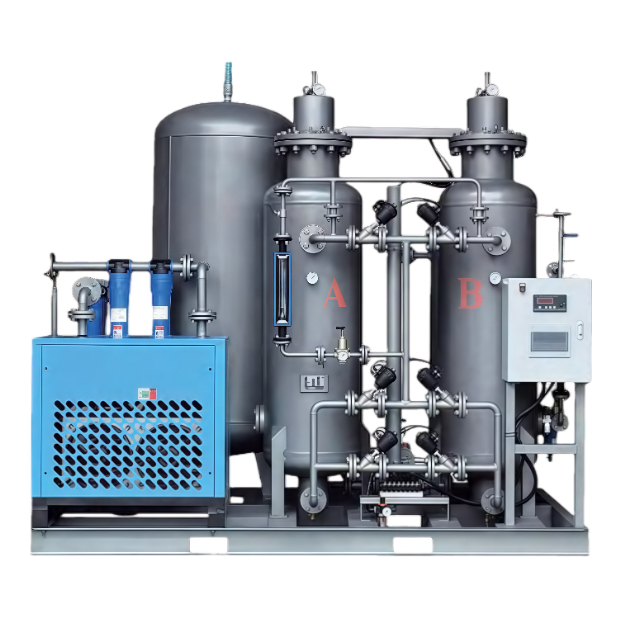
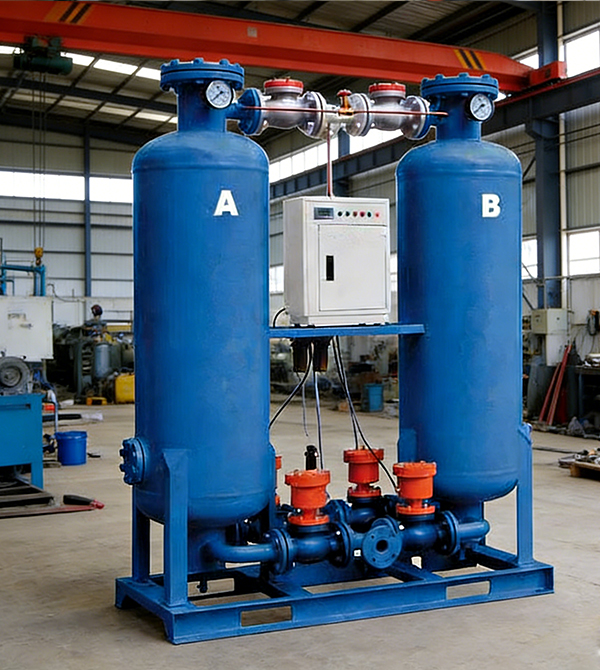
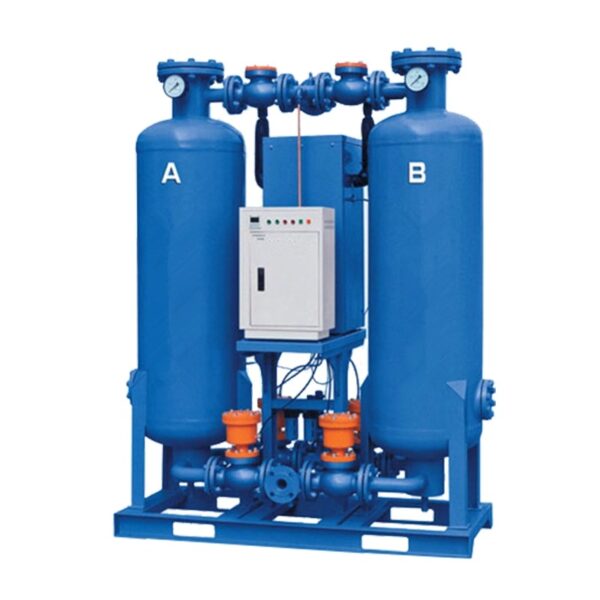
The heatless adsorption air dryer operates on pressure swing adsorption (PSA) principles. Two identical vessels packed with desiccant media (activated alumina, molecular sieve, or silica gel) alternate between drying and regeneration cycles. Wet compressed air enters the online tower, where water vapour is adsorbed onto the desiccant surface. A small portion (typically 12–18%) of dried air is diverted, depressurised to near-atmospheric pressure, and directed to the offline tower. This dry purge air strips accumulated moisture from the desiccant and vents it to the atmosphere via a silencer. After a preset cycle (4–10 minutes), towers switch roles. No external heat source is required, making this design intrinsically safe for hazardous environments such as underground mining and petrochemical facilities.
- Adsorption phase: Pressure maintains at line pressure (4–16 bar) → moisture captured → outlet dew point as low as -70°C.
- Regeneration phase: Depressurisation to 0 bar + dry purge flow → desiccant fully regenerated → ready for next adsorption cycle.
- Control logic: Timer-based or dew-point-demand switching (DPD) minimises purge air waste.
2. Critical Applications in Construction, Engineering & Mining Sectors
Heavy industries face extreme environmental challenges. A heatless adsorption air dryer is not an option but a requirement where moisture causes:
- Pneumatic instrumentation failures: Muddy air blocks I/P converters, positioners, and cylinder valves in mining slurry handling.
- Pipeline freezing in cold climates: Construction sites in Siberia or high-altitude projects need -40°C PDP to avoid ice plugs.
- Sandblasting & painting defects: Water droplets in compressed air cause coating delamination on structural steel.
- Underground drilling rig malfunctions: Humid air contaminates lubricants and accelerates wear on rock drills.
Case study: A large copper mine in Chile upgraded to a heatless adsorption air dryer from Aivyter, reducing pneumatic valve replacement frequency by 73% and eliminating winter freeze-ups in their conveyor control system. Aivyter engineered a high-efficiency purge control that lowered annual compressed air losses by over 110,000 m³.
3. Key Technical Parameters & Performance Metrics
Selecting the correct drying solution requires evaluating several interdependent factors. Below are the non-negotiable specifications for heavy-duty environments:
3.1 Pressure Dew Point (PDP)
ISO 8573-1 classes: Class 2 requires PDP ≤ -40°C; Class 1 requires ≤ -70°C. High-performance adsorption dryers consistently deliver Class 1-2, verified by calibrated dew point sensors.
3.2 Purge Air Consumption
Every heatless adsorption air dryer consumes a fraction of dried air for regeneration. Standard designs use 15–20% of rated flow. Premium units (e.g., Aivyter’s EcoPurge™ series) reduce it to 10–12% without dew point penalty by optimising bed geometry and diffusion systems.
3.3 Inlet Conditions & Pre-filtration
Liquid water and oil aerosols kill desiccant life. Install coalescing filters (≤0.01 ppm oil carryover) upstream. Maximum inlet temperature: 45°C (50°C for special designs). A refrigerated air dryer as a pre-stage can dramatically reduce desiccant load.
4. Addressing Industry Pain Points with Heatless Technology
Plant managers often hesitate due to perceived high operating costs (purge air) or maintenance complexity. However, modern heatless adsorption air dryers solve these directly:
- Pain point: High energy consumption. → Solution: Advanced sequencing with dew-point-dependent switching (DPD) reduces purge cycles by up to 35% during low demand periods.
- Pain point: Desiccant dusting and downstream contamination. → Solution: Integrated after-filters with differential pressure monitoring; Aivyter uses high-crush-strength desiccants (≥95% attrition resistance).
- Pain point: Remote site reliability. → Solution: Heatless designs have no heating elements or rotating parts; a simple PLC and robust pneumatic valves achieve MTBF >80,000 hours.
- Pain point: Frequent valve failures in dirty environments. → Solution: Aivyter’s heavy-duty poppet valves with PTFE seats withstand abrasive dust and corrosive gases common in mining.
5. Innovations in Purge Air Saving & Control Logic
The industry has moved beyond fixed-cycle timers. Today’s heatless adsorption air dryer incorporates:
- Demand-based regeneration: Microprocessor monitors outlet dew point; regeneration only initiates when PDP rises above setpoint (e.g., -40°C). Saves 20-40% of purge air.
- Rapid depressurisation valves: Reduce blow-down time from 30 seconds to 8 seconds, capturing more pressure energy and minimising peak purge flow.
- Smart tower pre-pressurisation: Gradually repressurises the regenerated tower before switchover, eliminating pressure spikes that destabilise downstream instruments.
For large engineering projects (tunnelling, LNG terminals), Aivyter provides custom control panels with remote SCADA integration, allowing operators to monitor purge ratios, dew point trends, and remaining desiccant life from central control rooms.
6. Selecting a Reliable Heatless Adsorption Air Dryer: 5 Criteria
Not all dryers perform equally under continuous heavy loads. Use these engineering criteria during procurement:
- Validated performance data: Request independent PDP tests at maximum flow and highest inlet temperature (+40°C, saturation).
- Purge efficiency certificate: A transparent spec sheet must state purge rate at given PDP. Avoid generic “low consumption” claims.
- Valve cycle endurance: Pneumatic or solenoid valves should be rated for >2 million cycles. Aivyter’s valve blocks are tested to 3 million cycles under dust ingress (IP66).
- Desiccant replacement access: Top-fill / bottom-drain ports simplify field service without removing vessels.
- Safety certifications: For mining (ATEX, IECEx) or oil & gas (NACE), ensure the control system and valves meet Zone 2 / Class I, Div 2 requirements.
7. Maintenance Best Practices to Extend Service Life
With proper care, a heatless adsorption air dryer operates 10+ years. Follow this regimen:
- Daily: Check differential pressure across prefilters and afterfilters (max 0.35 bar drop). Listen for abnormal valve cycling noises.
- Monthly: Verify purge exhaust silencer isn’t clogged; measure dew point with a portable tester.
- Quarterly: Inspect desiccant bed level (top-up if required). Test tower changeover timing for deviations >5%.
- Annually: Replace pilot filters, lubricate pneumatic actuators (non-fouling grease). Perform a full pressure drop test across each tower.
- Desiccant replacement interval: Typical 3–5 years depending on inlet oil contamination. Aivyter offers a desiccant reloading service with minimal system downtime.
8. Why Aivyter Dominates the Heavy Industry Segment
With over 15 years of engineering in compression drying systems, Aivyter has deployed more than 2,800 heatless adsorption air dryers across mining, tunnelling, offshore platforms, and heavy engineering. Differentiators include:
- Patented low-pressure-drop diffuser plates that reduce purge consumption by 18% compared to market averages.
- Heavy-duty stainless steel valves and corrosion-resistant vessels for saline or acidic environments (e.g., fertilizer plants).
- Global service network with 48-hour parts dispatch for critical mining territories.
- Full traceability to ISO 9001:2015 and pressure vessel certifications (PED, ASME).
Every unit is factory-tested with real-time dew point mapping to guarantee performance at project-specific conditions.
Frequently Asked Questions (FAQ)
Q1: What is the typical purge air loss of a heatless adsorption air dryer, and can it be recovered?
A1: Standard designs lose 15–20% of the rated flow as purge air. Advanced units (including Aivyter’s EcoPurge) reduce this to 10–12% through optimised orifice sizing and dew-point-demand switching. While purge air cannot be fully eliminated, pairing the dryer with a compressor heat recovery system can offset energy costs. In critical low-flow periods, a DPD controller can postpone regeneration and cut effective losses to below 8%.
Q2: How does a heatless adsorption air dryer differ from a refrigerated dryer for mining applications?
A2: Refrigerated dryers achieve +3°C PDP and cannot prevent freezing in sub-zero ambient conditions or pipelines. They also require stable electrical supply. A heatless adsorption air dryer provides -40°C to -70°C PDP, operates without electric heating (intrinsic safety for mines), and functions in ambient temperatures from -20°C to +50°C. For critical instrumentation in explosive zones, adsorption technology is mandatory.
Q3: What desiccant material is best for aggressive environments (high CO₂ or acidic gases)?
A3: Standard activated alumina degrades in acidic conditions. For mining waste gas or biogas, Aivyter recommends high-silica molecular sieve (Type 3A or 4A) or specially impregnated alumina. These resist chemical poisoning and maintain surface area. Always install a coalescing pre-filter with activated carbon layer to remove hydrocarbons before the adsorption dryer.
Q4: Can a heatless adsorption air dryer be retrofitted to existing compressed air systems without piping modifications?
A4: Yes, most heatless adsorption air dryers are designed as skid-mounted units with standard flanged or threaded connections (DN50 to DN300). Minimal bypass piping and a pre-filter housing are required. Aivyter provides free layout drawings and on-site installation supervision for heavy industry clients, ensuring pressure drop remains below 0.2 bar.
Q5: How often should the desiccant be replaced in a dust-laden construction site?
A5: Replace desiccant every 4,000–8,000 operating hours if inlet particulate filtration is inadequate (only 5 μm pre-filter). With proper pre-filtration (1 μm coalescing + 0.01 ppm oil removal), desiccant life extends to 12,000–20,000 hours. Aivyter installs differential pressure indicators that signal desiccant degradation 500 hours before breakthrough. For cement or mining sites, using a high-capacity dust filter upstream doubles desiccant service life.
Q6: Does the heatless adsorption air dryer need a special ventilation or exhaust system?
A6: The purge exhaust releases moisture-saturated air at near-ambient pressure. In confined spaces (underground mines, containerised compressor rooms), duct the exhaust silencer to outside ventilation. Aivyter offers explosion-proof vent kits with flame arrestors, essential for methane-prone coal mines. The exhaust must not be obstructed, or regeneration efficiency drops.
Need a site-specific evaluation? Our engineering team provides free dew point analysis and life-cycle cost comparisons for any heavy-duty application.
Contact Aivyter today to discuss your compressed air challenges. Request a quote, technical datasheet, or a customised heatless adsorption air dryer solution for mining, construction, or industrial engineering projects. Send an inquiry →
about
Aivyter
We provides trusted air compressors and mining equipment, engineered for durability, efficiency, and demanding industrial applications.