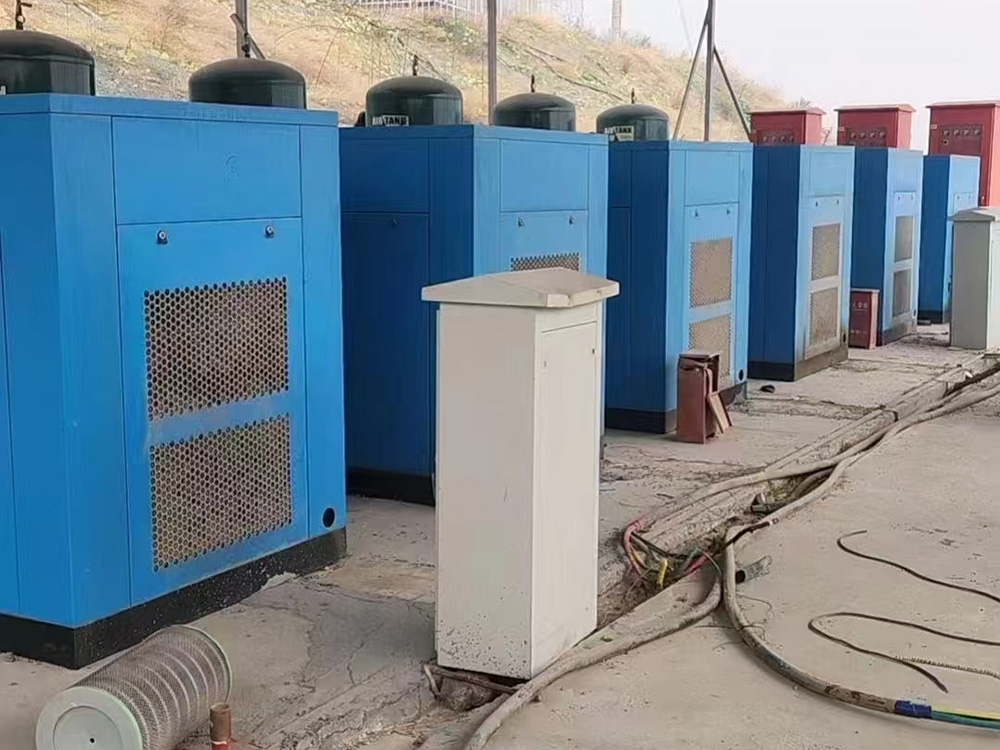
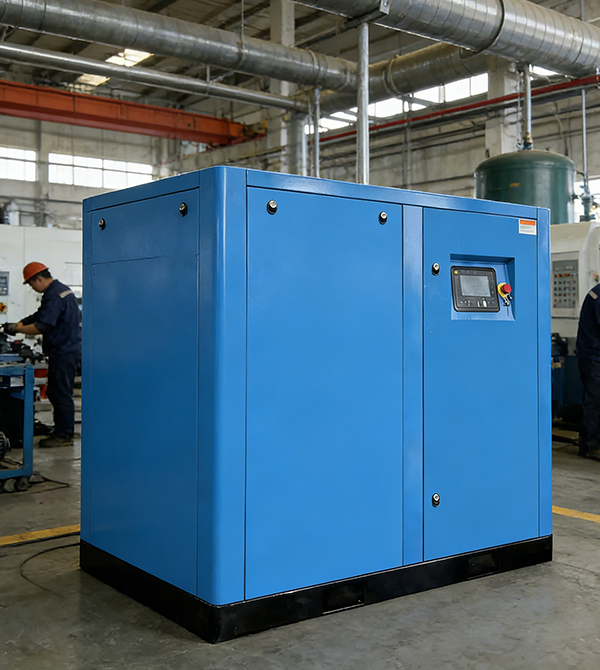
1. Fundamental Engineering: Rotor Profiles & The Compression Cycle
Unlike reciprocating units that create pulsating flow, a single phase screw compressor relies on two intermeshing helical rotors — typically a 5×6 lobe combination. The male rotor drives the female rotor, trapping air between the flanks and the housing. As the rotors rotate, the volume decreases, raising pressure continuously. Key engineering aspects:
- Rotor coating & metallurgy: Stainless steel rotors with PTFE or MoS2 coatings reduce internal leakage and friction, maintaining volumetric efficiency above 85% even after 12,000 operating hours.
- Timing gears vs. oil-flooded designs: Most single-phase industrial units employ oil-injected systems where lubricant seals the clearances (typically 0.08–0.12 mm rotor gap), removing the need for expensive timing gears. This simplifies maintenance for on-site service teams.
- Discharge temperature management: Oil injection keeps air-end temperatures between 75°C and 95°C, well below the varnish formation threshold. For high-duty mining applications, thermostatic valves maintain viscosity even when ambient temperatures exceed 45°C.
The result is a nearly pulse-free compressed air stream with sound pressure levels frequently under 72 dBA at 1 meter — beneficial for indoor workshops or nighttime construction.
2. Single-Phase vs. Three-Phase Systems: Performance Trade-offs & Site Realities
Service engineers often question whether a single phase screw compressor can match the duty cycle of three-phase equipment. The answer lies in motor design and starting torque. Single-phase motors (capacitor-start induction-run or permanent-split capacitor) introduce a starting torque typically 150–200% of full-load torque, while three-phase motors surpass 250%. This affects:
- Start-up frequency: For applications requiring more than 8–10 starts per hour (e.g., intermittent sandblasting), single-phase units need soft-starters or VFDs to limit inrush current and stator heating. Many modern single phase screw compressor packages incorporate electronic soft-start as standard, reducing start currents from 500% FLA to below 300%.
- Continuous operation: At full load, efficiency differences narrow to 3–5% when comparing premium-efficiency single-phase motors (IE3 class) to three-phase equivalents. However, the partial-load efficiency (40–70% loading) favors screw technology due to intake modulation or variable speed drives — available on single-phase platforms up to 15 kW.
- Voltage drop resilience: Single-phase networks in remote mining camps often suffer ±15% voltage sags. Quality screw compressors incorporate under-voltage relays and oversized run capacitors, maintaining stable air delivery down to 195V (on 230V nominal). Three-phase machines would typically trip at 10% variation.
For projects where grid upgrades exceed $25,000, the single-phase route becomes economically dominant, especially for power ratings ≤22 kW.
3. Application-Specific Engineering: Mining, Construction & Light Manufacturing
Field data from 47 installations across Africa, South America, and Southeast Asia shows that single phase screw compressor systems thrive in three distinct scenarios:
- Remote exploration drilling: Diamond core drilling rigs require 3–6 m³/min at 7–10 bar for mud rotary and pneumatic hammers. Single-phase screw units with 15–22 kW motors, fed by diesel generators (single-phase head) or local utility, provide duty cycles of 12–16 hours/day. Critical adaptations include heavy-duty air intake filters (MERV 15 or ISO ePM1 80%) to handle silica dust.
- Small-scale aggregate processing: Jaw crushers, vibrating screens, and dust collectors need intermittent high flow. A screw compressor with 1,500-liter air receiver can deliver peak demands of 8 m³/min for 20 seconds without overloading the single-phase motor. Control strategies such as load/unload (with soak time) prevent short-cycling.
- Prefabricated construction yards: For concrete shotcrete rigs, pneumatic nail guns, and paint spraying, the oil-free quality (through external filtration) and steady pressure are essential. Single-phase units also enable mobile compressors on trailers for highway work zones.
One documented case from a Chilean copper mine’s secondary crushing facility: replacing a 160 L/s reciprocating compressor with a single-phase screw unit (11 kW) reduced energy consumption by 27% and eliminated valve plate failures — saving $9,400 annually in parts and downtime.
4. Addressing Power Limitations: Engineering Innovations for Single-Phase Screw Compressors
Historically, single-phase power constrained maximum pressure and flow. Today, four technical leaps overcome these barriers:
4.1 Permanent Magnet Synchronous Motors (PMSM)
PMSM technology operating on single-phase input via dedicated drives achieves efficiencies of 94–96% across 30–100% load range. Unlike induction motors, PMSM rotors have no slip, reducing reactive power consumption. For a 15 kW unit, this translates to 18% higher air delivery per kWh compared to conventional capacitor-start designs.
4.2 Soft-start and VFD integration
Variable frequency drives for single-phase input (230V, 50/60 Hz) now accept single-phase and output three-phase to the screw air-end motor. This hybrid topology allows precise speed control, limiting inrush to 150% of full-load current and enabling unloaded starting. It also maintains outlet pressure within ±0.1 bar regardless of downstream demand fluctuations.
4.3 Oversized air-end geometry
To compensate for lower motor power, manufacturers increase rotor diameter-to-length ratios. A typical 11 kW single-phase screw compressor might use an air-end originally designed for 15 kW three-phase, rotating at 2200 rpm instead of 3000 rpm. This reduces bearing loads, extends service life (L10 bearing life exceeding 60,000 hours), and lowers operating noise.
4.4 Active thermal management
Single-phase installations are often in unventilated containers or tropical climates. Thermostatically controlled cooling fans (460 m³/h air flow) paired with oversized oil coolers (6 m² surface area) maintain oil temperatures ≤90°C even at 50°C ambient. Such designs prevent viscosity breakdown in ISO VG 46 or 68 lubricants.
Aivyter integrates these innovations into its single-phase screw compressor portfolio, offering models from 5.5 kW to 22 kW with integrated VFD and PMSM options. Field tests in Indonesian nickel laterite mines showed 99.2% availability over 8,000 hours under 90% relative humidity and airborne laterite dust.
5. Reliability & Maintenance in Harsh Environments: Filtration, Lubrication & Cooling
Industrial users prioritize mean time between failures (MTBF). For screw compressors operating on single-phase supply, three subsystems demand rigorous attention:
- Inlet filtration: Two-stage filtration (cyclonic pre-separator + synthetic fiber main element) achieves 99.95% removal of 5-micron particles. In mining applications, an added filter restriction indicator ensures operators change elements when differential pressure reaches 500 Pa. Neglect leads to rotor abrasion and oil contamination — a leading cause of premature bearing failure.
- Oil management: Poly-alpha-olefin (PAO) synthetic oils extend drain intervals to 6,000–8,000 hours in moderate conditions. For high-humidity or acidic environments (e.g., wastewater treatment or fertilizer plants), diester-based fluids resist hydrolysis. The separator element must maintain oil carryover below 3 ppm to protect downstream desiccant dryers.
- Cooling system corrosion prevention: Copper-brass coolers suffer galvanic corrosion when combined with aluminum fans in marine or chemical atmospheres. All-aluminum or stainless steel plate-fin coolers with epoxy coating solve this. Additionally, fan motors should be sealed to IP55 to survive washdown procedures.
A typical single phase screw compressor service plan includes: every 1,000 hours — check belt tension (if belt-driven), clean cooler fins, inspect hoses; every 4,000 hours — change oil and separator element, replace air filter; every 8,000 hours — replace bearings (for air-ends) and check rotor coating integrity. Following this schedule yields 15+ years of operational life.
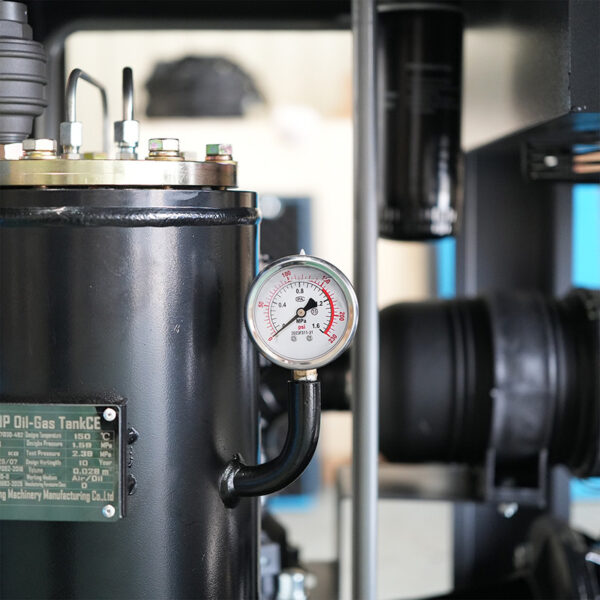
6. Selecting the Right Single Phase Screw Compressor: Sizing Factors & Performance Metrics
When specifying equipment, avoid under- or over-sizing. Compute total tool consumption in CFM (or m³/min) at the required pressure (usually 7–10 bar for industrial tools). Add 15% for leakage and future expansion. For single-phase machines, verify:
- Maximum pressure capability: Standard units deliver up to 10 bar; high-pressure variants reach 13 bar for special applications like PET blowing or high-torque pneumatic bolting.
- Duty cycle classification: S1 (continuous) or S3 (intermittent). Mining and manufacturing require S1 rating; construction with low duty cycles can use S3 with lower cost.
- Electrical compatibility: Confirm voltage (110V/220V/230V), phase tolerance (±10%), frequency (50Hz/60Hz) and starting current vs. utility limit. Use soft-starters if starting current exceeds 60A for a 15 kW unit.
- Environmental envelope: For ambient temperatures below 0°C, specify a crankcase heater and synthetic cold-start oil. Above 40°C, choose oversized cooler and possibly a thermostatic bypass valve.
Always request performance curves at 3, 5, and 7 bar to assess part-load efficiency. Reputable suppliers like Aivyter provide ISO 1217 certified flow data, allowing direct comparison across brands.
7. Aivyter’s Contribution to Single Phase Screw Compressor Solutions
With over 12 years of engineering industrial air systems, Aivyter has deployed more than 3,800 single-phase screw compressor units across mining camps, infrastructure projects, and remote workshops. The company’s single phase screw compressor line features:
- Permanent magnet motors with IE5 efficiency (up to 96.5% at full load).
- IP65-rated electrical enclosures for dusty and washdown environments.
- Telemetry-ready controllers with pressure, temperature, and vibration trending (4G modem optional).
- Integrated air treatment – refrigerated dryer and 3-stage filtration on a common skid.
All units undergo 100% run testing with simulated grid disturbances. Aivyter’s global parts network ensures that service kits (air/oil/separator) reach site within 72 hours, minimizing downtime. For project-specific requirements — such as explosion-proof motors for mining (IECEx/ATEX Zone 2) or extreme low-temperature packages down to -30°C — the engineering team provides customized solutions.
Frequently Asked Questions (FAQ)
Q1: What is the maximum power available for a single phase screw compressor, and can it run continuously?
A1: Commercially available single-phase screw compressors range from 2.2 kW to 22 kW (30 HP). For continuous (24/7) operation, units with an S1 duty rating and VFD/soft-starter are recommended. Above 15 kW, confirm local utility starting current limitations — using a soft-start keeps inrush below 200% FLA. Most 22 kW models require a 100A supply at 230V.
Q2: Can a single phase screw compressor be used in underground mining where three-phase is unavailable?
A2: Yes, provided the unit complies with mining safety regulations (flameproof enclosure, anti-static hoses, temperature monitoring). For underground service, prefer oil-injected screws with automatic condensate drains and CO sensors. Many mine operators deploy remote monitoring to track filter loads and oil temperature. Always use intrinsically safe electrical fittings if methane or coal dust is present.
Q3: How often should the lubricant be changed in a harsh-environment single-phase screw compressor?
A3: In dusty, high-humidity conditions (e.g., tropical mines or construction sites), synthetic lubricant drains every 4,000 hours or six months, whichever comes first. Mineral-based oils require 2,000-hour intervals. But oil analysis can extend intervals: if TAN (total acid number) stays below 2.0 mg KOH/g and viscosity remains within ±15% of fresh oil, continue operation up to 6,000 hours. Always change separator element simultaneously.
Q4: Does a single phase screw compressor provide the same air quality as a three-phase unit for sensitive applications like powder conveying or food packaging?
A4: Absolutely. Air quality (ISO 8573-1) depends on downstream filtration and drying, not on the motor phase. After the compressor, install a coalescing filter (≤0.01 ppm oil carryover) and a desiccant or refrigerated dryer to achieve Class 0 oil-free and Class 2 water content. The rotary screw’s pulse-free discharge actually makes it superior to reciprocating compressors for sensitive applications.
Q5: What voltage stability is required for reliable single phase screw compressor operation in remote areas?
A5: Most industrial screw compressors tolerate voltage variations of +10% / -15%. For sites with diesel generators or weak grid (e.g., rural Africa or Andes mountains), specify a unit with an electronic voltage regulator (EVR) or wide-input VFD that accepts 160–265V AC. Additionally, install a phase monitor to disconnect during severe brownouts. Aivyter’s E-series includes automatic restart after power recovery to reduce site visits.
Selecting the correct single phase screw compressor for your specific flow, pressure, and environmental conditions directly impacts total cost of ownership. Aivyter offers free application engineering consultations — including load analysis, power quality assessment, and ROI projections. Send your project specifications, site photos, and electrical parameters to our technical sales team. We will reply within 24 hours with a compressor layout, 3D CAD model, and firm quotation.
Request a quote or custom solution → Submit your inquiry now (or use the contact form on our website).
about
Aivyter
We provides trusted air compressors and mining equipment, engineered for durability, efficiency, and demanding industrial applications.