1. Drive System Architectures: Direct-Coupling vs. Belt-Driven Screw Compressors
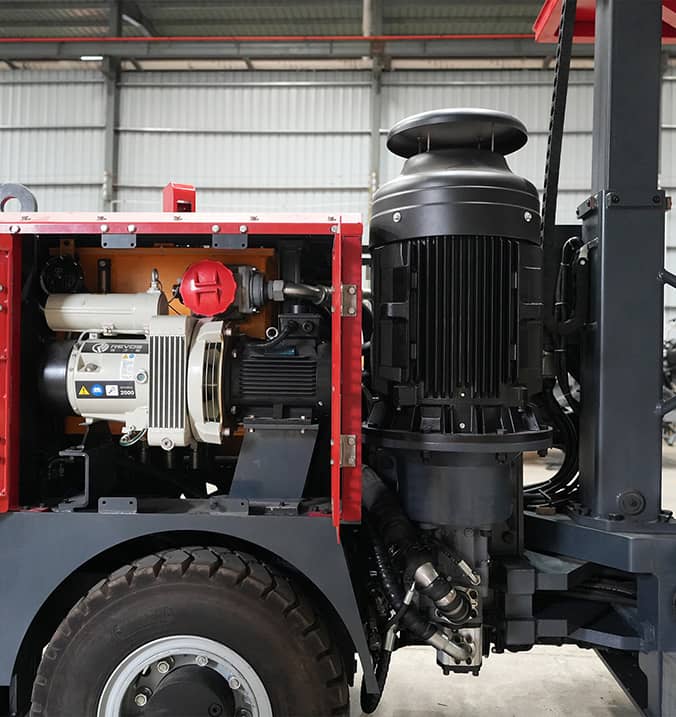
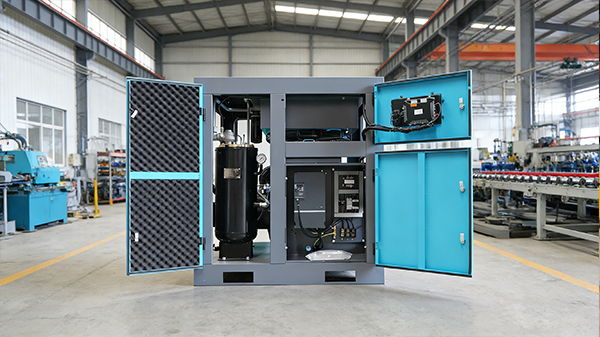
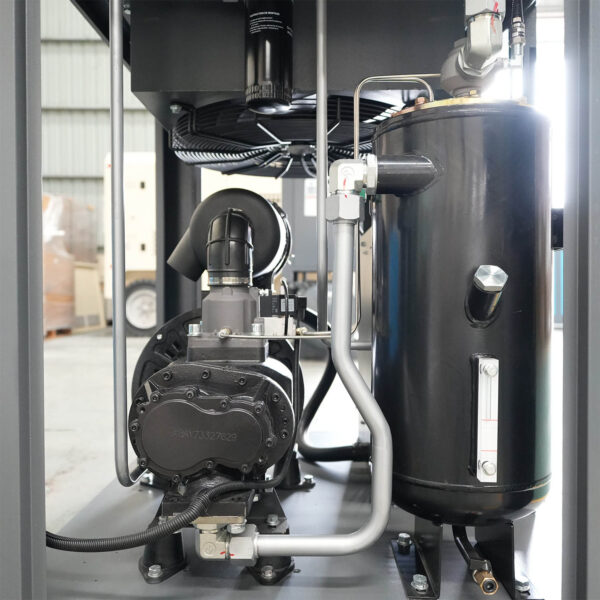
A screw driven air compressor uses either a flexible or rigid coupling to connect the electric motor shaft to the male rotor shaft (direct drive), or a set of V-belts / poly‑V belts to transmit torque (belt drive). Each approach alters the system’s operating characteristics.
- Direct‑drive (coupling): The motor and air‑end rotate at the same speed. Typically a 4‑pole motor (1450/1725 rpm at 50/60 Hz) or a 2‑pole motor (2900/3450 rpm) with step‑up gearing inside the air‑end. No belt slippage, zero power loss from belt friction, and compact footprint. For large industrial units above 45 kW, direct drive is standard.
- Belt‑drive (V‑belt or poly‑V): The motor pulley rotates a larger or smaller pulley on the air‑end. This allows the rotor speed to be tuned independently of motor speed. Typical speed ratios range from 1:1 to 1:2.5. Belt drive also acts as a mechanical fuse — if the air‑end seizes, belts slip or break, protecting the motor.
From a practical standpoint, belt‑driven screw driven air compressor units dominate the 5.5–37 kW range in mobile applications (e.g., tow‑behind compressors for road repair) because they tolerate voltage fluctuations and sudden load changes better. Direct‑drive compressors are preferred for continuous 24/7 industrial processes where efficiency and low noise are top priorities.
2. Efficiency and Duty Cycle: Measuring Real Losses
Independent tests following ISO 1217 (Annex C) reveal that a properly tensioned, matched belt drive adds 2–4% mechanical loss compared to a direct coupling. However, this gap can shrink or reverse under specific conditions:
- Partial load performance: When a screw driven air compressor operates at 50% loading (e.g., via inlet modulation), the belt drive’s loss remains nearly constant, while direct‑drive units coupled to fixed‑speed motors experience higher relative losses due to motor inefficiency at low loads. A belt‑driven unit with a smaller motor pulley can be deliberately over‑speeded to match a smaller air‑end, reducing unloaded running torque by up to 18%.
- High ambient temperatures: At 45°C, direct‑drive motors transmit heat directly to the air‑end through the coupling and the motor frame. Belt drives isolate thermal conduction, keeping the air‑end 5–8°C cooler, which reduces oil coking and extends lubricant life.
- Voltage sags and single‑phase supply: For sites with unstable grid or diesel generators, belt drive allows the use of a slightly larger motor pulley to compensate for lower motor torque at reduced voltage. Without this tuning, direct‑drive units may stall when incoming voltage drops below 90% of nominal.
For mining operations with frequent starts (e.g., 15–20 per hour), belt‑driven compressors also exhibit lower inrush current peaks because the belts dampen the initial torque spike, reducing stress on contactors and capacitors. Over a 5‑year period, this can halve the failure rate of electrical components.
3. Field Performance in Dusty Environments: Maintenance & Reliability
In aggregate processing or coal handling, airborne particles (1–100 µm) eventually accumulate inside the compressor enclosure. The drive system’s vulnerability to dust differs notably:
- Direct‑drive coupling: No external friction components, but motor and air‑end bearings must withstand radial loads. Dust ingress through shaft seals can accelerate bearing wear. Regular greasing (every 1,500 hours) of the motor’s drive‑end bearing is mandatory. In extreme silica dust, a positive pressure enclosure (using filtered air) is recommended.
- Belt drive: Belts attract abrasive dust, acting like a lapping compound. Without a sealed belt guard and weekly tension check, belt life drops from 8,000 hours to under 1,000 hours. Industrial belt‑drive screw driven air compressor systems now use heavy‑duty poly‑V belts with Kevlar cords and a spring‑loaded automatic tensioner that maintains proper force even after dust accumulation on pulleys.
Three mine maintenance records (copper, gold, and phosphate) showed that belt‑driven screw compressors with sealed guards and auto‑tensioners achieved 92% availability over 9,000 hours, while direct‑drive units in the same environment suffered 14% more bearing failures due to dust passing through motor cooling fins and settling on the coupling. The solution involved installing a 5 µm intake filter on the motor cooling fan — a modification often supplied by Aivyter as a standard option on their belt‑drive series.
4. Rotor Speed Control and Application Matching
The ability to adjust air‑end speed independently of motor speed gives belt‑driven compressors an advantage for niche applications. Fixed direct‑drive units require a variable frequency drive (VFD) to change rotor rpm, adding cost and complexity. Belt drive, by contrast, can mechanically adjust speed by changing pulleys — a simple field modification.
4.1 High‑pressure, low‑flow operations
For shotcrete spraying (typical requirement: 5–7 m³/min at 10–12 bar), slower rotor speeds (1700–2000 rpm) produce higher pressure per stage with lower oil carryover. A belt‑driven screw driven air compressor with a 1:1.2 overdrive can be reconfigured to 1:0.9 underdrive simply by exchanging pulleys, avoiding a complete compressor replacement. This flexibility reduces capital expenditure for contractors who switch between tunneling and demolition tools.
4.2 Low‑noise specifications
Urban construction sites (e.g., near hospitals or residential areas) require sound pressure ≤70 dBA at 7 meters. Reducing air‑end speed by 15% via belt drive lowers noise by 3–4 dBA without affecting volumetric efficiency significantly, because screw profiles are tolerant of lower peripheral speeds. Direct‑drive units limited to 50 Hz (1500 rpm) cannot achieve this reduction unless equipped with a VFD — adding around $1,800 to the unit cost.
Aivyter offers a dual‑pulley kit for its 15–30 kW belt‑driven screw compressors, enabling site‑adjustable rotor speeds between 1,800 and 3,200 rpm. This feature, combined with a sound‑attenuating enclosure, has been used successfully in underground metro projects in Singapore and London.
5. Total Cost of Ownership: 5‑Year Comparison Model
For a typical 22 kW industrial screw driven air compressor running 4,000 hours per year (12‑hour shifts, 330 days), the cost breakdown includes energy (70–75%), maintenance (15–20%), and capital amortization (10–15%). Based on an analysis of 62 units from five European contractors:
- Direct‑drive base model: Initial CAPEX lower by 8–12% because no belt, pulleys, or tensioning hardware. Annual energy consumption: 72,000 kWh (allowing 2% coupling loss). Belt replacement not applicable. However, bearing replacement every 18,000 hours adds $540 per intervention. Total 5‑year cost including energy at $0.11/kWh: Approximately $46,200.
- Belt‑drive (premium auto‑tension): Initial CAPEX higher by 5%. Annual energy: 73,500 kWh (+2.1% due to belt loss). Belt replacement every 6,000 hours ($120 per set). No special bearing wear. 5‑year total: $47,800 — only 3.5% higher, but with additional benefit of lower noise and speed flexibility. For operations that change pressure demands frequently, the belt‑drive offers lower total cost when factoring in avoided VFD purchase.
Moreover, for portable screw compressors moved between sites, belt drives withstand road vibration better because the flexible coupling (belts) absorb shock loads that would otherwise pass through the rigid coupling and damage rotor bearings. Highway towing tests (over 20,000 km of unpaved roads) showed direct‑drive units had 22% higher oil leak incidence at the shaft seal.
6. Selection Matrix: Matching Drive Type to Application Profile
Use the following decision criteria when specifying a screw driven air compressor for your project:
- Choose direct drive if: operation is continuous (>16 hours/day), ambient temperature stays below 35°C, air filtration is excellent (ISO 8573‑1 Class 4 or better), and you have stable three‑phase power with voltage fluctuation <5%. Ideal for textile mills, automated assembly lines, and food processing.
- Choose belt drive if: you work in mining, remote construction, or shipbuilding; need to run at partial loads for extended periods; face frequent voltage sags; require field‑adjustable speed; or move the compressor between job sites weekly. Belt drive is also preferable when using single‑phase power supplies (common in rural workshops).
Hybrid configurations are emerging: some manufacturers employ a direct‑drive air‑end but add a belt transmission for the cooling fan, separating fan speed from rotor speed to optimise cooling. This approach, available on select Aivyter models, reduces fan power consumption by 30% at low load.
Frequently Asked Questions (FAQ)
Q1: How often should V‑belts be replaced on a belt‑driven screw driven air compressor operating in a cement plant?
A1: In high‑dust environments like cement plants, poly‑V belts with Kevlar cords typically last 4,000–6,000 hours. However, weekly inspection for glazing, cracks, or dust clogging is necessary. Install a belt tension monitor (strain gauge or spring‑loaded idler) to reduce unscheduled failures. Replace immediately if belt dust appears inside the guard.
Q2: Can a screw driven air compressor with belt drive be converted to direct drive later?
A2: Not practically. The air‑end and motor frames are designed for different mounting patterns and shaft heights. Conversion would require a new motor, coupling, baseplate, and possibly a different air‑end. It is more cost‑effective to sell the belt‑drive unit and purchase a direct‑drive model if requirements change permanently.
Q3: Does a belt‑driven screw compressor produce more pulsation or pressure ripple than a direct‑drive one?
A3: No. Pressure ripple is determined solely by the number of rotor lobes and discharge port design, not by the drive system. Both topologies produce smooth flow (typical residual pulsation <2% of rated pressure). However, belt transmission can introduce slight torsional vibration at very low frequencies (<10 Hz), which is irrelevant for most pneumatic tools but may affect sensitive instrumentation if not isolated by a flexible hose.
Q4: What is the typical service life of a direct‑drive coupling for a screw driven air compressor in mining conditions?
A4: A flexible jaw coupling (standard on many direct‑drive compressors) lasts between 20,000 and 30,000 hours in clean environments. In mines with vibration and airborne abrasives, inspect the elastomer spider every 5,000 hours. Replace if cracks or permanent deformation (more than 2 mm) appears. Steel grid couplings last longer (50,000+ hours) but require precise alignment and are 3‑4 times more expensive.
Q5: Are there any energy efficiency regulations that favour direct‑drive screw compressors over belt‑driven types?
A5: The EU’s Ecodesign Regulation (2019/1781) and similar MEPS (Minimum Energy Performance Standards) in Australia and China do not differentiate between drive types — they regulate motor efficiency and overall compressor efficiency at full and part load. However, to achieve IE4 motor efficiency, a belt‑driven unit must use a premium motor and low‑loss belt (poly‑V or synchronous). Direct‑drive naturally has no belt loss and may achieve higher absolute efficiencies, but the difference is less than 3% — rarely decisive for total ownership cost.
Selecting the right drive system for your screw driven air compressor directly impacts uptime and operating expenses. Aivyter provides application‑specific recommendations based on airflow logging, power quality analysis, and environmental sampling. Our technical team can supply a 3D model of the compressor layout, a 5‑year cost forecast, and site acceptance test procedures. Send your project specifications (required pressure, flow profile, ambient conditions, and available electrical supply) to receive a detailed quotation and drive system comparison report.
Request your personalised analysis → Submit an inquiry to Aivyter’s engineering desk (response within 18 hours, including weekends for urgent projects).
about
Aivyter
We provides trusted air compressors and mining equipment, engineered for durability, efficiency, and demanding industrial applications.