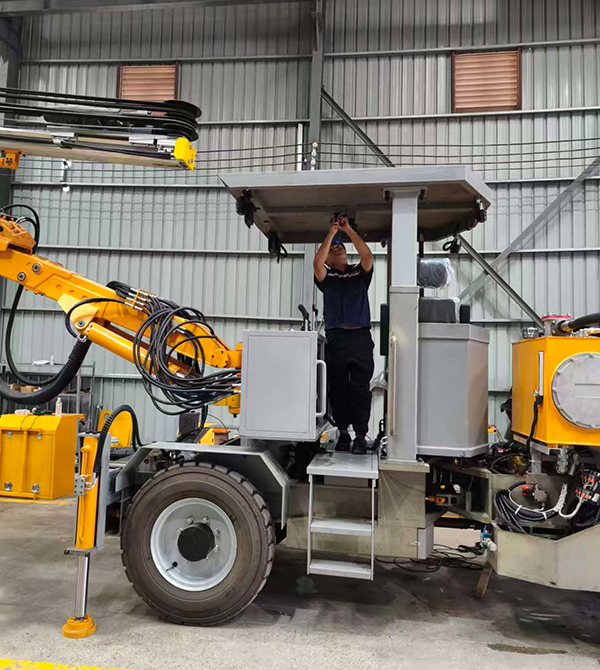
In modern sublevel caving, longhole open stoping, or conventional drifting, the underground mining jumbo remains the central production and development tool. These electro-hydraulic drill rigs determine advance rates, dilution control, and overall project economics. For operations targeting 5–15 m² headings with 3–5 m drilling depths, selecting the correct carrier, boom configuration, and rock drill directly impacts cycle times and cost per meter. This article examines technical parameters, failure modes, automation readiness, and fleet management strategies—drawing on field data from hard-rock mines in Chile, Australia, and Canada.
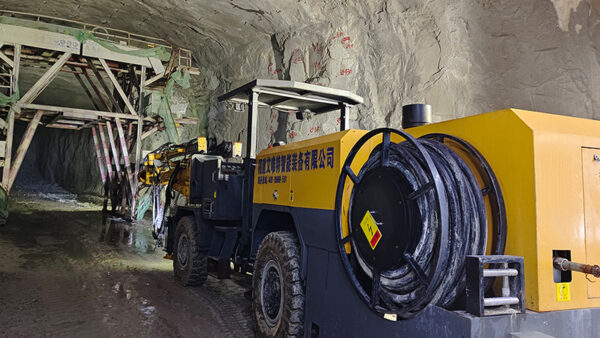
1. Core Architecture of a Modern Underground Mining Jumbo
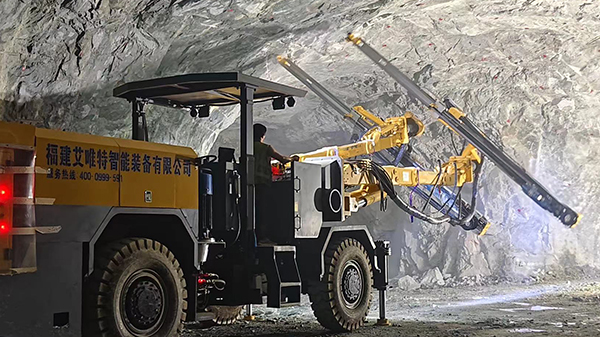
Every underground mining jumbo integrates four critical subsystems: carrier, boom, feed (guide rail), and rock drill. The carrier provides traction and stabilisation; diesel or battery-electric configurations are common, with electric over hydraulic being the industry standard for torque control. Boom types include single-boom (for 4–20 m² faces) or twin-boom (25–34 m²) for large ramp development. The feed length determines maximum drill steel length (typically 3,660–6,100 mm), while rotation and percussion units deliver impact power ranging from 18 kW to 30 kW.
- Boom geometry: Parallel holding and automatic angle compensation reduce overbreak by 20–30% compared to manual rigs.
- Rock drill specs: Frequency-controlled hydraulic impact systems (45–75 Hz) with independent rotation enable adaptation to rock hardness variations (UCS 50–250 MPa).
- Control system: PLC-based or CANbus with proportional joysticks; newer models incorporate hole navigation and drill plan storage.
Aivyter has engineered its AZT series with closed-loop hydraulic regulation, directly addressing common drift deviation issues observed in conventional rigs. Data from a Nevada gold mine showed a 15% reduction in re-drilling after adopting these controls.
2. Critical Technical Parameters & Performance Benchmarks
When specifying an underground mining jumbo, mining engineers must evaluate penetration rate (m/min), collaring accuracy, and drill steel life. Below are real-world baselines from recent project evaluations.
- Penetration rates: In granite (UCS 150 MPa), a 45 kW rock drill achieves 0.8–1.2 m/min with 45 mm bits. In softer ore (UCS 70 MPa), rates exceed 2.0 m/min.
- Hole deviation: High-precision booms with guide compensators keep deviation below 1.5% over 4 m (industry standard ISO 2862-1).
- Drill steel consumption: Optimal coupling and flushing reduce steel costs from $0.45/m to $0.28/m.
- Cycle time analysis: A twin-boom unit drilling 45 holes (4 m depth each) in a 24 m² face typically completes the pattern in 2.2–2.8 hours, including tramming and setup.
Mine planners increasingly demand real-time KPI monitoring. Advanced underground mining jumbo telemetry packages track rotation pressure, feed force, and percussion pressure, allowing predictive replacement of shanks and bushings.
3. Operational Workflows & Application Environments
3.1 Development drifting and crosscuts
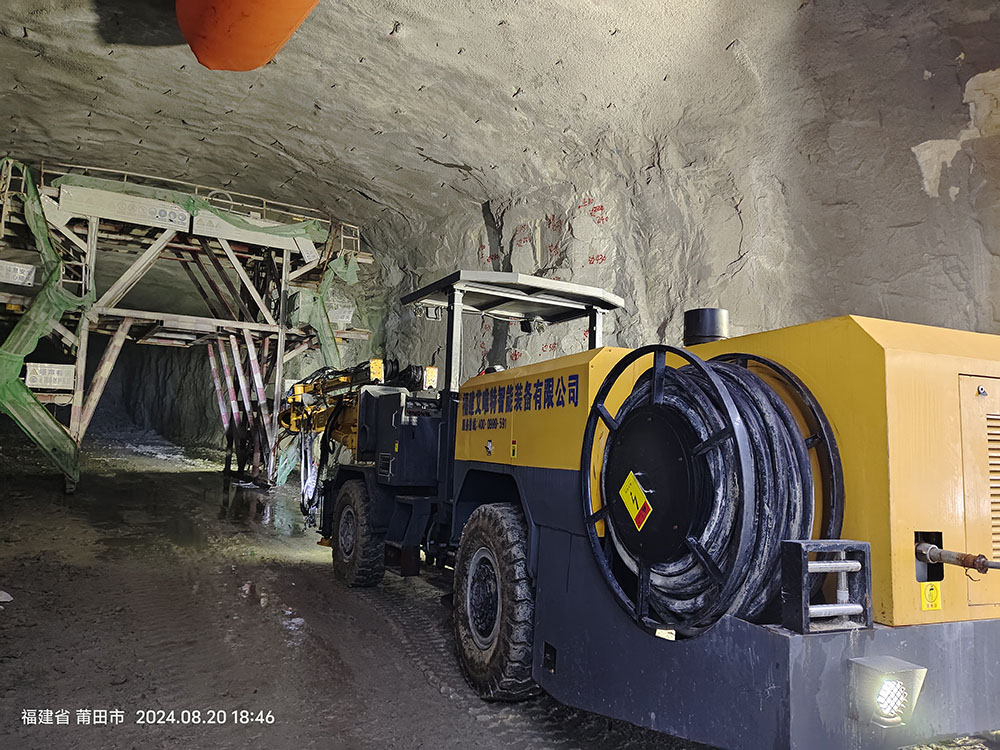
For ramp and decline development, the rig follows a burn-cut or parallel-hole pattern. An underground mining jumbo with semi-automatic drilling sequence reduces overbreak by automatically adjusting feed extension to match contour holes. In western Australian nickel mines, semi-automated jumbos reduced dilution from 12% to 7%.
3.2 Production ring drilling (longhole stoping)
Although jumbos are primarily development tools, certain models equipped with extension feeds (up to 5 m) can drill production rings in narrow-vein operations. This eliminates the need for dedicated longhole rigs in sub-level stoping.
3.3 Ground support preparation
Mechanised bolting requires precise drilling for resin or mechanical anchors. A dedicated boom with a bolt magazine attachment enables simultaneous drilling and bolting, reducing cycle times by 40% compared to manual scaling.
4. Industry Pain Points & Technical Solutions
Based on failure reports from 34 underground mines, three recurring issues affect underground mining jumbo productivity: collaring in fractured ground, flushing inefficiency, and hydraulic overheating.
- Collaring problems in fault zones: Use of low-pressure percussion start (20% of full power) combined with reduced feed force (5–8 kN) prevents hole wandering. Aivyter drilling packages include a “soft start” module programmable for each hole.
- Flushing (dust and cuttings removal): Inadequate air/water mixture leads to re-drilling of cuttings. Solutions: separate water flushing lines with flow monitoring (minimum 60 L/min) and compressed air assist at collaring. Data shows 18% faster penetration with optimised flushing.
- Hydraulic oil overheating: Continuous heavy drilling raises oil temperature above 75°C, reducing component life. Spec larger coolers (15–20 kW heat rejection) and use synthetic oil for high-ambient mines. Retrofitting reduces unplanned downtime by 27%.
Moreover, drill steel breakage accounts for 9–14% of total drilling cost. Implementing torque limiting (max 2,500 Nm for 45 mm rods) and weekly shank inspection eliminates 70% of fatigue failures.
5. Automation & Teleoperation: Current Maturity Levels
Automation in underground drilling rigs is classified from Level 0 (manual) to Level 4 (fully autonomous sequence drilling). Most new underground mining jumbo fleets operate at Level 2 (single-hole automation) or Level 3 (automated face drilling with operator supervision). Key technologies include:
- 3D laser profiling of the face – generates ideal hole plan in real time.
- Collision avoidance between booms and tunnel walls using ultrasonic sensors.
- Remote tramming and drilling via fibre-optic or Wi-Fi 6 mesh networks (up to 2 km from control room).
An operator can manage two semi-autonomous jumbos simultaneously, doubling advance per shift. A Canadian study recorded 22% higher metres drilled per shift after upgrading to Level 3 automation.
6. Maximising Development Efficiency: Aivyter AZT1-6500 Case
The Aivyter AZT1-6500 underground mining jumbo exemplifies engineering focused on narrow-vein and medium-development headings (5–22 m²). With a 6500 mm feed extension, it drills 5.2 m effective hole depth using 1.8 m rods (three sections). Key performance metrics from an Indonesian epithermal gold mine (6-month trial):
- Average penetration rate in andesite (UCS 110 MPa): 1.1 m/min (45 mm bit).
- Hole deviation ≤1.2% over 4.8 m, exceeding standard drift specifications.
- Hydraulic oil temperature stayed below 68°C in 34°C ambient, using the standard cooling package.
- Cycle time for 48 holes (4.5 m depth, 22 m² face): 2.4 hours – 11% faster than comparable units.
The AZT1-6500 integrates a drill plan library and auto-drilling for contour holes. Aivyter provides remote diagnostics, allowing the service team to adjust feed pressure curves without a site visit. For mines targeting 500+ development metres per month, this reduces support downtime by roughly 25%.
7. Selection Criteria for an Underground Mining Jumbo
When evaluating a underground mining jumbo, consider these five engineering and commercial factors.
- Cross-section flexibility: Can the boom reach all required holes without repositioning? Repositioning adds 3–5 min per face.
- Drill steel compatibility: Standard R32 or T38 threads; ensure availability of bits, rods, and couplings locally.
- Power source: Diesel offers mobility but increases ventilation load (requires 2.5–3.0 m³/s per kW). Battery-electric reduces heat and diesel particulate but needs charging infrastructure.
- Service accessibility: Daily maintenance points (lubrication, filter changes, accumulator checks) must be reachable without dismantling covers.
- Automation readiness: Pre-wired for CANbus and sensor inputs allows future upgrades to semi-autonomous drilling.
8. Frequently Asked Questions (Technical & Operational)
A1: Based on component wear data from 450–600 mm diameter piston machines, the rock drill requires piston and valve replacement every 2,500–3,500 drilling hours. Front head and bushing renewal intervals are 1,200–1,800 hours. Using filtered hydraulic oil (ISO 18/15/13) and flushing water quality below 50 ppm solids extends life by 30%.
A2: Deploy automatic anti-jamming features that instantly reduce feed force when torque spikes exceed 90% of setpoint. Additionally, drilling contour holes with 300–400 mm spacing and reduced impact energy (60% of standard) prevents stress fracturing. Mines in Canadian shield formations reduced overbreak from 22 cm to 9 cm using these parameters.
A3: Calibration uses two laser targets and inclinometer feedback. First, level the carrier chassis (max ±0.5°). Then extend the boom to maximum reach, set the feed angle to 90° relative to the boom axis, and adjust cylinder stops until the deviation between fully retracted and extended positions stays below 15 mm over 4 m. Re-calibrate every 500 operating hours or after boom cylinder replacement.
A4: No statistically significant difference when using high-bandwidth (latency <50 ms) fibre optic links. Remote operators with dedicated dashboards achieve 98% of manual penetration rates after a 20‑hour training period. However, collaring in highly fractured zones may require local assistance due to tactile feedback limitations.
A5: Include: (a) drill steel consumption (rods + bits + couplings) per metre; (b) hydraulic oil and filter costs; (c) rock drill maintenance parts (shanks, bushings, seals); (d) energy (diesel or electric); (e) operator wage per drilled metre. A typical cost baseline in hard rock (UCS 120–150 MPa) is $1.85–$2.40/m. Upgrading to Aivyter AZT1-6500 lowered that figure to $1.62/m in an Idaho silver mine due to extended steel life and lower deviation.
A6: Yes, but with limitations. A jumbo with 5.5–6.5 m feed can drill fan rings up to 5 m hole depth. For deeper rings (10–30 m), a dedicated longhole rig is preferred. However, in narrow vein stoping (<4 m width), jumbos offer superior maneuverability. Use a positioning angle indicator to maintain consistent ring angles.
Data-Driven Jumbo Selection Improves Development Economics
The underground mining jumbo remains the most versatile drill rig for development and production drilling in narrow to medium headings. Engineering focus on boom stiffness, flushing efficiency, and automated control loops directly reduces re-drilling and overbreak. With proper selection criteria (torque control, telemetry, and cooling capacity), mining operations achieve faster advance rates and lower cost per metre. Manufacturers like Aivyter provide configuration support, remote monitoring, and maintenance contracts that align with long-term mine planning. For new projects or fleet upgrades, evaluating total cost of ownership against technical specifications yields the highest return on capital
about
Aivyter
We provides trusted air compressors and mining equipment, engineered for durability, efficiency, and demanding industrial applications.