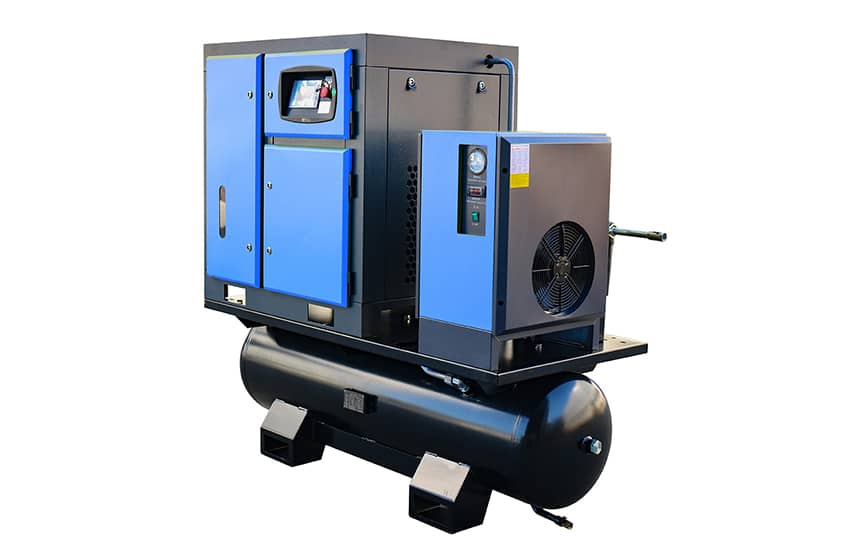
Compressed air serves as a foundational utility across modern manufacturing, assembly, and extraction sectors. Often referred to as the fourth utility, it powers heavy machinery, pneumatic tools, control systems, and material conveying processes. For facilities requiring continuous, reliable, and high-volume airflow, the industrial rotary screw air compressor has become the standard technology. Unlike reciprocating piston models designed for intermittent use, rotary screw units operate with a 100% duty cycle, providing constant pressure without thermal degradation or mechanical downtime.
Selecting and managing these systems requires a deep understanding of their mechanical design, operational variables, and the specific demands of various industrial environments. This analysis covers the physical principles of rotary screw compression, configuration choices, practical applications, and the engineering solutions required to resolve common operational challenges.
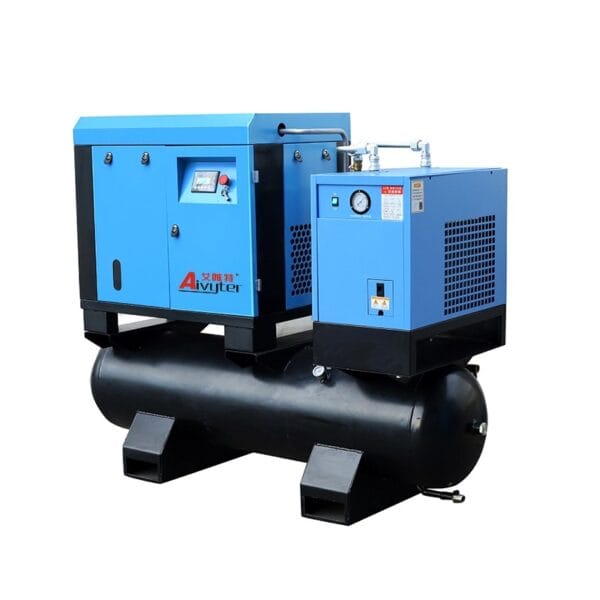
1. Mechanical Principles of Rotary Screw Compression
The core operation of a rotary screw compressor relies on positive displacement. The process occurs within the air end, which houses two intermeshing helical rotors: the male rotor and the female rotor. These rotors are precision-engineered with asymmetric profiles to minimize back-leakage and optimize volumetric efficiency.
- The Intake Phase: As the rotors spin, the space between the male and female lobes increases at the inlet port, creating a partial vacuum. Air is drawn into the compression chamber.
- The Compression Phase: As rotation continues, the inlet port closes. The intermeshing lobes reduce the volume of the trapped air pocket, pushing it axially along the screw profile. This reduction in volume increases the pressure of the air.
- The Discharge Phase: The compressed air reaches the discharge port at the opposite end of the air end, where it is expelled into the downstream system.
Rotary screw designs are categorized into two primary configurations based on their lubrication methods: oil-injected and oil-free.
Oil-Injected Rotary Screw Compressors
In oil-injected systems, lubricating fluid is introduced into the compression chamber. This fluid serves three functions: sealing the internal clearances between the rotors to prevent air slip, lubricating the high-speed bearings, and absorbing heat generated during the compression cycle. After compression, the air-oil mixture passes through a separator tank where the lubricating fluid is mechanical-separated and filtered before being cooled and recirculated. This configuration is widely used in heavy industry due to its long operational lifespan and high thermal efficiency.
Oil-Free Rotary Screw Compressors
In environments where product contamination must be completely avoided, oil-free systems are utilized. These units feature timing gears that synchronize the rotors without physical contact, eliminating the need for lubrication within the compression chamber. Because there is no sealing oil, these systems operate at higher rotational speeds and often require multiple stages of compression with intercoolers to manage heat dissipation. They are suitable for food processing, pharmaceuticals, and semiconductor manufacturing.
2. Key Operational Parameters and System Configurations
To integrate an air system into an industrial process, plant engineers must analyze several operating metrics and design variables. These factors dictate how the machinery performs under varying load profiles.
The primary performance indicators are Free Air Delivery (FAD), measured in Cubic Feet per Minute (CFM) or cubic meters per minute (m³/min), and operational pressure, measured in PSI or Bar. Matching these metrics to the process requirements prevents issues like pressure drops and over-pressurization.
Another major design decision involves choosing between fixed-speed and variable-speed drives (VSD). Modern systems, engineered by manufacturers like Aivyter to withstand demanding environments, offer specialized configurations for both types:
- Fixed-Speed Compressors: These units run at a constant speed, making them highly efficient when operating at full capacity. When air demand falls, the compressor transitions to an “unloaded” state, where the motor continues running without compressing air. While this prevents constant motor starting cycles, it consumes significant idle energy.
- Variable Speed Drive (VSD) Compressors: VSD systems utilize an inverter to vary the motor’s speed, matching air production to real-time demand. By eliminating unloaded runtime and reducing starting current spikes, VSD units provide high efficiency in operations with fluctuating air requirements.
The table below summarizes the key operational differences between these two configurations:
| Operational Parameter | Fixed-Speed Configuration | Variable Speed Drive (VSD) |
|---|---|---|
| Motor Speed Control | Constant RPM | Variable RPM (Inverter-driven) |
| Part-Load Efficiency | Lower (energy wasted during unload cycles) | High (energy scales with air demand) |
| Starting Amperage | High starting current (Inrush current) | Soft-start (controlled current ramp) |
| Pressure Stability | Fluctuates within a set pressure band | Maintains stable pressure within ±0.1 Bar |
3. Heavy Industry Application Scenarios
The continuous output and durability of these machines make them suited for heavy industrial environments. The operational requirements vary significantly across different sectors.
Manufacturing and Assembly Lines
Automated manufacturing plants rely on consistent pneumatic pressure to power robotic arms, clamps, conveyor belts, and air-driven tools. Any drop in pressure can disrupt automated processes, leading to production errors. Utilizing an industrial rotary screw air compressor ensures continuous pressure, supporting automated assembly lines with clean, dry air.
Mining and Mineral Extraction
Mining operations require compressed air for pneumatic drilling, ventilation in underground shafts, dust suppression systems, and material conveying. Because these environments are filled with dust, abrasive particles, and humidity, the compression equipment must feature heavy-duty filtration and robust structural frames to ensure reliable operation.
Infrastructure and Construction
In civil engineering, high-output air systems power heavy pneumatic breakers, tunnel boring machines, and sandblasting equipment. These operations often require portable, diesel-driven rotary screw units that can perform reliably under extreme weather conditions and high physical vibration.
4. Operational Challenges and Engineering Solutions
Operating high-capacity compressed air systems in demanding environments presents several engineering challenges. Left unaddressed, these issues can result in premature wear, equipment downtime, and reduced system efficiency.
Moisture and Condensation Control
When atmospheric air is compressed, its temperature rises, and its ability to hold water vapor increases. As the air cools downstream, this moisture condenses into liquid water. Water in air lines leads to piping corrosion, pneumatic component failure, and spoiled products. To mitigate this, systems require integrated moisture management hardware:
- Water Separators: These utilize centrifugal force to extract bulk liquid water directly after the compression stage.
- Refrigerated Air Dryers: These cool the compressed air to approximately 3°C, forcing water vapor to condense so it can be drained out before entering the plant network.
- Desiccant Dryers: For applications requiring extremely dry air, desiccant materials (such as activated alumina or molecular sieves) adsorb water molecules, achieving pressure dew points as low as -40°C.
Thermal Management
Compressing air generates substantial heat. In oil-injected systems, the lubricating fluid carries this thermal energy away from the air end. If the fluid temperature exceeds safe limits, its viscosity drops, reducing its sealing and lubricating capabilities. Modern systems, including those manufactured by Aivyter, integrate heavy-duty cooling radiators, thermostatically controlled valves, and high-flow cooling fans to maintain stable operational temperatures even in ambient environments up to 45°C.
Particulate Contamination
In dust-heavy industries like mining and concrete production, airborne particulates can quickly bypass basic filters. If these abrasive particles enter the air end, they can scratch the rotor profiles and damage high-speed bearings. Addressing this requires multi-stage filtration systems, including cyclonic pre-filters that remove larger particles before the air reaches the primary micro-fiber intake filter.
5. Maintenance Protocols for Extended Operational Lifespan
To maintain performance and prevent unexpected mechanical downtime, maintenance teams must adhere to structured preventative maintenance protocols. Regular inspections help identify wear before it leads to system failure.
The operational duty of your industrial rotary screw air compressor requires consistent attention to key components, including lubrication, filtration, and mechanical alignment.
- Fluid Analysis: Standard testing of the compressor fluid helps track additive depletion, oxidation levels, and metal wear particles. This analysis guides fluid change intervals and can warn of internal bearing wear.
- Filtration Replacement: Air intake filters and fluid filters must be changed based on differential pressure readings rather than time intervals alone. High differential pressure increases energy consumption and places additional stress on the motor.
- Separator Maintenance: The air-oil separator element must be replaced regularly to ensure oil carryover remains below acceptable levels (typically less than 3 ppm). High oil carryover leads to fluid loss and downstream air contamination.
- Drive Alignment: For direct-drive and belt-driven systems, regular checks on coupling alignment and belt tension prevent uneven bearing loads, reducing vibration and mechanical wear.
Modern industrial operations require compressed air systems that deliver high reliability, energy efficiency, and stable air quality. Selecting a high-performance industrial rotary screw air compressor from a trusted partner like Aivyter helps facilities optimize their production capabilities and reduce downtime.
For detailed engineering advice, customized system configurations, or a comprehensive proposal tailored to your plant’s specific CFM and pressure requirements, please contact our engineering support team today. We provide professional assistance to ensure your compressed air infrastructure meets your long-term operational goals.
Frequently Asked Questions
Q1: What causes high oil carryover in a rotary screw compressor?
A1: High oil carryover is typically caused by a degraded air-oil separator element, running the system below its design operating temperature (which prevents proper moisture separation), overfilling the oil reservoir, or using incompatible fluid that foams under pressure.
Q2: How does ambient temperature affect compressor performance?
A2: Higher ambient temperatures reduce air density, which decreases the mass flow rate and volumetric efficiency of the compressor. Additionally, hot ambient air reduces the cooling capacity of air-cooled radiators, requiring enhanced cooling designs to prevent overheating.
Q3: When should a facility choose a water-cooled compressor over an air-cooled model?
A3: Water-cooled models are suitable for facilities with limited ventilation, high ambient temperatures, or where a central cooling water loop is already available. They are also preferred for high-horsepower installations where recovering heat through water is more practical.
Q4: Why is pressure dew point important in a compressed air network?
A4: The pressure dew point is the temperature at which water vapor in compressed air begins to condense into liquid at a given operating pressure. Maintaining a low dew point prevents moisture from condensing in downstream piping, protecting instruments and tools from corrosion.
Q5: What are the primary benefits of using an industrial rotary screw air compressor over a piston compressor?
A5: Rotary screw compressors offer a 100% duty cycle, allowing continuous operation without cooling breaks. They also generate less vibration, operate at lower noise levels, provide better energy efficiency under continuous load, and carry over less oil into the air line compared to reciprocating piston designs.
about
Aivyter
We provides trusted air compressors and mining equipment, engineered for durability, efficiency, and demanding industrial applications.