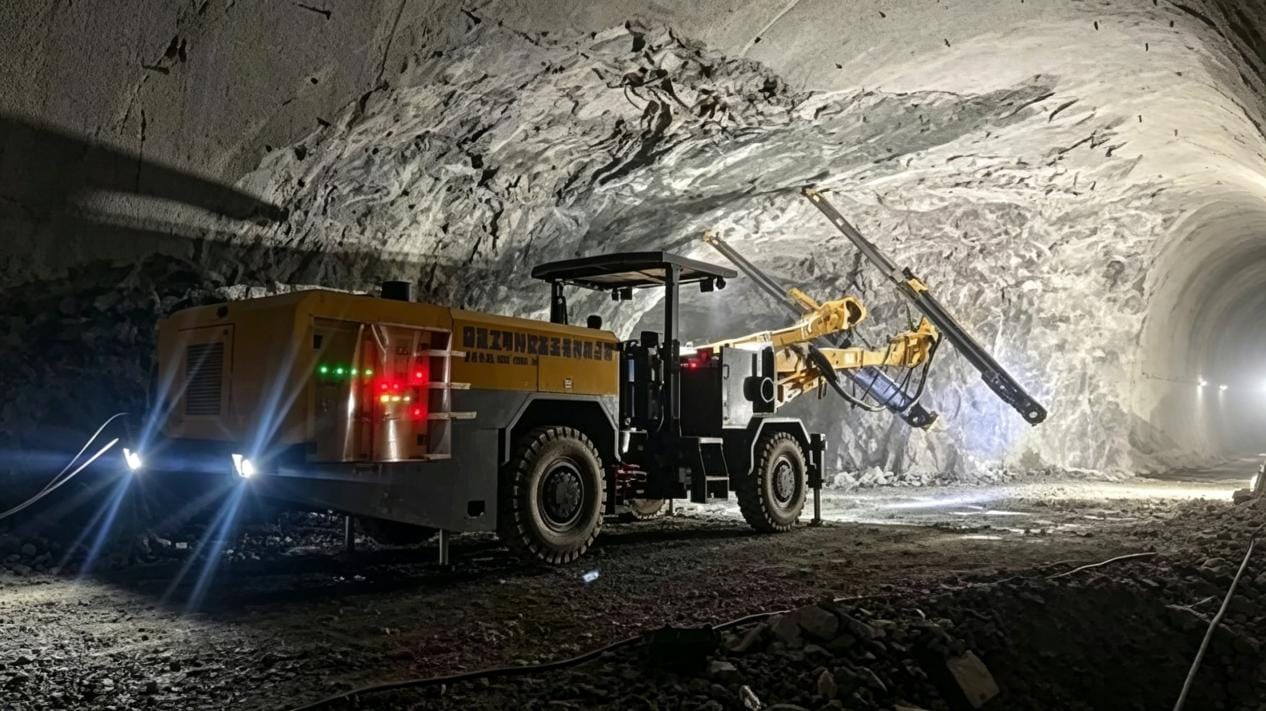
An underground mining drill rig is only as good as its fit to the tunnel in front of it. A machine that performs well in a 5 m × 6.5 m production drift can be the wrong choice for a 2.5 m access gallery. The mismatch shows up later as slow setup, overbreak, worn drill steel, and a cost per meter that never settles down.
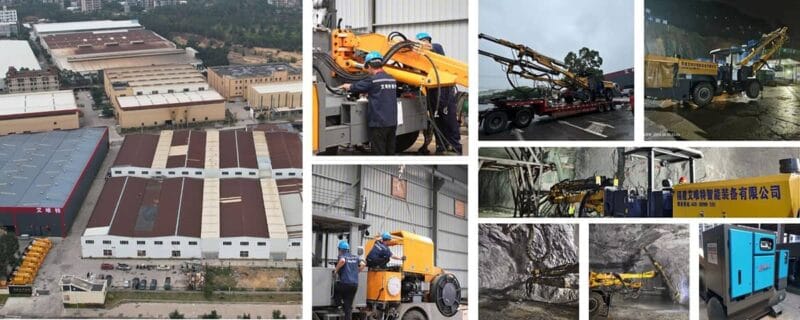
Before you compare models, send Aivyter your tunnel section, rock type, and target advance as an inquiry. The Fuzhou manufacturer builds drilling jumbos and underground support equipment. Its engineers use those inputs to shortlist a drill jumbo and confirm the boom, feed, and power configuration. Start the conversation on the Aivyter contact page.
What an underground mining drill rig does
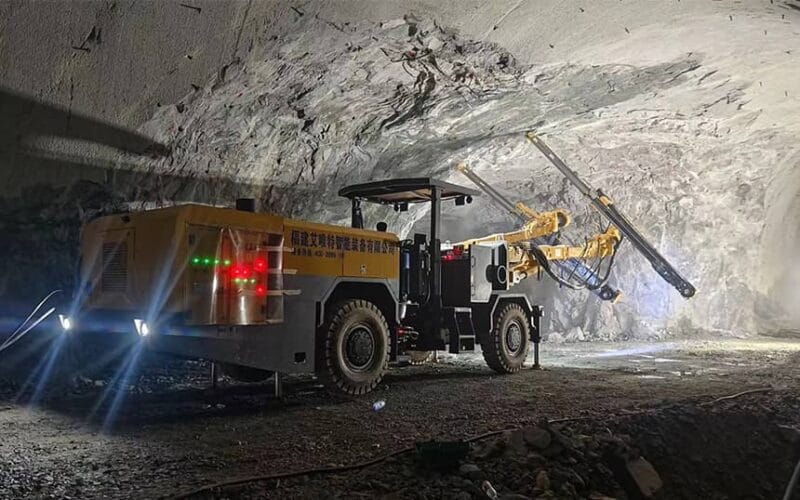
An underground mining drill rig carries one or more hydraulic rock drills on a boom. It drills blast holes into the face so the next round can be charged and fired. The same platform may also drill anchor holes, probe holes, and drainage holes.
In a drill-and-blast development cycle, the rig works after scaling and face marking. Drilling speed, hole accuracy, and setup time decide how quickly the face is ready for loading. That is why the machine must match the tunnel and the rock, not just the hole diameter.
Why the tunnel section comes first in underground mining drill rig selection
Most buyers start with horsepower. That is the wrong end of the decision. The tunnel sets the working envelope, and the envelope eliminates more machines than any other factor.
Measure the clearance envelope, not just the face
Walk the full route from the portal or shaft to the face. Note the narrowest point, the tightest curve, and every spot where a parked machine could block ventilation or mucking.
- Minimum width and height along the entire travel route.
- Inner and outer turning radius at each bend.
- Floor condition, grade, and load capacity.
- Passing bays, junctions, and refuge chambers.
- Ventilation allowance for a diesel engine.
A rig that fits the face but cannot reach it adds hours of non-drilling time. A small difference in turning radius can decide whether the machine enters the drift at all.
Match boom coverage to the face shape
Coverage is more than the largest rectangle in the brochure. You need reach at the crown, the hanging wall, and the bottom corners without repositioning on every hole.
Single-boom rigs suit development faces and narrower headings. Two-boom rigs make more sense when face area and cycle time justify the extra width and cost. The right answer depends on how many square meters each boom must cover and how often the machine must move.
How rock conditions shape underground mining drill rig performance
Rock does not simply make drilling slower. It changes the combination of impact energy, rotation torque, feed force, and flushing that keeps the bit cutting instead of rubbing.
Hardness, fractures, and abrasiveness
A hard, abrasive rock can wear out a bit before the round is finished. A fractured or blocky rock can pull the steel off line and raise the risk of a stuck rod. Neither condition responds well to a machine chosen on price alone.
For reference, the Aivyter AZT1-6500 is rated for rock with a Protodyakonov hardness coefficient of f=6 to 16, with coverage of 5 m × 6.5 m. That range covers many metal mine development and tunnel conditions, but it is still a starting point, not a substitute for a site test.
Flushing, hole size, and drill steel
Flushing clears cuttings and cools the bit. Weak water flow in a deep hole turns a sharp bit into a polished plug. Confirm the water pump’s flow and pressure at the working height, not only at the tank.
- Hole diameter range: typically 43 mm to 115 mm across the Aivyter jumbo range.
- Drill rod length and practical hole depth.
- Bit type and rock abrasiveness.
- Water quality and available supply.
- Air demand for the rock drill and controls.
Small changes here affect consumable cost more than the purchase price does. A well-matched underground mining drill rig can cut rod and bit use without changing the shift pattern.
Single-boom, two-boom, or compact face rig?
Boom count is a production decision. It is not a status symbol. More booms mean more simultaneous drilling, but also more width, more hydraulic complexity, and a larger capital commitment.
Compact rigs for narrow development
Aivyter builds the AZK-125 compact underground mining drill rig for tight headings. It covers sections from 2 m × 2 m to 5 m × 4 m, works in a 2.5 m × 2.5 m aisle, and turns on a 2,397 mm inner radius. Its single boom covers 24 m², with a maximum working range of 5,697 mm × 5,400 mm.
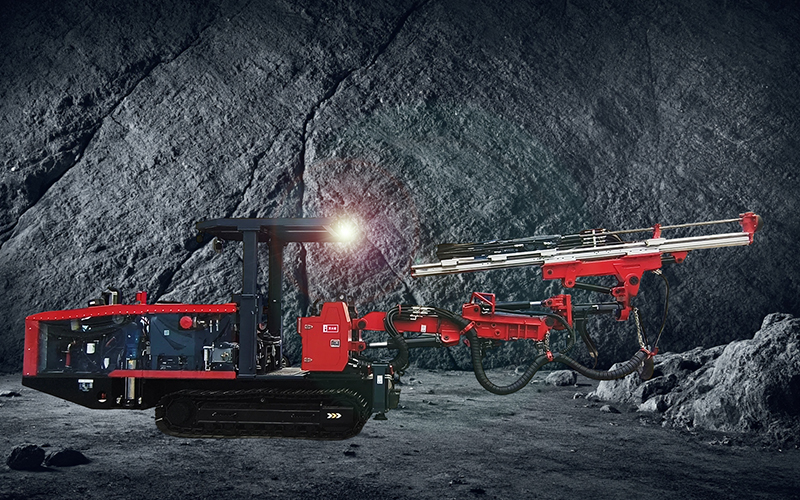
The package includes a 20 kW rock drill, 820 N·m maximum torque, and a 55.8 kW Yuchai engine. For narrow vein development, those numbers matter more than a long feature list.
Single-boom jumbos for flexible production
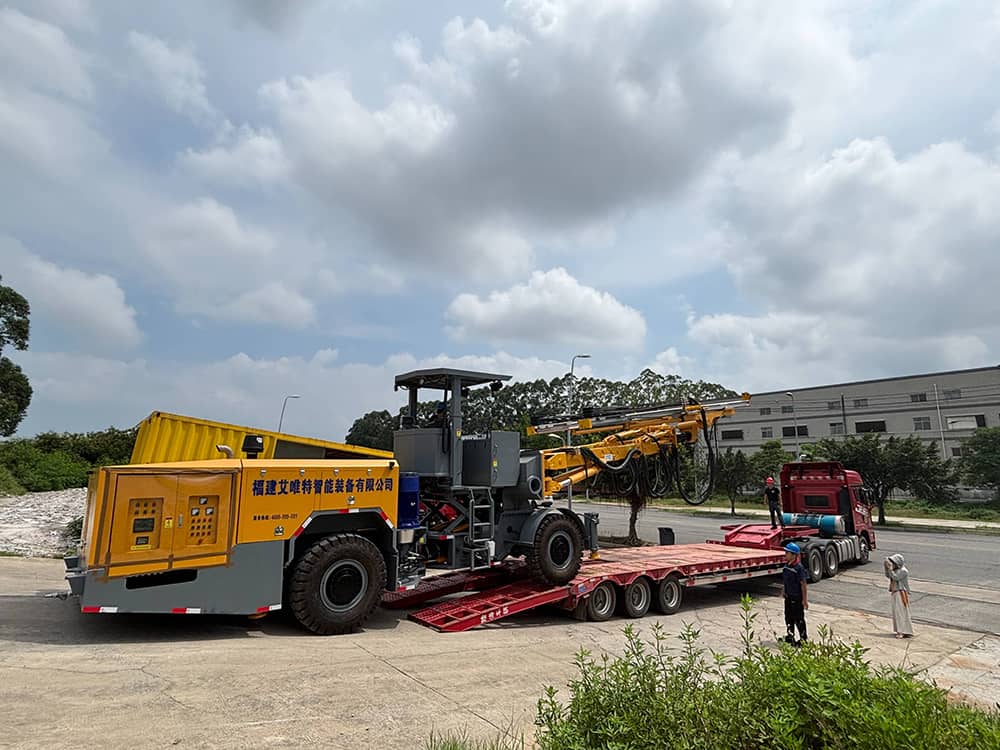
The Aivyter AZT1-6500 underground mining drill rig handles sections from 3 m × 3 m to about 5 m × 6.5 m. It drills 43 mm to 102 mm holes, accepts 4,300 mm or 3,700 mm rods, and reaches 4,000 mm or 3,400 mm of hole depth. Installed power is 65 kW, with a 55 kW main motor and a 66 kW Cummins diesel engine for tramming.
At 12,000 kg, it is light enough for many development applications but still carries a full hydraulic boom. A 15° climbing ability and 7.2 km/h tramming speed keep repositioning time under control.
Two-boom jumbos for large faces
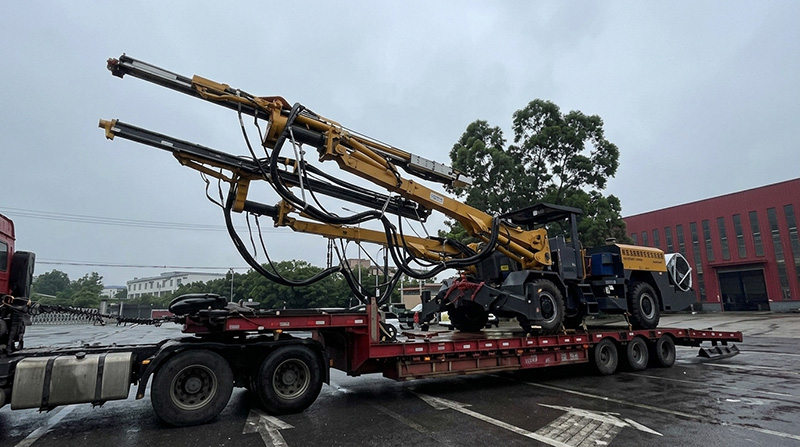
The Aivyter AZT2-9700 underground mining drill rig is the choice when face size supports two drills. It reaches 9.7 m in height, drills 43 mm to 102 mm holes, and uses 5,525 mm rods for a 5,300 mm hole depth. Aivyter quotes a drilling speed of 0.8 m to 2 m per minute, depending on rock and bit.
Two 55 kW motors drive the rock drills, while a 129 kW diesel engine moves the 33,000 kg carrier at up to 15 km/h. The machine suits medium and large tunnels where one boom would leave the face waiting.
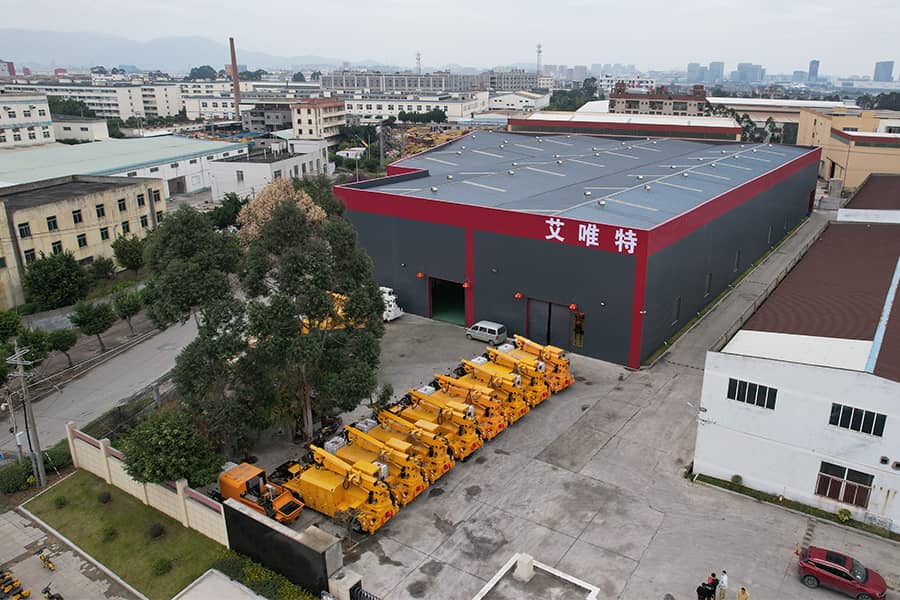
Aivyter builds all three classes in Fuzhou and supports customization of voltage, engine brand, and working dimensions. That flexibility helps when a standard model is close but not exact.
Which numbers on an underground mining drill rig change cost per meter?
A specification sheet is a starting point. The cost per meter comes from how those numbers interact with the site.
Coverage versus actual section
Do not size the underground mining drill rig to the exact face. Leave a working margin for boom positioning, bit changes, and uneven walls. A machine that only covers the face from one perfect parking spot will slow every round.
Hole depth versus advance per round
A 5,300 mm rod does not deliver 5,300 mm of advance. Collaring, bit length, hole angle, and pull reduce the effective round. Plan the pull from the drilling pattern, then check that the feed beam and rod change fit the available height.
Installed power versus site power
Electric rigs need a stable supply, correct voltage, and protection against overload. Diesel rigs need fuel storage, ventilation, and a maintenance plan for the engine and aftertreatment. Compare the total site requirement, not just the motor rating.
Weight, floor, and transport
A heavier underground mining drill rig can be more stable, but it also needs a floor that carries the load and a route that accepts the axle weight. Check the transport permit, lifting points, and container or lowbed dimensions before the order is confirmed.
What a low bid can hide
The lowest purchase price for an underground mining drill rig is not the lowest operating cost. Underground equipment earns money only when it is drilling, and downtime has a way of arriving at the worst moment.
- Spare parts lead time for hydraulic pumps, rock drills, and feed components.
- Local service coverage and remote troubleshooting.
- Operator training and commissioning support.
- Warranty exclusions and the definition of wear parts.
- Component brands and the availability of equivalent parts.
- Documentation, hydraulic schematics, and electrical diagrams.
Ask each supplier to price a two-year consumable and wear-part package. The answer often changes the ranking. Aivyter lists a standard lead time of 15 to 30 working days, depending on order quantity and customization, so confirm the delivery plan against your mobilization date.
Site readiness before the rig arrives
Most commissioning delays start before the machine leaves the factory. A good underground mining drill rig can still sit idle if the site is not ready for it.
Ventilation and emissions
Diesel equipment in a confined heading needs airflow and a clear emissions plan. Confirm the engine standard, the ventilation volume, and the location of any scrubber or exhaust extension. For electric rigs, confirm cable routing and protection from traffic.
Water, power, and floor conditions
- Water pressure and flow at the face.
- Voltage, phase, and breaker capacity.
- Drainage and floor bearing strength.
- Clearance from blast fumes and muck piles.
- A level parking spot for maintenance.
These checks are simple, and they prevent the usual first-week surprises. Send the site layout with the inquiry so the supplier can flag conflicts early.
Operator and maintenance readiness
Train operators on the control pattern before production starts. A skilled operator can hear a dull bit or a soft hydraulic response and correct it before the hole is lost. Keep a small critical spares kit on site: drill steel, shank adapters, bits, hoses, filters, and seals.
A practical selection sequence
Use the same sequence for every supplier, whether you are buying a compact face rig or a two-boom underground mining drill rig. It makes technical differences visible and keeps the conversation on the project rather than the brochure.
- Record the tunnel section, minimum clearance, grade, and turning radius.
- Log rock type, hardness, abrasiveness, and water conditions.
- Set the required holes per round, hole diameter, and daily advance.
- Calculate the coverage each boom must deliver.
- Shortlist single-boom, two-boom, and compact rigs.
- Compare consumables, service, lead time, and training, not only price.
- Request a written configuration and a site-specific quote.
This process also gives the supplier enough detail to propose a real machine. Vague inquiries attract vague answers.
FAQ
Q1: What size underground mining drill rig do I need for a 3 m × 3 m tunnel?
A1: Start with a compact or single-boom rig that can work inside the actual clearance, not just the nominal section. The Aivyter AZK-125 covers sections from 2 m × 2 m to 5 m × 4 m, while the AZT1-6500 starts at 3 m × 3 m. Check turning radius and boom coverage before choosing between them.
Q2: How many booms should an underground mining drill rig have?
A2: Use one boom for development faces and narrow headings where maneuverability matters. Use two booms when the face is large enough to keep both drills working without frequent repositioning. The decision should follow face area, hole count, and the advance you need per shift.
Q3: Can one underground mining drill rig handle blast holes, anchor holes, and probe holes?
A3: Many hydraulic jumbos can, provided the boom, feed, and rock drill are configured for the hole range. The AZT1-6500, for example, supports 43 mm to 102 mm holes and includes a 360° rotating thruster. Confirm the required hole angles, rod sizes, and drilling pattern with the supplier before you rely on one machine for every task.
Q4: What rock hardness can a modern underground mining drill rig handle?
A4: It depends on the rock drill, bit, feed force, and rock structure, not a single hardness number. The AZT1-6500 is rated for f=6 to 16, but abrasive or highly fractured ground can still limit penetration and steel life. A short site trial gives a more reliable answer than a catalog rating.
Q5: How do I compare quotes for an underground mining drill rig?
A5: Normalize each quote to the same scope: boom configuration, rock drill model, feed length, engine or motor, voltage, water pump, safety package, commissioning, training, spare parts, and delivery terms. Then compare cost per meter and expected uptime. Ask for a written list of exclusions so the lowest headline price does not become the highest project cost.
Next step: test the fit against your project data
A well-matched underground mining drill rig reduces overbreak, protects drill steel, and keeps the cycle moving. The machine does not need to be the largest on the market. It needs the right coverage, the right rock drill, and a service plan that keeps it working.
Send Aivyter your tunnel dimensions, rock conditions, hole pattern, and target advance. The team can match the work to the AZK-125, AZT1-6500, AZT2-9700, or a customized configuration, then explain the power, water, and site requirements in writing.
Request a quote and a model recommendation from Aivyter. Include your project location and mobilization date so the reply covers delivery as well as the right underground mining drill rig.
about
Aivyter
We provides trusted air compressors and mining equipment, engineered for durability, efficiency, and demanding industrial applications.