Compressed air ranks among the largest electrical loads in subsurface mining. In many operations, air compressors consume 15% to 30% of the entire mine’s power supply. When air pressure falters at the working face, productivity drops immediately.
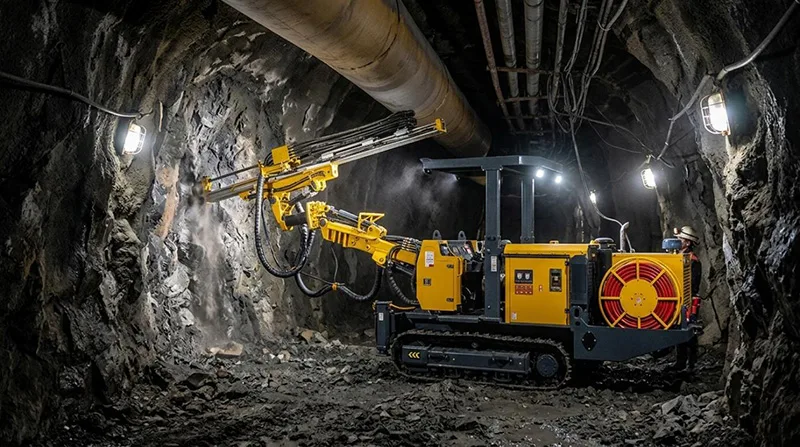
Every drill rig underground mines rely on depends on steady, dry, and properly pressurized air. Whether you run handheld jacklegs, pneumatic stoper drills, or a modern electro-hydraulic underground mining jumbo, air quality drives daily output. Poor air management inflates mining operational costs and accelerates component wear.
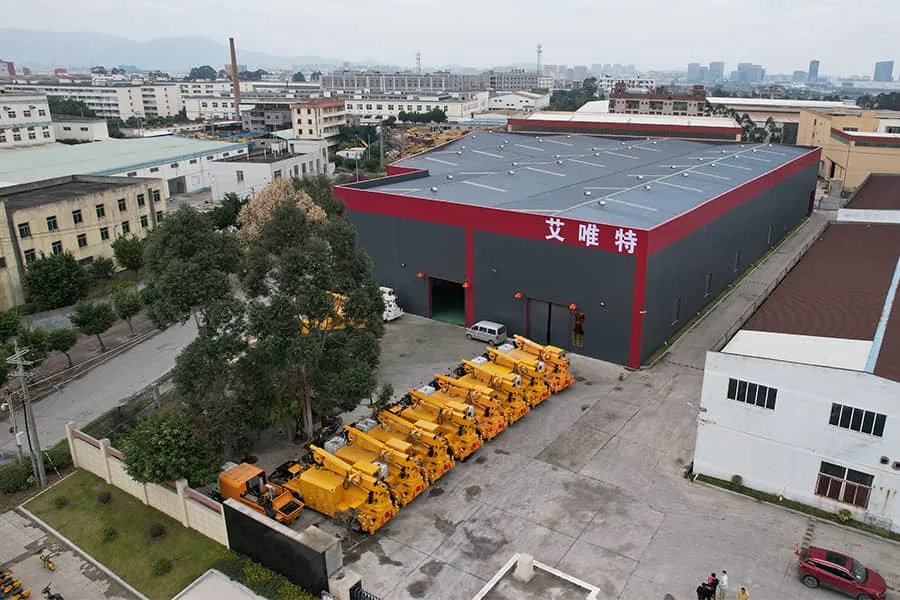
At Aivyter, our engineering team helps mining contractors solve underground airflow bottlenecks before they stall production. This guide outlines practical steps to cut energy waste, eliminate leaks, and raise drilling efficiency. If your site struggles with weak face pressure or surging power bills, contact our specialists today for a tailored air system review.
Why Compressed Air Optimization Matters for Drill Rig Underground Mines
Subsurface rock excavation leaves little margin for wasted energy. When your air network underperforms, you pay twice: once on the utility meter and again through slow advance rates.
Drilling Efficiency and Face Pressure
Percussive rock drills convert air pressure directly into piston impact energy. Even a slight pressure drop in mining headers reduces blow frequency and strike force. Operators notice slower penetration speeds, poor bit rotation, and stuck drill steels.
Maintaining rated manifold pressure keeps your rock drills operating at peak design output. Consistent airflow also flushes rock cuttings cleanly from the borehole, preventing re-grinding and premature bit wear.
Energy Waste and Mining Operational Costs
Compressing air is inherently inefficient because most electrical input converts into heat. Pumping that air down a deep shaft and across kilometers of haulage drifts multiplies the loss. Undersized headers and leaky couplings force surface compressors to run continuously at full load.
According to technical resources shared by the Society for Mining, Metallurgy & Exploration (SME), optimizing underground utility distribution offers one of the fastest paybacks in mine energy management. Reducing wasted airflow directly trims kilowatt-hours per ton of ore moved.
Equipment Lifespan and Reliability
Unconditioned compressed air carries water, compressor oil carryover, and fine abrasive dust. That mixture washes away rock drill lubricants and pits internal cylinder walls. Seals harden, valve plates crack, and maintenance crews spend valuable shift hours rebuilding hammers instead of advancing headings.
Common Compressed Air Challenges in Underground Mines
Subsurface environments punish mechanical infrastructure. Recognizing where air energy disappears is the first step toward fixing your network.
1. Air Leaks in Aging Pipelines
Blasting shockwaves, heavy haul trucks, and shifting ground constantly stress steel pipes and flexible hoses. Gasketed couplings loosen, isolation valves weep, and pinhole corrosion forms along wet drift floors.
A single 6-millimeter leak in a 7-bar header wastes massive volumes of expensive air around the clock. Because underground mines operate 24/7, unaddressed compressed air leaks often account for 25% to 40% of total compressor output.
2. Severe Pressure Drops Over Long Distances
Air loses pressure whenever it rubs against rough pipe walls or passes through sharp elbows. As mine workings extend deeper away from the surface compressor house, friction losses climb steeply.
Crews working near the shaft collar enjoy plenty of power, while crews three kilometers away barely reach 5 bar. Too many operations respond by cranking up surface pressure, which wastes energy without fixing the underlying restriction.
3. Supply-Demand Mismatch and Idle Running
Underground drilling happens in cycles rather than at a steady pace. Multiple rigs may collar holes and flush cuttings simultaneously, creating sharp demand spikes. Ten minutes later, operators pause to scale rock or load explosives.
Without smart controls, fixed-speed compressors keep spinning while unloaded. An unloaded rotary screw unit still burns roughly 25% to 35% of its full-load electricity while producing zero useful air.
4. Contaminated Air: Moisture, Oil, and Dust
Warm, humid air enters the intake, gets compressed, and cools rapidly inside damp underground drifts. Water condenses along the pipe walls and pools in low spots. When that wet air expands inside a pneumatic drill rig, temperatures plunge and ice crystals can freeze exhaust ports solid.
As documented in technical references on compressed air systems, unseparated moisture and particulates rapidly degrade downstream pneumatic actuators. Keeping contaminants out of your distribution headers protects every machine connected to the line.
5 Proven Strategies to Optimize Compressed Air for Underground Drill Rigs
You do not need to rebuild your entire mine infrastructure overnight to capture major savings. Target the biggest losses first using these five field-proven steps.
1. Conduct Regular Ultrasonic Leak Detection
Ventilation fans, mucking loaders, and pumps make underground headings far too loud for human ears to detect small air leaks. Equip your maintenance team with ultrasonic acoustic detectors instead.
- Walk main haulage headers and development headings during scheduled shift-change quiet windows.
- Tag every leaking Victaulic coupling, ball valve, and hose whip with high-visibility repair numbers.
- Measure the estimated loss rate and prioritize fixes on main distribution trunks first.
- Install automated shutoff valves at abandoned headings so dead zones stay isolated from active air lines.
2. Optimize Pipe Sizing and Install Underground Air Receivers
Small-diameter pipes choke airflow and starve distant faces. When extending headers to new production levels, size steel mains generously to keep air velocity below 6 to 8 meters per second.
Place dedicated buffer tanks, known as air receivers, close to active zones where each drill rig underground mines deploy faces peak demand. Local receivers act like hydraulic accumulators. They supply sudden bursts of flushing air without dragging down pressure across the entire mine network.
3. Upgrade to VSD Compressors and Smart Controls
Traditional fixed-speed compressors struggle with erratic subsurface drilling schedules. Upgrading one or more trim units to Variable Speed Drive (VSD) technology matches motor speed directly to real-time air consumption.
Pair VSD units with a central master sequencer. Instead of fighting each other over narrow pressure bands, the compressors coordinate staging automatically. This eliminates wasteful blow-off cycles and keeps header pressure tight within a 0.2-bar band.
4. Implement Point-of-Use Filtration and Drying
Surface aftercoolers and refrigerated dryers remove bulk moisture, yet condensation still forms when pipes run through cold intake airways. Protect expensive rock drills by placing water separators and particulate filters right at the heading manifold.
Follow clean-air benchmarks based on ISO 8573-1 purity classes for solid particles, water, and oil content. Clean air allows inline lubricators to deliver a precise oil mist to your pneumatic drill rig without emulsifying into sludge.
5. Eliminate Artificial Demand via Pressure Regulation
Running a compressor station at 8.5 bar to feed a rig rated for 6.5 bar creates artificial demand. Every unregulated leak, open blowgun, and pneumatic tool consumes proportionally more air at higher pressure.
Install reliable pressure regulators and calibrate gauges regularly against traceable measurement practices, such as those maintained by NIST. Lowering system discharge pressure by just 1 bar cuts compressor power draw by roughly 6% to 7% while sharply reducing leak volume.
At Aivyter, we engineer underground rock drilling systems that pair high penetration speeds with tight air efficiency. By matching drill air passages and flushing circuits to realistic mine header pressures, our equipment helps mines avoid costly over-pressurization.
Pneumatic vs. Electro-Hydraulic Drill Rig Underground Mines: When to Upgrade?
At a certain mine scale, optimizing old pneumatic equipment reaches a natural ceiling. Pure pneumatic rock drills convert less than 15% of electrical compressor input into actual rock-breaking work at the bit.
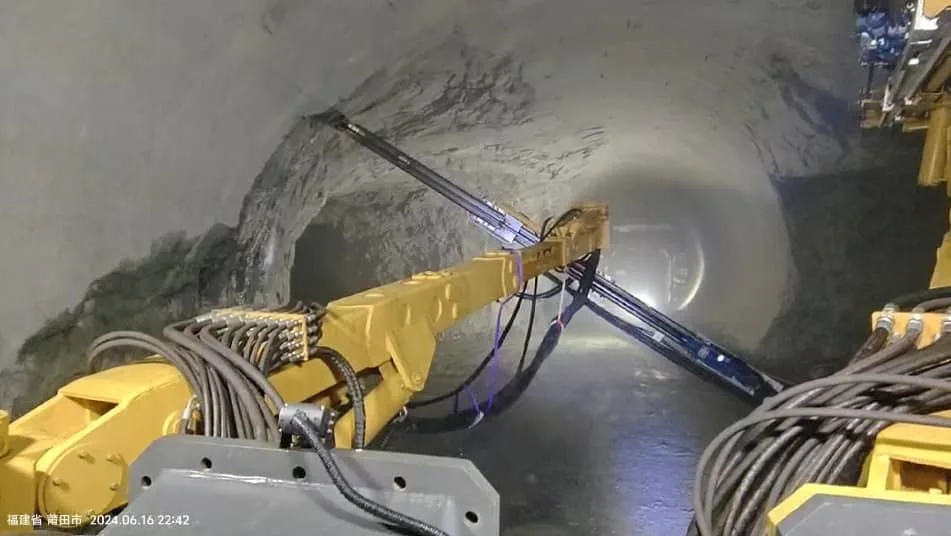
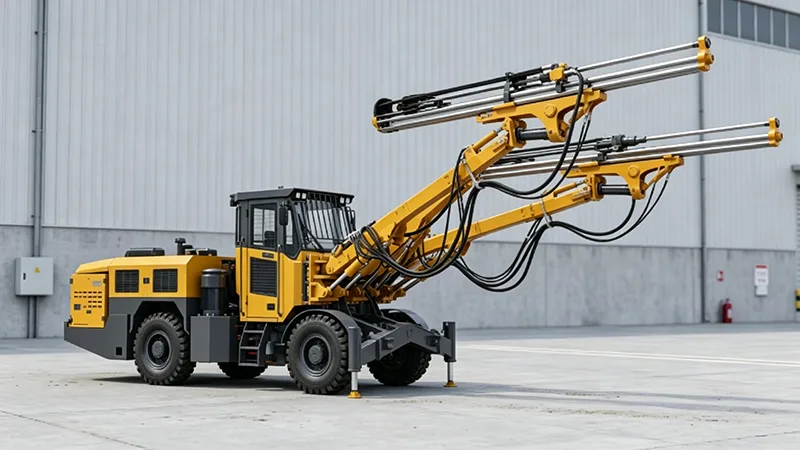
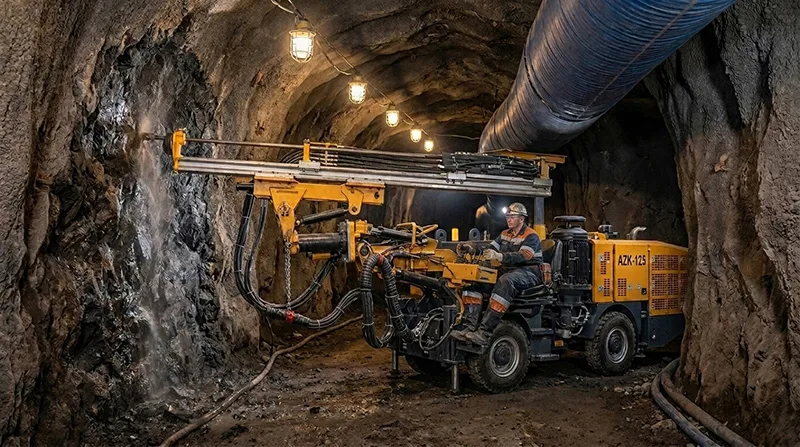
Modern electro-hydraulic machines transform that energy equation. An electro-hydraulic underground mining jumbo uses high-efficiency electric motors and hydraulic pumps to drive percussion, rotation, and boom positioning. It relies on your underground air compressor only for hole flushing, rock-dust suppression, and shank lubrication.
| Comparison Factor | Pneumatic Drill Rig | Electro-Hydraulic Underground Mining Jumbo |
|---|---|---|
| Primary Power Source | 100% Compressed Air | Electric Motor + Hydraulic System (Low Air for Flushing) |
| Compressed Air Consumption | Very High (10–25+ m³/min per drifter) | Low (1.5–4 m³/min for flushing and misting) |
| Energy Efficiency | Low (approx. 10%–15% wire-to-bit) | High (approx. 50%–65% wire-to-bit) |
| Penetration Rate | Moderate | High (2x to 3x faster in hard rock) |
| Initial Capital Cost | Lower | Higher |
| Best Application | Narrow veins, secondary blasting, remote stopes | Main development drifts, high-tonnage production headings |
If your development crews wait on air pressure to recover before starting a round, upgrading to an electro-hydraulic drill rig in underground mines often pays for itself through power savings alone. Many sites also install compact onboard compressors directly onto their jumbo chassis, freeing the main mine header completely.
Frequently Asked Questions (FAQ)
Q1: What is the optimal operating air pressure for a drill rig in underground mines?
A1: Most pneumatic rock drills perform best at 6.0 to 7.0 bar (87 to 101 psi) measured directly at the drill manifold under full load. Operating below 5.5 bar drastically cuts strike energy, while exceeding 7.5 bar accelerates piston and seal failure. Always verify exact pressure limits in your manufacturer’s manual.
Q2: How much drilling efficiency is lost per 1 bar of pressure drop?
A2: Because percussion energy is tied closely to working pressure, a 1 bar drop at the rock drill typically reduces penetration rates by 15% to 25%. In hard granite or quartzite formations, severe pressure loss can stall bit advance almost entirely and increase bit-button shearing.
Q3: How do you calculate compressed air leak losses in an underground mine?
A3: Schedule a 30-minute test during an off-shift maintenance window when all production tools and rigs are shut off. Run your surface compressors to charge the mine header to normal working pressure, then time the loaded versus unloaded cycle over 15 minutes. Multiply the compressor’s rated free air delivery by the ratio of loaded time to total test time to determine your baseline leak rate.
Q4: Why does my underground mining jumbo still need compressed air if it runs on electricity?
A4: Even though electricity and hydraulics power the hammer and feed beam, compressed air plays three vital roles. It pressurizes the drifter front head to keep abrasive rock slurry out of internal seals, delivers misted oil to the shank adapter, and assists water flushing when clearing deep boreholes.
Q5: Should underground air compressors be installed on the surface or underground?
A5: Surface stations are easier to ventilate, cool, and service, making them ideal for main base-load supply. However, deep mines with multi-kilometer haulage levels benefit from placing skid-mounted booster compressors or modular rotary-screw stations near active production zones to cut pipe friction losses.
Lower Your Energy Bills and Drill Faster
Inefficient compressed air quietly drains mining profits every single shift. By hunting down compressed air leaks, adding local air receivers near active headings, and controlling header pressure accurately, you protect equipment life and speed up every round.
Whether you are fine-tuning legacy air headers or planning a transition toward high-efficiency electro-hydraulic fleets, small engineering changes deliver fast financial returns. Every bar of recovered pressure translates into cleaner boreholes and lower power bills per meter drilled.
Ready to cut energy waste across your drill rig underground mines operations? Contact Aivyter today to request our free Underground Compressed Air Audit Checklist, or speak directly with our mining equipment engineers for an air consumption assessment and custom rig quote.
about
Aivyter
We provides trusted air compressors and mining equipment, engineered for durability, efficiency, and demanding industrial applications.