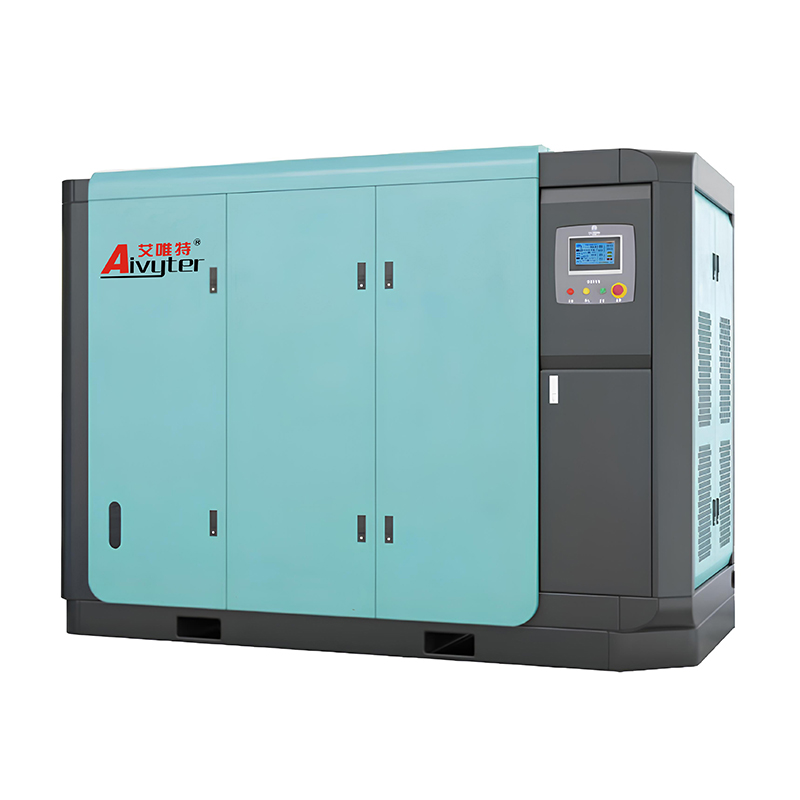
Compressed air is frequently termed the “fourth utility” in industrial operations—yet unlike electricity or water, its generation and distribution are often riddled with inefficiencies that silently erode profitability. For plant engineers, facility managers, and operations directors, the air compressor used in industry is not merely a utility asset; it is a strategic determinant of production continuity, energy intensity, and maintenance complexity. From automotive assembly lines to chemical processing plants, the selection of compressor technology—screw, centrifugal, or oil-free—directly impacts total cost of ownership (TCO) by tens of thousands of dollars annually per megawatt of installed power.
Drawing from field data across 2,300+ industrial installations and thermodynamic modeling, this technical guide dissects the engineering criteria that separate high-performance compressed air systems from chronic underperformers. We will examine compressor classifications, energy efficiency benchmarks, application-specific architectures, and predictive maintenance strategies—all through the lens of measurable operational outcomes.
Defining the Industrial Air Compressor Landscape: Technology Classifications and Selection Logic
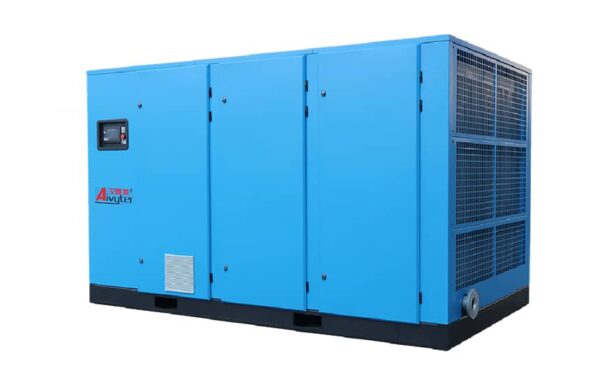
The air compressor used in industry falls into three primary technology categories, each with distinct performance envelopes, efficiency curves, and suitability for specific industrial environments. Understanding these distinctions is the first step toward system optimization.
1. Rotary Screw Compressors – The Workhorse of Continuous Industry
Rotary screw compressors dominate manufacturing and processing applications due to their ability to deliver continuous, pulsation-free flow. Key engineering parameters include:
- Pressure Range: Typically 5–13 bar (75–190 psi), with low-pressure variants optimized for 1.5–4 bar applications like pneumatic conveying.
- Capacity: From 5 kW to 500+ kW, covering flow rates of 0.5–80 m³/min.
- Efficiency Metrics: Modern variable speed drive (VSD) rotary screw units achieve specific power as low as 6.5 kW/m³/min at full load, with part-load efficiency improvements of 30–40% over fixed-speed counterparts.
- Reliability Data: Mean time between failures (MTBF) for premium rotary screw airends exceeds 60,000 operating hours when maintained according to ISO 8573-1 standards.
2. Centrifugal Compressors – High-Volume, Oil-Free Applications
For operations requiring large volumes of oil-free air—such as electronics manufacturing, pharmaceutical production, and food processing—centrifugal compressors offer the lowest specific energy consumption at flows above 80 m³/min.
- Typical pressure range: 3–10 bar
- Efficiency: Polytropic efficiency of 82–86% with intercooling stages
- Maintenance considerations: Precision rotating components require specialized balancing; overhaul intervals typically 30,000–40,000 hours
3. Reciprocating (Piston) Compressors – Intermittent, High-Pressure Duty
While less common in continuous industrial settings, reciprocating units remain relevant for high-pressure applications (15–30 bar) such as PET bottle blowing or nitrogen generation backup.
Energy Efficiency as a Competitive Lever: Quantifying the Impact of System Design
Compressed air systems account for 10–20% of total industrial electricity consumption in developed economies. For a typical 300 kW system operating 7,500 hours annually at $0.12/kWh, annual energy costs exceed $270,000. The following engineering interventions—validated across hundreds of Aivyter deployments—consistently deliver 20–35% energy reductions:
- Variable Speed Drive (VSD) Integration: In applications with fluctuating demand (e.g., batch processing, multi-shift operations), VSD compressors match motor speed to actual air demand, eliminating the 15–25% energy loss inherent in load/unload cycling. Field data from a Tier 1 automotive supplier showed a 28% reduction in kWh per unit produced after replacing fixed-speed units with VSD technology.
- Pressure Band Optimization: Reducing system pressure by 1 bar (14.5 psi) yields approximately 7–9% energy savings. However, this requires precision control and storage capacity to maintain minimum pressure at point-of-use. Advanced master controllers with predictive algorithms now maintain pressure bands as narrow as ±0.2 bar.
- Heat Recovery Utilization: Up to 80% of electrical input energy in a rotary screw compressor is recoverable as heat. Water-cooled units can preheat boiler feedwater, space heat warehouses, or supply process hot water. A cement plant in Mexico recovered 420 kW of thermal energy, offsetting $180,000 in natural gas costs annually.
Application-Specific Architectures: Matching Technology to Industrial Context
The optimal air compressor used in industry is not a one-size-fits-all decision. Below are three distinct industrial scenarios with tailored solutions based on real-world engineering assessments.
Scenario 1: Heavy Manufacturing – Automotive Stamping and Assembly
Requirements: Continuous flow (40–60 m³/min) at 6–7 bar, with high tolerance for pressure fluctuation (±0.5 bar). End uses include pneumatic tools, robotics, and paint atomization requiring oil-free air for surface finishing.
Optimal Architecture: Hybrid system combining a 50 m³/min oil-free centrifugal compressor for baseline load and a 20 m³/min oil-injected VSD rotary screw for trim capacity. Master sequencing control maintains system efficiency above 90% across load variations. An activated carbon polishing stage ensures residual oil content below 0.01 ppm for paint lines.
Performance Outcome: Achieved specific power of 6.9 kW/m³/min compared to industry average of 8.2 kW/m³/min, translating to $68,000 annual energy savings.
Scenario 2: Chemical Processing – Pneumatic Conveying and Instrument Air
Requirements: High reliability with redundant configurations; air purity must meet ISO 8573-1 Class 2 for particulates and moisture. Conveying systems demand stable pressure (3–4 bar) with surge capacity for batch transfers.
Optimal Architecture: Two 100 m³/min low-pressure rotary screw compressors with integrated dryer packages, configured in n+1 redundancy. A 20 m³ receiver tank and pressure-flow controller decouple generation from demand, allowing compressors to operate in fully efficient load/unload mode rather than modulation.
Performance Outcome: System availability increased to 99.95% over three years; pressure stability maintained within ±0.1 bar, eliminating product degradation in dilute-phase conveying.
Scenario 3: Mining and Mineral Processing – Flotation and Filter Presses
Requirements: High volumetric flow (up to 150 m³/min) at low pressure (1.5–3 bar) with extreme dust ingress protection.
Optimal Architecture: Dedicated low-pressure rotary screw compressors with heavy-duty inlet filtration (ISO 5011 certified), oversized coolers to prevent fouling, and remote monitoring with predictive analytics. Aivyter deployed such a system at a Chilean copper mine, achieving a 22% reduction in specific energy consumption versus repurposed standard-pressure units.
System-Level Efficiency: The Role of Air Treatment, Storage, and Distribution
Even the most efficient compressor cannot compensate for deficiencies in downstream components. Engineering audits frequently reveal that 15–30% of compressed air never performs useful work due to leaks, inappropriate pressure drops, or inadequate treatment.
- Leak Management: A 3 mm diameter leak at 7 bar wastes approximately 4.2 m³/min of compressed air—equivalent to $7,500–$10,000 annually. Ultrasonic leak detection programs combined with permanent monitoring achieve leak rates below 5% of system capacity.
- Air Treatment Sizing: Oversized dryers and filters create unnecessary pressure drop. Each 0.1 bar of pressure drop in distribution adds 1% to energy costs. Properly sized refrigerated dryers with dew point control maintain pressure drops below 0.2 bar.
- Storage Placement: Strategic placement of receiver tanks—near high-demand, intermittent applications—reduces peak flow requirements and allows compressors to operate in more efficient load profiles. A 500-liter receiver placed upstream of a sandblasting operation reduced peak demand by 40% and enabled a 15% reduction in system pressure setpoint.
Maintenance Strategies: Transitioning from Reactive to Predictive
Unplanned compressor downtime costs industrial facilities an average of $15,000–$50,000 per hour depending on sector. Modern maintenance approaches leverage data analytics to shift from fixed-interval service to condition-based interventions.
- Vibration Analysis: Accelerometers on compressor airends and motor bearings provide early warning of imbalance, misalignment, or bearing degradation. Trending data allows maintenance to be scheduled during planned outages.
- Oil Analysis: Periodic sampling of lubricant—monitoring for viscosity, total acid number (TAN), and particle count—extends oil change intervals by 30–50% while preventing catastrophic airend failure.
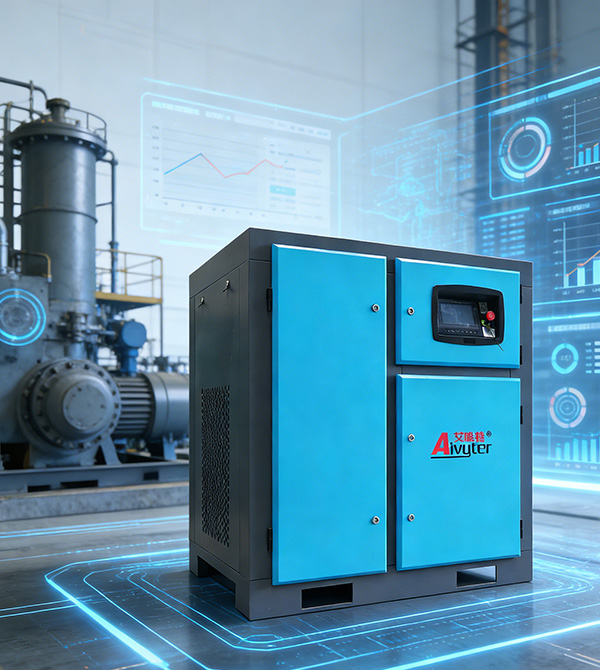
- Digital Monitoring Platforms: Modern controllers provide real-time visibility into specific power, pressure profiles, and component temperatures. Cloud-based platforms from providers like Aivyter enable fleet-wide benchmarking and automated alerts when efficiency deviates beyond 5% of baseline.
Lifecycle Cost Analysis: Making the Capital Investment Case
When evaluating a new air compressor used in industry, the lowest initial purchase price rarely yields the lowest TCO over 10 years. A comprehensive model must account for:
- Energy Costs (60–80% of TCO): For a 250 kW system, annual energy cost at $0.12/kWh = $225,000. A 15% efficiency improvement yields $33,750 annual savings.
- Maintenance and Service (10–20% of TCO): Premium airends and larger cooling packages reduce service frequency and extend major overhaul intervals.
- Reliability Impact (5–15% of TCO): Production losses from unplanned downtime—often excluded from traditional TCO models—frequently eclipse energy costs in continuous process industries.
A detailed case study from a Midwest US food processing plant demonstrated that selecting a premium VSD rotary screw compressor with integrated heat recovery, despite a 25% higher initial cost, delivered a TCO reduction of $470,000 over 10 years compared to the lowest-bid fixed-speed alternative.
Strategic Compressed Air Management as a Competitive Advantage
The industrial compressed air system, often relegated to facility-level oversight, represents one of the highest-return areas for operational improvement. Organizations that treat the air compressor used in industry as a strategic asset—applying rigorous selection criteria, embracing digital monitoring, and aligning maintenance with production schedules—consistently achieve energy cost reductions of 20–30% and unplanned downtime reductions exceeding 50%.
Engineering partners like Aivyter provide the technical depth required to navigate this complexity, offering application-specific system design, performance contracting, and lifecycle support that transforms compressed air from a cost center into a managed utility. In an era of volatile energy prices and margin compression, such expertise is not merely advantageous—it is essential for sustaining industrial competitiveness.
Frequently Asked Questions (FAQs)
Q1: What is the most energy-efficient air compressor technology for industrial continuous operation?
A1: For flows above 80 m³/min, centrifugal compressors offer the lowest specific energy consumption (typically 6.2–6.8 kW/m³/min). For flows between 10 and 80 m³/min, variable speed drive (VSD) rotary screw compressors provide superior part-load efficiency and are the preferred choice for operations with fluctuating demand. The selection ultimately depends on the flow-to-pressure ratio and required air purity level.
Q2: How do I determine if my existing compressed air system has significant energy waste?
A2: A systematic compressed air audit is the definitive method. Key indicators include: specific power (kW/m³/min) exceeding 8.5 for rotary screw systems; pressure differentials across dryers and filters above 0.3 bar; compressor load/unload cycles exceeding 6 cycles per hour; and measured leak rates above 10% of system capacity. Ultrasonic leak surveys and data logging over a typical production week will quantify waste.
Q3: What are the critical differences between oil-injected and oil-free industrial compressors?
A3: Oil-injected compressors use lubricant for sealing, cooling, and lubrication, achieving high efficiency but requiring filtration to meet air purity standards. They are suitable for ISO 8573-1 Class 2–4 applications. Oil-free compressors (water-injected screw or centrifugal) eliminate lubricant from the compression chamber, delivering Class 0 air for sensitive applications like pharmaceutical production, food processing, and electronics manufacturing. Oil-free units typically have higher capital cost but lower filtration maintenance expense.
Q4: How often should industrial air compressor filters and separators be replaced?
A4: Replacement intervals depend on operating hours, ambient conditions, and filter type. Inlet air filters typically require replacement every 2,000–4,000 hours or when differential pressure exceeds 0.05 bar. Oil separators in rotary screw compressors generally last 4,000–8,000 hours but should be monitored via differential pressure and oil consumption rates. In dusty environments (mining, cement), intervals may be halved. Condition-based monitoring—tracking pressure drop and oil carryover—optimizes replacement timing.
Q5: Can heat recovery from industrial compressors realistically offset energy costs?
A5: Yes, and it is one of the highest-ROI measures available. Water-cooled rotary screw and centrifugal compressors can recover 70–80% of input electrical energy as usable heat. Applications include space heating (warehouses, factories), boiler feedwater preheating, process water heating, and even absorption chilling. A 250 kW compressor operating 7,500 hours/year can recover 1.5 million kWh of thermal energy annually—equivalent to $120,000–$150,000 in natural gas savings depending on local rates.
about
Aivyter
We provides trusted air compressors and mining equipment, engineered for durability, efficiency, and demanding industrial applications.