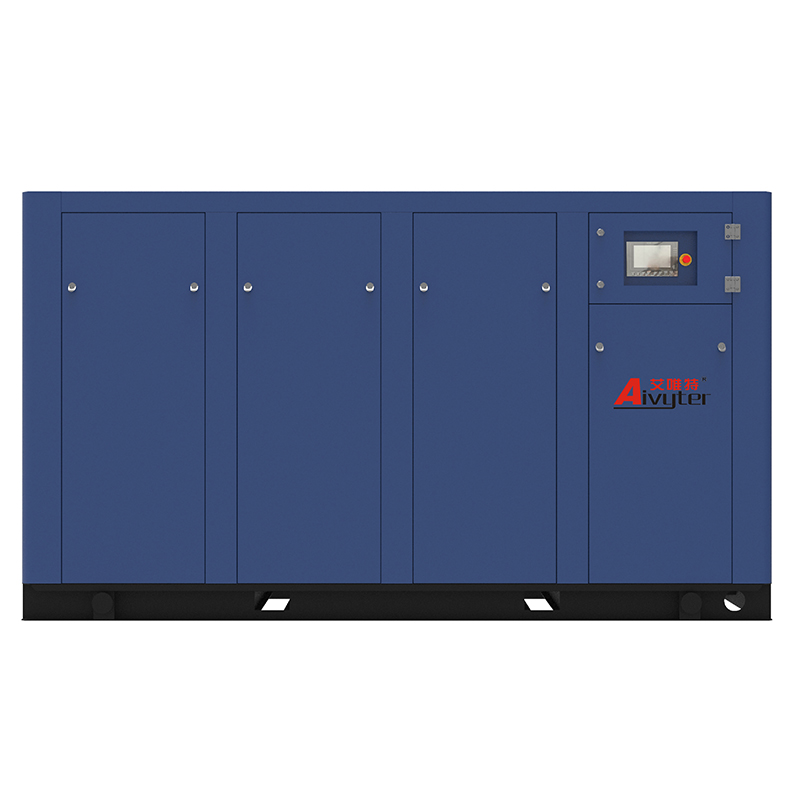
Industrial pneumatic systems consume significant utility power in modern manufacturing facilities. Within these networks, the two stage air compressor represents an established thermodynamic solution to a persistent engineering challenge: how to generate high operating pressures without incurring the steep energy penalties, thermal degradation, and mechanical wear common to single-stage equipment.
Whether configuring a heavy-duty automotive repair workshop or designing a centralized plant utility room for round-the-clock continuous production, understanding multi-stage compression principles is fundamental to balancing capital expenditure against long-term operating costs.
Thermodynamic Fundamentals: How a Two Stage Air Compressor Works
The foundational distinction between single-stage and two-stage machinery is not merely the number of moving parts, but the thermodynamics governing the compression cycle.
When atmospheric air is compressed rapidly, its temperature spikes in accordance with ideal gas behaviors (approaching an adiabatic process). In a standard single-stage configuration, this thermal buildup remains trapped inside the chamber, requiring the prime mover to expend substantial kinetic force to compress hot, low-density air. This dynamic lowers volumetric efficiency and subjects seals, rings, and lubricant to excessive thermal stress.
A two stage air compressor manages this thermal challenge through divided pressure ratios and intercooling:
- Stage 1 (Low-Pressure Intake & Compression): Atmospheric air passes through an intake air filter into a large-bore, low-pressure cylinder (in reciprocating units) or the primary rotor pair (in rotary screw units). The medium is compressed to an intermediate range, typically 80 to 100 PSI (5.5 to 6.9 bar).
- Intercooling Stage (Thermodynamic Re-densification): Before entering the secondary compression chamber, the intermediate-pressure air flows through an intercooler (finned copper/aluminum tubes or a liquid-cooled heat exchanger). This drop in temperature brings the cycle closer to an energy-conserving isothermal baseline. Cooling the charge increases its air density, reduces its specific volume, and condenses moisture carryover before downstream handling.
- Stage 2 (High-Pressure Compression): The pre-cooled, dense air enters a smaller-bore, high-pressure cylinder or high-stage rotary element. Because the air volume has contracted, the secondary stage drives the system to its ultimate discharge target (typically 175 PSI or 12+ bar for reciprocating platforms) using less mechanical energy than a single-stage machine would require for the same target pressure.
- Delivery & Discharge: The air passes through an aftercooler and non-return check valve, reaching the ASME receiver tank to sustain production demand.
Two Stage Reciprocating vs. Two Stage Rotary Screw Configurations
While the thermodynamic logic of intercooling remains consistent across machinery, structural execution differs based on the operational profile, continuous uptime demands, and total volumetric flow required.
1. Reciprocating (Piston) Two-Stage Compressors
- Operating Profile: Well-suited for intermittent to heavy-duty cycling (typically 60% to 80% duty cycle limits to prevent piston thermal saturation).
- Mechanical Configuration: Identified by asymmetric cylinder architecture—a wide low-pressure cylinder connected via an externally finned tube manifold directly to a narrower high-pressure cylinder driven by a common crankshaft.
- Primary Target: Facilities requiring high working pressures (145 to 175 PSI) at moderate flow rates (15 to 50 CFM), such as truck tire service stations, sandblasting shops, and CNC machine job shops.
2. Rotary Screw Two-Stage Compressors
- Operating Profile: Engineered for continuous-duty base-load utility supply (100% duty cycle, 24/7/365 run schedules).
- Mechanical Configuration: Houses two distinct, synchronized airends often driven by a central gear drive or direct coupling. Oil injection between stages absorbs heat directly from the compression pocket, followed by mechanical interstage oil/gas cooling paths.
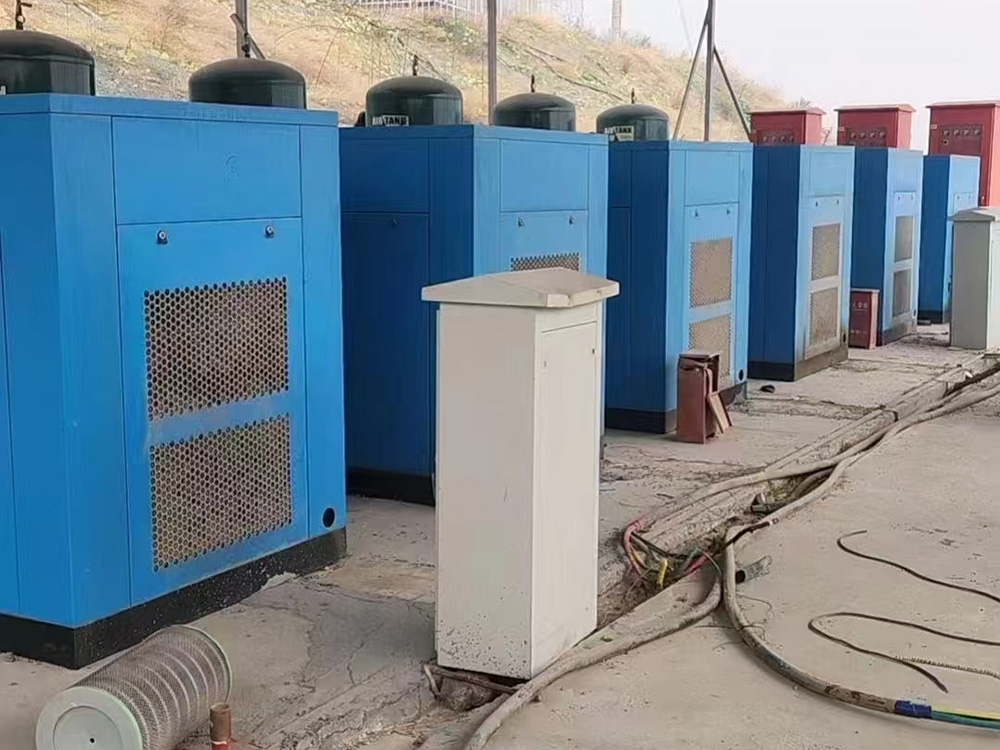
- Primary Target: High-demand industrial plants requiring consistent 100 to 150 PSI delivery at high volumetric flow rates (100 to over 2,500 CFM), such as automotive assembly, chemical processing, packaging lines, and pharmaceutical operations.
Engineering Comparison: Single-Stage vs. Two Stage Air Compressor
Equipment failures often occur when single-stage machines are pushed into multi-shift industrial service windows. The operational trade-offs between configurations are detailed below:
| Operational Metric | Single-Stage Compressor | Two Stage Air Compressor |
|---|---|---|
| Nominal Discharge Pressure | 90 – 135 PSI (Max continuous limit) | 150 – 175+ PSI (Standard operational threshold) |
| Volumetric Efficiency (ηv) | 65% – 75% (Substantial clearance air expansion) | 85% – 92% (Reduced pressure ratio per stage) |
| Thermal Profile | High discharge temperatures (>350°F / 176°C) | Low discharge temperatures via interstage heat exchange (<250°F / 121°C) |
| Lubricant Breakdown & Carbon Buildup | Accelerated oil degradation; varnish on reed valves | Extended lubricant life; low risk of valve carbonization |
| Duty Cycle Rating | 50% – 60% (Requires mandatory thermal cool-down) | 80% (Piston) up to 100% (Industrial Rotary Screw) |
| Specific Power (kW/100 CFM) | Higher specific energy input above 90 PSI | 10% to 15% lower specific power consumption |
Industrial Application Profiles
Because of its ability to maintain stable system pressure without thermal derating, the two stage air compressor is common across demanding production sectors:
- Automotive Refinishing and Fleet Maintenance: Supplying smooth, moisture-reduced air flow to automotive paint spray booths to prevent paint surface defects, while simultaneously cycling high-torque 1-inch impact wrenches and pneumatic lifts at 150+ PSI.
- Precision CNC Machining and Metal Fabrication: Driving tool changers, spindle chuck clamping, plasma cutting air curtains, and dynamic laser-assist gas purge systems that drop out if line pressure fluctuates below 120 PSI.
- Automated Packaging and Bottling Plants: Supplying steady pneumatic action to high-cycle pick-and-place robots, blow molders, and continuous sealers. In these installations, downtime caused by thermal tripping can stop an entire packaging line.
- Industrial Woodworking and Cabinetry: Running multi-operator air nailers, broad-belt orbital sanders, and heavy-draw dust collection gate actuators without experiencing intermittent pressure drops.
Total Cost of Ownership (TCO) and Electrical Payback
In mid-to-high capacity compressed air platforms, purchase price represents only about 10% to 15% of total lifecycle expenditures over a 10-year operating horizon. General maintenance accounts for approximately 10%, while electrical utility consumption drives the remaining 75% to 80%.
Single-stage compressors forced to run near their mechanical limits (120 to 135 PSI) face high parasitic power loads because they lack intercooling. By dividing total compression into two distinct phases with lower individual pressure ratios ($r_p = \sqrt{P_{final}/P_{initial}}$), the motor does significantly less physical work per mass unit of delivered air.
Example Engineering Payback Scenario:
- Plant Profile: 50 HP compressor running two shifts daily (4,000 run hours per annum).
- Average Power Cost: $0.12 per kWh.
- Two-Stage Efficiency Benefit: Approximately 12% reduced specific energy input compared to an equivalent single-stage variant operating at high pressure.
- Calculated Energy Reduction: ~17,900 kWh saved annually, translating into direct utility cost savings of roughly $2,148 each year.
Over a multi-year service life, these power savings offset the initial machinery acquisition premium, while reduced mechanical stress on bearings, piston skirts, and valve components helps minimize rebuild downtime.
Selection Criteria: When Should You Invest in Two-Stage Technology?
Before issuing a machinery procurement tender, evaluate your site requirements against these baseline operational indicators:
- Terminal System Pressure Requirement: If your plant tools, instrumentation, or pneumatic actuators demand a supply line pressure of 120 PSI or higher, single-stage units operate too close to their thermal margins. A two-stage system is the proper mechanical choice for these applications.
- Continuous Operating Hours: If compressed air demands run for more than four continuous hours per shift without adequate idle periods, the thermal management of a two-stage platform is necessary to protect against valve failure and oil carryover.
- Air Quality and Moisture Loading: Because intercooling drops the compressed air temperature between stages, a significant portion of ambient humidity condenses inside the machine’s moisture separator before entering downstream lines. This relieves the moisture load on refrigerated dryers and in-line coalescing filters.
- Dynamic Load Fluctuations: If your air profile fluctuates dramatically between high and low plant consumption, consider pairing two-stage engineering with a Variable Speed Drive (VSD) system to balance power draw with current line demand.
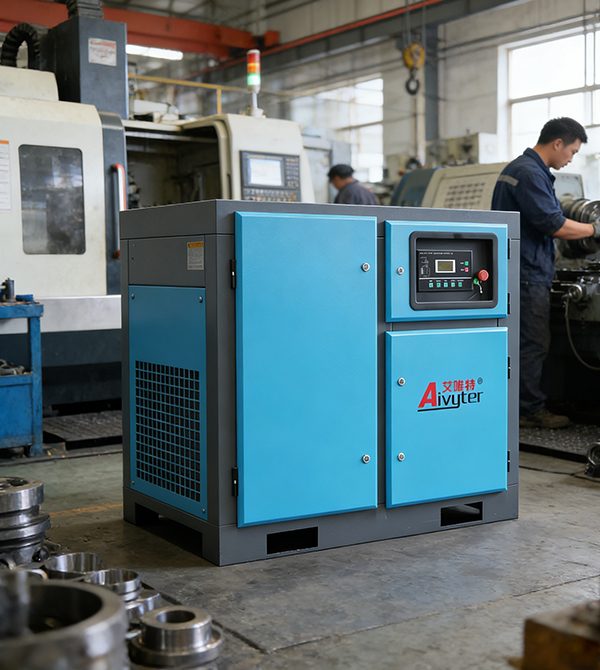
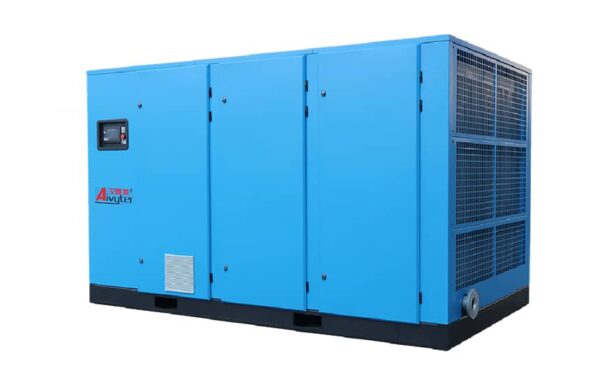
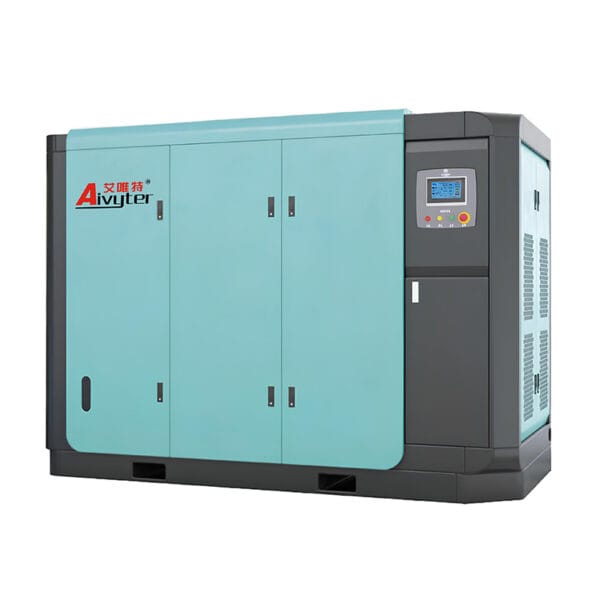
Industrial machinery platforms such as Aivyter provide both precision-machined heavy-duty reciprocating units and continuous-run two-stage rotary screw configurations. These systems help production engineers balance operational load requirements with optimized factory utility costs.
Frequently Asked Questions (FAQ)
1. Can a two stage air compressor operate on a 100% continuous duty cycle?
Reciprocating (piston-driven) two-stage compressors are mechanically limited to roughly an 80% duty cycle to avoid thermal buildup on cylinder walls and valve plates. For non-stop 100% continuous base-load utility demands, a two-stage rotary screw compressor is recommended, as continuous oil-injection cooling keeps operational temperatures stable under continuous load.
2. Why is the primary cylinder larger than the secondary cylinder in a piston compressor?
The primary cylinder processes ambient, uncompressed air at low density, which requires a larger volume. The intercooler then cools this air, reducing its volume and increasing its density. As a result, the secondary cylinder requires less physical displacement to further compress the dense air charge to its final discharge pressure.
3. Does a two stage air compressor eliminate the need for an external air dryer?
No. While the intercooler drops intermediate air temperatures and separates out some moisture before the second stage, the discharge air still carries residual water vapor at elevated pressure. To achieve ISO 8573-1 Class 4 or higher air quality standards, you should pair the machine with an appropriately sized refrigerated or desiccant air dryer and filtration train.
4. How do I confirm if my current compressor is single-stage or two-stage?
On reciprocating piston compressors, inspect the cylinder heads. If the unit features cylinders of different diameters connected by a finned cooling line, it is a two-stage unit. If all cylinders share identical bore dimensions and draw directly from the intake filter manifold to discharge to the tank, it is a single-stage machine, regardless of the cylinder count.
5. Is oil-free or oil-lubricated better for two stage configurations?
This depends on downstream purity requirements. Oil-lubricated two-stage compressors offer long service lives in metalworking, heavy automotive, and general machinery manufacturing. However, if your facility supports clean environments—such as food processing, pharmaceutical handling, electronics, or medical device assembly—an oil-free design prevents oil aerosol carryover from reaching sensitive products.
Optimize Your Industrial Compressed Air Network
Air network downtime, pressure drops, and high utility bills can quickly disrupt plant productivity. Specifying the correct two stage air compressor protects manufacturing processes, stabilizes pneumatic supply lines, and controls lifecycle operating expenses.
Aivyter engineers heavy-duty reciprocating and variable-speed two-stage rotary screw air compressors built for industrial production lines. Contact the Aivyter engineering support team today to review your system’s CFM demands, request an on-site compressed air energy audit, or get an equipment sizing quote tailored to your facility.
about
Aivyter
We provides trusted air compressors and mining equipment, engineered for durability, efficiency, and demanding industrial applications.