In remote mining sites, pipeline right-of-ways, or emergency road construction, the absence of three-phase grid power is not an inconvenience—it is the defining operational constraint. A portable diesel air compressor bridges this energy gap with a combination of high torque thermal efficiency and mechanical robustness that electric alternatives cannot replicate off-grid. For project managers and equipment superintendents, the decision to specify a diesel rotary screw compressor hinges on a matrix of site-specific variables: altitude deration curves, ambient dust loading, and the duty cycle of pneumatic tools from 90 lb breakers to 1,600 cfm down-the-hole hammers. This analysis dissects the engineering parameters that separate a reliable production asset from a maintenance liability, referencing real-world performance data from surface mining, quarrying, and heavy civil earthmoving.
1. Thermodynamic and Mechanical Foundations of Diesel-Powered Compression
Understanding why a portable diesel air compressor dominates outdoor industrial applications requires moving beyond the sales brochure and into the airend dynamics. The core is an oil-flooded rotary screw compressor, where the intermeshing rotors rely on a thin film of lubricant to seal, cool, and reduce mechanical friction. The diesel prime mover delivers a flat torque curve that is critical for maintaining rotor tip speed under varying discharge pressure.
The Rotary Screw Advantage: Continuous Flow vs. Reciprocating Interruption
In heavy industry, flow consistency correlates directly with tool productivity. Reciprocating piston compressors introduce pressure pulsations that reduce the impact energy of rock drills and create stalling in shotcrete pumps. Modern diesel rotary screw packages eliminate this variable. Key engineering distinctions include:
- Airend Profile: Asymmetric rotor profiles (typically 4/6 lobe combination) reduce blowhole leakage and improve volumetric efficiency by 7–12% compared to symmetric designs from previous decades.
- Fluid Coolant System: Thermostatically controlled oil coolers maintain injection temperature between 70°C and 90°C, preventing thermal degradation of lubricant while avoiding water condensation in the separator tank—a common failure point in humid or cold-start environments.
- Diesel Engine Coupling: Direct-drive or gear-driven configurations (versus belt-driven) are non-negotiable for mining applications. Belt slippage under heavy impulse loads creates heat and reduces energy transfer efficiency below 85%.
2. Critical Technical Parameters for Specifying a Diesel-Driven Air Compressor
Selecting a portable diesel air compressor without a detailed analysis of the site’s pneumatic demand profile leads to either air starvation or wet stacking (unburned fuel accumulation in the exhaust). The following metrics are the foundation of a precise specification.
CFM and PSI: Matching Air Demand to Pneumatic Tools
Compressor performance is rated according to ISO 1217, Annex C, which specifies intake conditions. Site personnel must derate the catalog cfm (cubic feet per minute) by approximately 3% for every 1,000 ft (305 m) of elevation above sea level. A 185 cfm unit at sea level becomes a 165 cfm unit at 6,000 ft altitude—a 10% loss in available air for percussive drilling.
- Paving Breakers (90 lb class): 65–85 cfm @ 90 psi
- Rock Drills (Drifter): 125–180 cfm @ 100–110 psi
- Sandblasting Pot (No. 6 Nozzle): 350–400 cfm @ 100 psi
- Down-the-Hole Hammer (6″ DTH): 750–900 cfm @ 350 psi (high-pressure variant)
Fuel Consumption and Runtime on a Single Tank
For remote mining or pipeline spreads, logistics fuel cost per hour often exceeds the machine’s amortized lease rate. A standard 375 cfm portable diesel air compressor with a Tier 4 Final / Stage V engine consumes between 2.8 and 3.4 gallons per hour (GPH) at 75% load factor. At full load (100% flow), consumption spikes to 4.2 GPH. This data is vital for calculating remote fuel cache requirements for a 14-day shift.
Sound Attenuation and EPA Emissions Compliance
Regulatory compliance in construction zones (OSHA 29 CFR 1926.52) and mine perimeters demands sound levels below 76 dBA at 7 meters. Aivyter engineering incorporates multi-layer acoustic foam and critical-grade silencers in the canopy design, reducing exhaust noise without creating excessive backpressure that robs engine power. Furthermore, compliance with EPA Tier 4 Final standards relies on Diesel Particulate Filters (DPF) and Selective Catalytic Reduction (SCR), technologies that require specific operator training to avoid regeneration interruptions.
3. Industry-Specific Applications of Diesel Portable Air Compressors
The versatility of a portable diesel air compressor is defined by its ability to operate as a standalone utility plant. The following applications highlight the variance in duty cycle and required ancillary equipment.
Mining Operations: Ventilation, Drilling, and Dust Suppression
In underground hard rock mining, diesel compressors are often staged on the surface collar or in well-ventilated declines to power pneumatic rock drills and shotcrete spraying rigs. The high ambient temperature of deep mines (40°C+) reduces air density, requiring oversized cooling packages. Surface coal and iron ore mining utilizes large towable compressors for blast hole drilling rigs. Here, the critical metric is service factor—the ability to run at 100% load for 10+ hours without thermal shutdown.
Heavy Construction and Pipeline Pressure Testing
Pipeline contractors utilize high-pressure portable diesel air compressors (350–500 psi) for dewatering and pneumatic pressure testing of welded joints. The towable compressor must maintain a steady pressure plateau without pulsation to validate weld integrity via acoustic emission testing. Additionally, in foundation drilling for bridge piers, the compressor supplies air to the hammer and simultaneously provides high-volume air for casing oscillators.
Quarrying and Shotcrete Applications
Aggregate quarries employ portable diesel air compressors for secondary breaking of oversize rock using hand-held pneumatic breakers and for clearing clogged crusher jaws. The presence of high silica dust demands a two-stage air filtration system: a centrifugal pre-cleaner followed by a dry-paper safety element. Failure to maintain this filtration results in dust ingestion that scores the airend rotors, leading to a 15-20% drop in cfm output within 500 hours.
4. Addressing Common Operational Pain Points with Engineered Solutions
Field maintenance logs from Aivyter service teams reveal recurring failure modes that are entirely preventable through proper equipment specification. The following solutions address the gap between manufacturer lab tests and site reality.
- High Altitude Derate: At elevations above 5,000 ft, naturally aspirated diesel engines lose up to 20% power. The engineered solution is a turbocharged engine with a high-altitude compensator or an electronic control module (ECM) that adjusts fuel mapping to maintain manifold pressure. Turbocharged diesel compressors mitigate this loss to less than 5%.
- Cold Weather Starting (Arctic Operations): Diesel fuel gelling and battery failure are primary winter downtime causes. Solutions include integrated block heaters, ether injection kits (regulated), and arctic-grade hydraulic hoses (rated to -40°F).
- Contamination of Service Fluids: In mining environments, the compressor oil becomes a magnet for silica dust. Aivyter units feature heavy-duty spin-on filters with a beta ratio of 200, ensuring 99.5% removal of particles larger than 5 microns.
- Vandalism and Theft: Job site security is a logistics cost. Lockable fuel caps, lockable battery isolator switches, and GPS telematics housed in tamper-proof enclosures are standard in modern portable diesel air compressor fleets.
5. Maintenance and Longevity: Maximizing ROI on Diesel Compressor Assets
Capital equipment life in the rental and mining sectors is measured in tens of thousands of hours. The difference between a 20,000-hour life and a 35,000-hour life is determined by adherence to fluid analysis and minor rebuild intervals.
Fluid Analysis and Component Life Extension
Oil sampling (ASTM D5185 for wear metals) is the most accurate predictor of airend bearing failure. An increase in iron (Fe) above 50 ppm or silicon (Si) above 15 ppm indicates either ingressed dirt or internal wear. Scheduled oil changes on a portable diesel air compressor should be based on operating hours and oil condition sensors, not just calendar intervals.
Service Intervals and Genuine Parts Availability
- Separator Element Replacement: Every 1,000 hours. A clogged separator causes excessive oil carryover, leading to downstream tool fouling and visible oil mist at the exhaust.
- Air Filter Service: Visual restriction indicators should trigger service, not just hour meters. In dusty quarry applications, filter service may be required every 50-100 hours.
- Engine Valve Adjustment: Overlooked in the rental market but critical for fuel economy. Tight valves lead to burnt seats; loose valves reduce compression efficiency.
6. The Role of Telematics and Smart Monitoring in Fleet Management
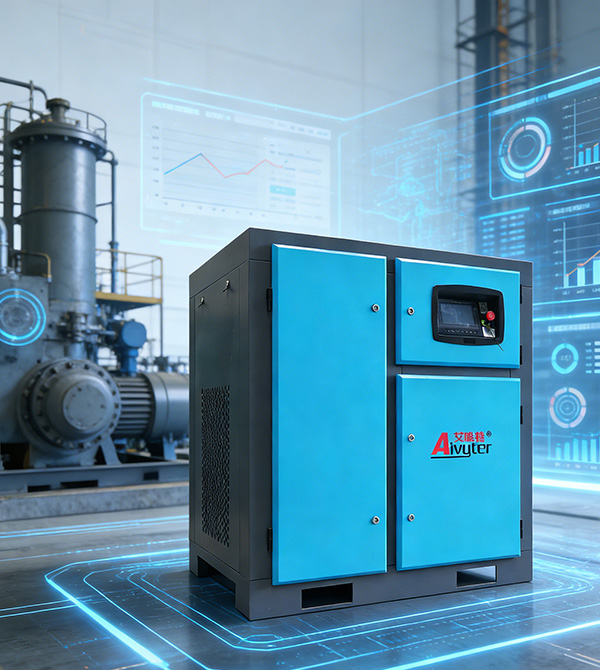
Modern heavy equipment management has moved beyond daily walk-around checks. Remote telematics on a portable diesel air compressor provide a digital twin of the machine’s status. Fleet managers at Aivyter utilize this data to predict failures rather than react to them. Data points transmitted include engine load factor, discharge temperature, separator pressure drop, and DPF soot load. This visibility prevents the common scenario of a compressor going offline during a critical concrete pour or blast cycle.
7. Future Trends: Hybrid and Electric vs. Diesel Reliability
While battery-electric portable compressors are emerging for indoor and urban emission-sensitive zones, the energy density of diesel fuel remains unchallenged for remote heavy industry. A typical 400 cfm diesel compressor consumes approximately 3 gallons per hour, equivalent to roughly 110 kWh of thermal energy input. To replace that with a lithium-ion battery pack for a single 10-hour shift would require a 1,100 kWh battery—a weight and recharge infrastructure that is currently impractical for a towable chassis. Consequently, the portable diesel air compressor will remain the workhorse for mining and pipeline construction, with future innovation focused on renewable diesel (HVO) compatibility and further reductions in DPF regeneration frequency.
Frequently Asked Questions
A1: A standard 90 lb class pneumatic breaker requires a minimum of 60-65 cfm at 90 psi for continuous operation. We typically recommend a portable diesel air compressor rated for 185 cfm to accommodate air hose loss, tool wear, and simultaneous use of a secondary small tool like a rock drill or pump.
A2: As elevation increases, air density decreases. A naturally aspirated diesel engine loses approximately 3% power per 1,000 feet above sea level. This translates directly to reduced cfm output. For operations above 5,000 feet, a turbocharged diesel compressor with altitude compensation is essential to maintain rated flow.
A3: With proper maintenance and fluid analysis, a well-built industrial portable diesel air compressor can achieve 30,000 to 35,000 hours before major overhaul. In extremely abrasive mining environments, the airend might require a minor rebuild at 15,000 to 20,000 hours due to dust ingestion wear on bearings and seals.
A4: Most modern diesel-driven compressors are approved for blends up to B20 (20% biodiesel). However, using biodiesel increases the frequency of Diesel Particulate Filter (DPF) regeneration events due to higher oxygen content in the fuel. It is critical to monitor oil dilution, as biodiesel can accumulate in the crankcase oil during extended idle periods, reducing lubricity.
A5: Intermittent duty implies the compressor can only run at full load for a short period (e.g., 30 minutes on, 30 minutes off). A portable diesel air compressor rated for 100% duty cycle is engineered to operate continuously at maximum pressure and flow for the entire shift without overheating or tripping thermal limits. For mining and quarry drilling, 100% duty cycle is non-negotiable.
Selecting the appropriate portable diesel air compressor requires careful alignment of site altitude, required cfm, and service duty. For engineering support, detailed spec sheets, or to request a customized quote for your next mining or heavy construction project, please contact the Aivyter technical sales team. Our application specialists can provide a detailed total cost of ownership analysis based on your specific fleet operating data.
Submit an inquiry today to receive a detailed performance comparison for your site conditions.
about
Aivyter
We provides trusted air compressors and mining equipment, engineered for durability, efficiency, and demanding industrial applications.