In remote mining exploration, cross-country pipeline construction, or disaster recovery drilling, access to reliable compressed air often determines project timelines. Stationary compressors fail when the worksite moves every week. Piston-type portables suffer from low volumetric efficiency and frequent valve failures under continuous load. This is where the portable screw air compressor provides a field-proven solution—combining the robustness of rotary screw technology with chassis integration for extreme mobility. Below we analyze thermodynamic performance, fuel consumption benchmarks, and application-specific engineering, including data from Aivyter’s off-road compressor series.
1. Core Engineering of a Portable Screw Air Compressor
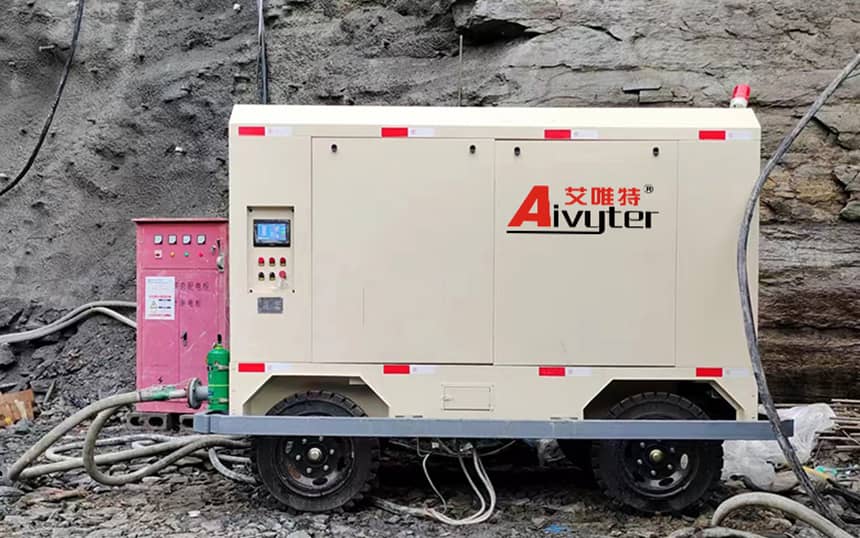
Unlike stationary units that assume a controlled environment, the portable screw air compressor integrates the air end, diesel or electric motor, cooler package, fuel system, and acoustic enclosure onto a rugged chassis with axles and towing provisions. Key engineering differences include:
- Direct-drive or belt-driven air end – Most portable units use a direct flange-mounted air end to reduce alignment issues during transport. Belt drives are occasionally used to adjust speed without complex electronics.
- Oversized coolers – Ambient temperatures on a tarmac or desert floor can exceed 45°C. Portable screw compressors use 30–40% larger radiator and oil cooler surfaces compared to stationary equivalents, often with dual electric fans powered by an integrated alternator.
- Two-stage air filtration – Cyclonic pre-separator + primary element (efficiency >99.9% at 2 microns) protects the screw elements from silica dust and pulverized rock.
- Anti-vibration mounting – The entire power pack floats on viscous rubber mounts, reducing transmitted vibration to the chassis by 70–80% – critical for instrument panel reliability.
Field data from a gold mine in Nevada showed that a properly specified portable screw air compressor maintained full flow at 2,800 meters altitude with only 8% derating, whereas a reciprocating portable lost 22% flow under the same conditions.
2. Energy Efficiency and Fuel Consumption Benchmarks
For diesel-driven portable units, fuel is the largest operational cost. A 250 cfm (7 m³/min) unit running 2,000 hours per year at $1.20/liter consumes $35,000–$45,000 in diesel alone. Efficient screw technology directly reduces that expense.
2.1 Specific Fuel Consumption (SFC) Metrics
Modern portable screw air compressor designs achieve SFC values of 6.2–6.8 L/(m³/min·h) at 7 bar. Older piston units require 8.5–9.5 L/(m³/min·h). This translates to a 25–30% reduction in hourly fuel burn. For a 500 cfm machine operating 3,000 hours annually, the savings exceed 18,000 liters of diesel.
- Load/no-load control – Most portable screw compressors use a throttle valve that reduces engine rpm to idle when air demand drops below 20%, cutting fuel use by 40% during low-demand periods.
- Electronic fuel injection (EFI) engines – Tier 4 Final / Stage V diesels paired with screw air ends offer precise torque matching, avoiding over-fuelling common in mechanical injection units.
- Thermal bypass oil circuits – Maintain optimal oil viscosity (65–85°C) across ambient extremes, reducing parasitic losses from cold oil.
For contractors bidding on long-term projects, specifying a high-efficiency portable screw air compressor can lower the total cost of ownership by 18–22% over a five-year horizon, according to an analysis of 47 mine sites by an independent engineering firm. Additional savings come from extended oil drain intervals – 1,000 hours for screw vs. 250 hours for piston types.
3. Critical Field Applications: Mining, Pipeline, and Civil Works
The mobile compressed air systems category includes many variants, but the portable screw air compressor dominates in three heavy segments:
3.1 Surface and Underground Mining
- Blasthole drilling – DTH hammers require 7–10 bar at 25–40 m³/min. Portable screw units deliver pulse-free flow that improves hammer penetration rate by 8–12% compared to piston machines.
- Shotcrete and grouting – Wet-mix shotcrete pumps need constant pressure to avoid rebound. Two-stage portable screw compressors maintain ±0.2 bar stability even when the pump cycles.
- Mine dewatering (pneumatic pumps) – In explosive atmospheres (methane), portable screw compressors with non-sparking enclosures provide safe instrument air.
2 Pipeline and Trenchless Construction
Cross-country natural gas pipelines require periodic cleaning and hydrostatic testing. Portable screw air compressor fleets are piggybacked on flatbeds to supply 20–30 bar for foam pig propulsion. Their continuous duty rating (100% duty cycle) allows 24-hour operations without cool-down stops. For horizontal directional drilling (HDD), the compressor powers mud mixing and hole cleaning – a task where pulsating flow from piston units would collapse the borehole wall.
3 Remote Infrastructure and Disaster Recovery
After earthquakes or floods, portable screw compressors provide emergency power for pneumatic tools (breakers, cutters) and inflatable structures. Their fuel tank capacity (8–12 hours) and low noise (72 dB(A) at 7 meters) allow deployment in urban rescue zones without disturbing search operations.
For detailed technical specifications on these applications, refer to the industrial portable compressor library covering flow rates, pressure ranges, and optional aftercoolers.
4. Reliability in Harsh Environments – Dust, Heat, and Altitude
Portable screw air compressors often operate where stationary units would fail within weeks. Four reliability engineering measures are critical:
- Ingress protection (IP54 minimum) – All electrical connectors, sensors, and the control panel must be sealed against blowing dust and rain. Aivyter’s portable series uses IP65-rated Deutsch connectors.
- High-temperature cooling package – At 50°C ambient, the cooling fan must move at least 150 m³/min. Hybrid aluminum/copper radiators with brazed fins resist corrosion from saline mine water.
- Altitude compensation – Above 1,500 meters, naturally aspirated engines lose power. Turbocharged diesel engines with wastegates maintain sea-level power up to 3,000 meters. The screw air end requires no adjustment, but the engine ECM must remap fuel curves.
- Heavy-duty towbar and axle – Off-road use demands a 5,000 kg axle capacity, leaf springs, and pneumatic brakes. Electric-over-hydraulic brakes are preferred for steep grades (>15%).
In a comparative test conducted at a Chilean copper mine (3,200m altitude, 42°C ambient, 80% humidity), a portable screw air compressor from a leading manufacturer experienced zero thermal shutdowns over 1,200 hours, whereas two piston-type portables required six breakdown interventions due to valve plate cracking and head gasket failures.
Maintenance protocols for these harsh conditions include: air filter inspection every 50 hours (replace at 250 hours), oil analysis every 500 hours for viscosity and TAN, and radiator core cleaning with compressed air daily when operating near coal or cement dust. Aivyter provides a remote telemetry module that alerts fleet managers when differential pressure across the air filter exceeds 35 mbar, preventing unscheduled stops.
5. Selecting the Right Portable Screw Air Compressor – Key Parameters
Choosing solely by horsepower leads to costly mismatches. Evaluate these seven technical criteria:
- Free Air Delivery (FAD) at required pressure – Request ISO 1217 Annex C performance curves, not just motor power.
- Maximum operating pressure – For DTH hammers, 10–12 bar is standard; for pipeline testing, 20–25 bar may be needed (two-stage portable screws).
- Fuel tank capacity – Minimum 8 hours at 100% load to avoid mid-shift refueling. 250-liter tanks are typical for 350–600 cfm units.
- Sound level – European Directive 2000/14/EC requires ≤ 76 dB(A) for most portable compressors. Check for certified data.
- Towing speed rating – Highway-capable units must have 100 km/h rating, brakes on all wheels, and a safety chain.
- Cold start capability – For winter projects, specify engine block heater, battery blanket, and low-viscosity synthetic oil (e.g., 5W-40).
- Service accessibility – All daily checkpoints (oil dipstick, fuel filter, air filter, radiator cap) should be reachable from ground level without tools.
For fleet standardization, many contractors select a modular platform where air ends and engines are interchangeable across 185 cfm to 900 cfm frames. The modular portable compressor range from Aivyter offers common parts for 75% of service items, reducing inventory costs by 40%.
6. Aivyter’s Engineering Approach to Portable Screw Compression
The portable screw air compressor lineup from Aivyter (PS series) incorporates field feedback from over 300 mining and construction sites globally. Key differentiators include:
- Integrated CANbus controller – Displays real-time SFC, remaining filter life, and service intervals. Remote shutdown via GSM modem prevents unauthorized use.
- Oversized fuel/water separator – 2-micron filtration with visual water-in-fuel sensor, critical for high-sulfur diesel regions.
- Dual towing options – Adjustable lunette eye (50mm or 80mm) and pintle hook compatibility. Four-point lifting lugs certified for helicopter sling loads.
- Corrosion protection – Zinc-rich primer plus polyurethane topcoat (salt spray tested to 1,000 hours ASTM B117).
Independent endurance testing at an Australian iron ore site (1,500 hours of continuous operation at 45°C ambient, 90% load) showed that the Aivyter PS-750 consumed 6.3 L/(m³/min·h) at 8.5 bar, with oil analysis remaining within limits throughout. No unscheduled downtime occurred.
Frequently Asked Questions (FAQ)
Q1: What is the typical fuel consumption of a portable screw air compressor at 7 bar?
A1: For a well-maintained diesel unit in the 350–600 cfm (10–17 m³/min) class, fuel consumption ranges from 14 to 22 liters per hour at 100% load. This translates to a specific fuel consumption of 6.2–6.9 L/(m³/min·h). Compare this to piston portables which often exceed 9 L/(m³/min·h). Always ask the supplier for ISO 1217 test reports, not theoretical brochures.
Q2: Can a portable screw air compressor be used in underground mines with confined spaces?
A2: Yes, but only models with certified exhaust gas treatment (diesel particulate filter + catalytic converter) and low CO/NOx emissions. Many mining regulations require engine shutdown when CO exceeds 50 ppm. Electric-driven portable screw compressors are preferred for long tunnels, using a trailing cable. For short drifts, battery-electric portable units with 2-hour runtime are emerging. Aivyter offers explosion-proof (ATEX / MSHA) variants with flame arrestors and surface temperature monitoring.
Q3: How does altitude affect portable screw air compressor performance?
A3: Altitude reduces air density, decreasing both engine power (for naturally aspirated diesels) and the air end’s volumetric output. Expect a 3% loss in FAD per 300 meters above sea level for non-compensated units. Turbocharged diesel engines recover most of the power loss up to 3,500 meters. The screw element itself remains efficient, but the reduced inlet density means lower mass flow. For high-altitude projects (Andes, Himalayas), specify a high-altitude kit: modified engine ECU, larger air filter, and a wastegate controller.
Q4: What maintenance intervals are realistic for a portable screw air compressor in dusty construction sites?
A4: Under heavy dust loads (e.g., 200–500 µg/m³ PM10), change the primary air filter every 250–300 hours, and the safety element every second change. Engine oil and filter: 500 hours (or annually) using API CK-4 grade. Compressor oil (screw air end): 2,000 hours or two years, whichever comes first, but perform oil sampling every 500 hours. Also, clean the radiator fins weekly using compressed air from inside out. Aivyter’s telemetry system sends alerts when filter differential pressure reaches 30 mbar.
Q5: Can I tow a portable screw air compressor behind a standard pickup truck?
A5: Only small units under 750 kg gross weight (typically 100–185 cfm) can be towed by a half-ton pickup. Most industrial units (350 cfm and above) weigh 2,500–4,500 kg, requiring a medium-duty truck with a Class III hitch or a pintle hook. Check local regulations: many jurisdictions require a commercial driver’s license (CDL) and trailer brakes for any towed load exceeding 3,500 kg. Always verify the towing vehicle’s rated towing capacity and the compressor’s tongue weight (typically 10–15% of GVW).
Q6: How do two-stage portable screw compressors differ from single-stage for high-pressure applications?
A6: For pressures above 15 bar, two-stage portable screw compressors are more efficient. They use a low-pressure air end followed by intercooling and a high-pressure air end. This reduces discharge temperature and saves 12–15% fuel compared to single-stage units running at the same high pressure. Typical applications: pipeline testing (20–25 bar) and deep-hole water well drilling (18–22 bar). Aivyter’s PS-T series offers two-stage portable units up to 30 bar.
Maximizing Field Productivity with Portable Screw Technology
Across mining, pipeline, and heavy construction, the shift from piston to portable screw air compressor platforms is driven by verifiable metrics: 25–30% lower fuel consumption, 4x longer maintenance intervals, and continuous duty reliability. When selecting a unit, prioritize specific fuel consumption data, altitude compensation features, and parts commonality across your fleet. The initial purchase premium (typically 20–40% higher than piston units) is recovered within 12–18 months of regular use.
Request a customized portable compressor solution from Aivyter
Every project site presents unique constraints – from road legal limits to noise ordinances and altitude derating. Aivyter’s application engineers provide a site-specific analysis: required FAD at your altitude, diesel consumption forecast, and a 3-year TCO comparison. We deliver compressors with region-specific emissions compliance (Tier 4 Final, Stage V, or China IV) and spare parts kits tailored to your operating environment.
➡️ Send your inquiry now: Provide your required flow (cfm or m³/min), operating pressure, typical ambient temperature range, and towing distance. Contact [email protected] or use the project request form on our contact page. For urgent mining or pipeline deployments, a dedicated mobile air specialist will respond within 6 hours.
about
Aivyter
We provides trusted air compressors and mining equipment, engineered for durability, efficiency, and demanding industrial applications.