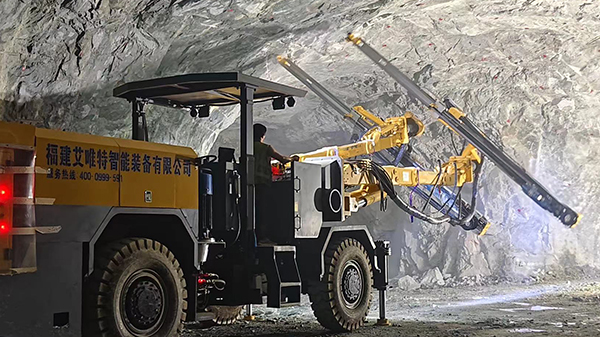
Buying an underground drilling rig is never a routine equipment swap. It is a multi-million-dollar capital decision that shapes your mine development schedule for years. Choose the wrong setup, and you either stall your critical path or end up with expensive iron sitting idle in an underground cut.
Mine managers searching for a mining jumbo for sale usually hit an immediate fork in the road: do you deploy a nimble single-boom carrier or a high-capacity double-boom rig? Both configurations have their place in underground mining. However, putting a double boom into a narrow vein is just as disastrous as crawling through an arterial decline with a single feed beam.
At Aivyter, we regularly help mine operators evaluate rock conditions, tunnel dimensions, and haulage targets before cutting a purchase order. Below are the four operational comparisons you need to review before signing off on your next underground drilling rig.
1. Drift Dimensions and Face Coverage
Your drift cross-section sets the physical boundary for your equipment. If the boom cannot reach the perimeter holes without radical repositioning, your cycle time explodes. Conversely, squeezing an oversized chassis into a narrow decline destroys sidewalls, chews up trailing cables, and ruins tires.
Single Boom Jumbo Drill: Agility in Confined Headings
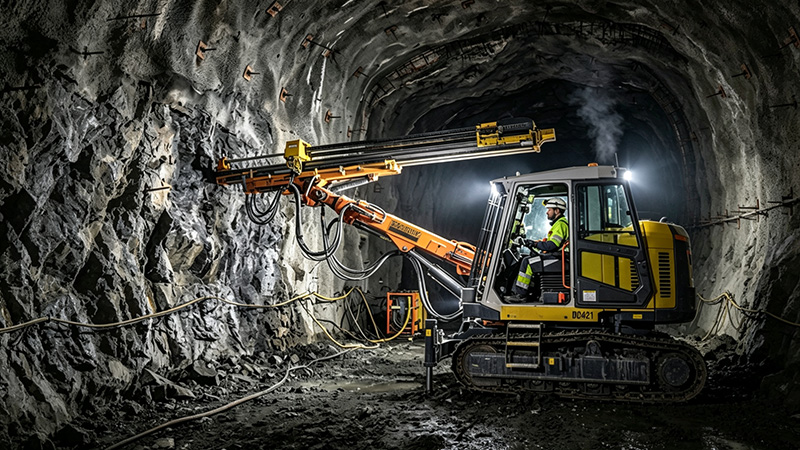
A single boom jumbo drill excels in headings ranging from 6 m² up to 20 m². These machines feature compact chassis designs, center-articulated steering, and narrow footprints. They are engineered for narrow-vein extraction, exploratory sublevels, and captive drifts where turning radiuses are sharp and cross-cuts are tight.
- Typical coverage: Up to 5.5 meters wide by 5.5 meters high.
- Turning radius: Significantly shorter inside-turn radius, reducing wall scrubbing.
- Overbreak control: The operator maintains a direct line of sight to each perimeter hole, minimizing dilution in erratic ore bodies.
Double Boom Mining Jumbo: Dominating Major Headings
A double boom mining jumbo thrives in cross-sections from 20 m² to over 50 m². When driving main haulage ramps, access drifts, or civil infrastructure tunnels, a single boom simply cannot reach the high lifters or perimeter holes without carrier re-spotting. Dual feed beams cover broad face profiles from a single setup position.
- Typical coverage: Spans faces up to 9 to 12 meters wide.
- Setup stability: Heavy-duty carrier frames and wide-stance leveling jacks anchor the machine firmly against intense drilling torque.
- Parallel tasks: Modern units allow simultaneous face drilling and roof bolting preparation across wide drives.
Field Insight: Do not buy coverage you do not need. If your mine plan features multiple remote, scattered work headings across different mining levels, two mobile single-boom units will yield far better overall utilization than one massive double-boom rig stuck in traffic between levels.
2. Cycle Time and Heading Productivity
Face advance rate directly dictates mine revenue. The faster you drill out a round, the sooner the blasting crew can load the face. Here, the mechanical capacity of your feed system plays an aggressive role.
The Math Behind Drilling Cycles
On average, a development round requires anywhere from 40 to 65 blast holes, plus reamed cut holes. A single boom attacks these holes sequentially. If drilling an average 3.5-meter hole takes two minutes including positioning, steel handling, and penetration, a 50-hole round takes at least 100 minutes of pure drill time.
A double boom rig runs two drifters at the same time. The total jumbo drill cycle time drops by roughly 35% to 45%. It does not cut time precisely in half because operators must prevent feed interference, but it regularly trims face drilling down to roughly an hour.
Watch the Entire Production Chain
Drilling speed does not matter if your mucking fleet lags behind. If your downstream fleet—such as your load-haul-dump (LHD) units and haul trucks—cannot clean out the previous muck pile quickly, a double boom rig will spend hours waiting at the cross-cut entrance.
Before prioritizing pure drilling speed when browsing a mining jumbo for sale, evaluate your mine’s ventilation clearing rates, ground support cycle, and haulage capacity. High drilling speeds deliver zero return on investment when the rig sits waiting on empty haul trucks.
3. CapEx, OpEx, and Total Cost per Drilled Meter
Procuring mining equipment requires looking beyond the initial invoice. The true operational benchmark is your Total Cost per Drilled Meter ($/m), balancing capital depreciation against real rock drill wear.
Upfront Capital Costs (CapEx)
When reviewing mining equipment procurement quotes, expect a double boom rig to run 50% to 80% higher in purchase cost than a single boom unit. You are purchasing two heavy-duty rock drills, two complete feed extensions, an expanded hydraulic system, larger electrical switchboards, and a heavier prime mover.
Operational Expenses (OpEx)
The operating equation splits into two distinct profiles:
- Consumables: A double boom uses twice as many drill rods, shank adapters, and drill bits per shift. If your rock mass is highly abrasive (like hard quartzite or massive sulfides), your consumable inventory run-rate increases quickly.
- Power and Hydraulics: Dual boom setups demand larger electrical substations and trailing cables (often requiring 1000V setups versus 660V systems), consuming significantly more kVA during full operation.
- Drifter Maintenance: Running two drifters means rebuild schedules arrive twice as often, requiring a stocked on-site inventory of seals, diaphragms, and front-head components.
For large-scale, high-tonnage mines, a double-boom rig dramatically drops the cost per ton by cutting workforce hours per meter advanced. However, for marginal mines or erratic veins, a single boom protects precious cash flow by keeping hydraulic complexity and daily operational costs low. Brands like Aivyter supply both platforms, allowing planners to run accurate total-cost simulations prior to purchase.
4. Operator Competence, Maintenance Overhead, and Operational Risk
A machine is only as dependable as the crew running it and the technicians maintaining it. Underground environments push electronics, hydraulics, and steel structures to their absolute limits.
Operator Workload and Spatial Awareness
Operating a single boom jumbo drill is intuitive. The operator tracks a single feed beam, watches the collar angle, and manages hole penetration depth. Training new drillers on single-boom machinery takes significantly less time, which helps operations battling high staff turnover.
A double boom machine demands superior spatial coordination. Even with modern parallel holding automation and anti-jamming controls, the drifter operator must balance two working feed systems. They have to monitor feed pressure, rotation torque, and water flushing on two independent systems simultaneously while avoiding boom cross-overs or collisions in tight quarters.
Maintenance and Electrical Requirements
Maintenance complexity does not scale linearly; it compounds. A double boom machine has twice the hydraulic valves, dual hose-reel setups, and advanced instrumentation that underground mechanics must diagnose under wet, muddy conditions.
If your underground operation relies on general mechanics rather than specialized electro-hydraulic technicians, high-end automated double-boom rigs can suffer prolonged troubleshooting downtime. Single boom units feature streamlined, direct hydraulic systems that are simpler to repair and get running again quickly.
Fleet Redundancy Considerations
Consider risk concentration. Two single boom jumbos provide inherent operational redundancy. If one machine blows a main feed hose or needs drifter service, the other rig keeps your primary heading moving. With a single double-boom machine, a severe breakdown in the carrier or electrical input shuts down 100% of your development face.
Head-to-Head Specification Comparison
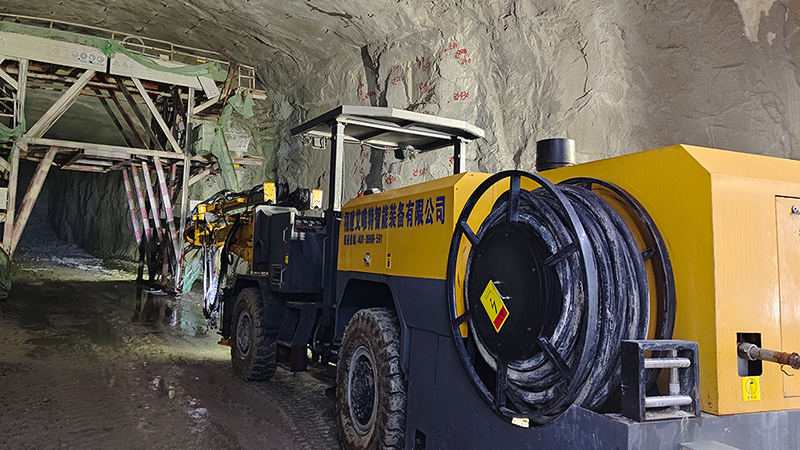
The table below summarizes the operational trade-offs to review before selecting an underground drilling rig:
| Operational Factor | Single Boom Jumbo Drill | Double Boom Mining Jumbo |
|---|---|---|
| Working Section | 6 m² – 20 m² | 20 m² – 50+ m² |
| Target Applications | Narrow vein, sub-levels, captive drives | Main ramps, haulage headings, large civil drives |
| Cycle Time Impact | Standard sequence (one hole at a time) | 35% – 45% faster drill completion |
| CapEx Range | Baseline investment | 50% to 80% higher than single boom |
| Maintenance Demand | Standard hydraulics, quick troubleshooting | High; requires experienced electro-hydraulics crew |
| Operator Learning Curve | Short (weeks) | Moderate to steep (months for full output) |
| Overbreak Control | High accuracy in tight, undulating profiles | High efficiency on symmetrical, standard profiles |
Procurement Decision Tree: Which Model Fits Your Mine?
To narrow down the right mining jumbo for sale, work through these three clear-cut operational rules:
- If your heading cross-section is under 15 m²: Choose a single boom jumbo drill. A double boom carrier will struggle with wall clearances, turn poorly around sharp corners, and lead to high maintenance downtime caused by constant wall strikes.
- If you must advance more than 6 to 8 linear meters per day across major headings: Buy a double boom mining jumbo. A single boom simply cannot turn the rounds around quickly enough to keep loaders and haul trucks productive in large sections.
- If your mine operates across multiple disconnected stopes or levels: Favor two single-boom units over one double-boom rig. Fleet mobility and multi-face flexibility beat pure face-drilling speed every time.
Frequently Asked Questions (FAQ)
Q1: Can a single boom jumbo drill be used for ground support and bolting?
A1: Yes. Many single boom rigs are multipurpose. They accept split-set drivers, mechanical anchor adapters, and hollow-core grouted bars. However, dedicated mechanized bolters are preferred if your rock classification requires dense, immediate ground support patterns.
Q2: How much air and water pressure does an underground drilling rig need?
A2: Most modern hydraulic drifters require a clean flushing water supply at 8 to 15 bar (116 to 217 psi) to clear cuttings efficiently. Onboard or mine-supplied air pressure for shank lubrication and hole clearing typically runs between 4 and 7 bar (58 to 100 psi).
Q3: How does rock hardness impact the choice between single and double boom rigs?
A3: In extremely hard, unyielding formations (over 180 MPa UCS), your penetration rate slows down significantly. In these rock conditions, a double boom rig prevents drilling from becoming a major operational bottleneck by maintaining two drifter feeds at the same time.
Q4: Is an automated positioning system worth the investment on a double boom jumbo?
A4: Yes, especially in large-profile ramps. Automated boom positioning ensures precise hole spacing, eliminates drifter collar error, and strictly prevents overbreak. This reduction in overbreak saves thousands of dollars in crushed rock haulage and shotcrete consumption down the line.
Q5: What are the primary wear items to stock when purchasing a mining jumbo?
A5: Prioritize shank adapters, drill steel (rods), couplings, button bits, feed slide pads, wire ropes or feed chains, and hydraulic seal kits. If you purchase a double boom unit, keep at least one fully serviced, complete spare rock drill in your warehouse ready for hot-swaps.
Choose the Right Underground Rig with Aivyter
Investing in an underground drill is all about matching equipment capacity to your extraction plan. Buying too much capacity wastes valuable capital on unused steel. Buying too little leaves your operations lagging behind downstream development targets.
Whether you need a maneuverable single-boom workhorse for steep-dipping narrow veins or a heavy-duty double-boom platform for primary haulage development, Aivyter supplies robust, field-tested underground jumbo solutions designed for difficult underground environments.
Do you need to match your specific drift dimensions to the right machine? Contact our underground engineering team today. Send us your heading profiles and rock parameters, and we will provide an equipment selection analysis alongside a competitive quote for your next mining jumbo for sale.
about
Aivyter
We provides trusted air compressors and mining equipment, engineered for durability, efficiency, and demanding industrial applications.