In industrial fabrication, the air compressor for laser cutter is not merely a utility—it is a critical process component that directly dictates cut edge quality, operational speed, and long-term capital equipment reliability. For engineering managers and plant operators in metal fabrication, aerospace, and heavy industrial sectors, the choice between a standard shop compressor and a purpose-built laser assist system represents a balance of initial capital expenditure against production throughput and maintenance liabilities. Drawing from decades of experience in industrial gas systems for fiber and CO₂ laser platforms, this analysis provides a data-driven framework for specifying, sizing, and maintaining compressed air systems that meet the rigorous ISO 8573-1 Class 0/1 purity standards required by modern laser resonators.
1. Technical Parameters: Why Laser Cutting Demands Industrial-Grade Air Purity
Unlike pneumatic tools that tolerate residual oil aerosols and moisture, a laser cutting system uses compressed air as the assist gas. Contaminants such as particulate, hydrocarbon vapor, or liquid water interact with the laser beam’s focal point and the molten metal, causing oxidation, nozzle fouling, and inconsistent cut profiles. The standard reference, ISO 8573-1, specifies air purity classes. For high-power fiber lasers (4kW to 20kW+), the recommended quality is Class 1.2.1 or better—meaning ≤0.01 mg/m³ of oil, ≤0.1 µm particulate filtration, and a pressure dew point (PDP) of ≤ -40°C to prevent condensation during expansion at the cutting head.
Selecting a standard reciprocating or oil-lubricated rotary screw air compressor for laser cutter without downstream filtration leads to accelerated degradation of the laser optics and inconsistent piercing performance. Industry data indicates that facilities switching from untreated shop air to a dedicated oil-free screw compressor with integrated refrigeration or desiccant drying reduce nozzle changes by 63% and cut-edge burr formation by up to 45% in stainless steel applications.
1.1 Critical Performance Metrics: Flow Rate, Pressure Stability, and Duty Cycle
- Flow Rate (Nm³/h or CFM): A 6kW fiber laser cutting 20mm mild steel typically consumes 4.5–6.5 m³/min at 8 bar. Under-sizing the compressor leads to pressure drops below the cutting head’s minimum threshold (usually 6.5 bar), causing dross formation and incomplete cuts.
- Pressure Stability (Bar): High-quality systems maintain ±0.1 bar regulation. Pressure fluctuations of ±0.5 bar alter the kerf dynamics, compromising dimensional accuracy in sheet metal nesting.
- Duty Cycle: Laser cutting operations often run 18–24 hours in 2- or 3-shift setups. A compressor rated for 100% continuous duty (industrial rotary screw or scroll) is non-negotiable; piston-type compressors with 50–60% duty cycles lead to thermal overload failures.
2. System Architecture: Oil-Free vs. Oil-Injected Solutions
The central decision in specifying an air compressor for laser cutter is whether to adopt an oil-free (dry screw or scroll) or oil-injected rotary screw with extensive downstream filtration. Each architecture presents distinct total cost of ownership (TCO) profiles.
2.1 Oil-Free Rotary Screw Compressors
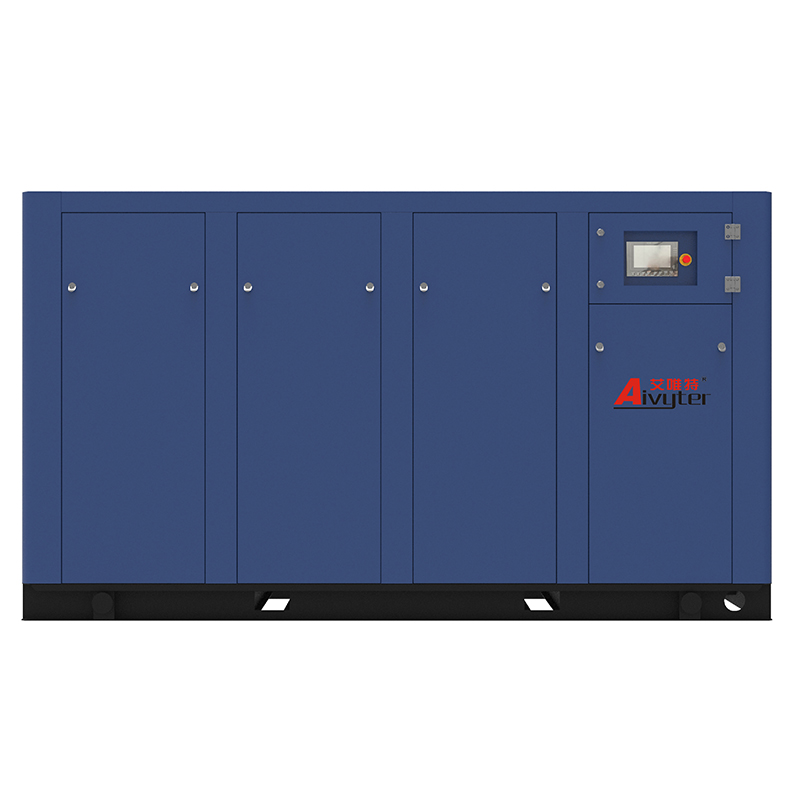
For facilities with multiple high-power lasers (aggregate >15 kW) and stringent quality requirements (medical devices, automotive Class A surfaces), oil-free compressors represent the gold standard. These units utilize water or coated rotors to achieve ISO 8573-1 Class 0 certification without consumable coalescing filters. While the initial investment is 35–50% higher than oil-injected equivalents, they eliminate ongoing costs of filter elements (replaced every 2,000–4,000 hours) and reduce energy consumption by 12–18% due to lower pressure drop across the filtration train. Aivyter’s industrial oil-free series, engineered for 24/7 laser environments, demonstrates specific energy consumption (SEC) as low as 6.2 kW per m³/min, significantly below industry averages.
2.2 Oil-Injected Rotary Screw with Filtration
For job shops or facilities with one to two lasers under 4kW, an oil-injected screw compressor paired with a high-efficiency filtration system (coalescing filter + activated carbon filter + refrigerated dryer) remains the most common configuration. The critical design consideration is the filtration arrangement: the final particulate filter must be located as close to the laser cabinet as possible to avoid re-contamination from downstream piping. Engineers must also account for a pressure drop of 0.6–0.8 bar across the filtration chain, requiring the compressor to be set at a higher discharge pressure (e.g., 8.5 bar to deliver 7.5 bar at the cutting head).
3. Application-Specific Configurations for Fiber and CO₂ Lasers
The type of laser resonator fundamentally alters the compressed air requirements. Fiber lasers, now dominant in metal cutting, operate with higher peak power densities but are sensitive to hydrocarbon contamination on the protective window. CO₂ lasers, while less common in new installations, require exceptionally dry air (PDP -40°C or lower) to prevent moisture absorption in the optical path.
3.1 High-Power Fiber Laser Cutting (6kW–30kW)
At these power levels, the assist gas pressure is modulated dynamically—higher pressure for piercing thick plate (up to 15 bar) and lower pressure for high-speed cutting. The air compressor for laser cutter system must therefore be equipped with a variable frequency drive (VFD) to match the highly variable demand profile. A fixed-speed compressor in such applications typically cycles excessively, leading to increased wear and moisture carryover. Data from a Tier 1 automotive supplier showed that switching from a 75 kW fixed-speed oil-injected compressor to a 55 kW VFD oil-free unit reduced annual energy costs by $23,000 while improving cut consistency on 8mm aluminum chassis components.
3.2 Tube and Pipe Laser Cutting
Rotary laser cutting applications impose unique challenges: the assist gas must remain consistent during continuous rotation, and the system often includes multiple cutting heads. Here, compressed air storage (receiver tanks) becomes crucial. A minimum of 10 gallons of storage per 100 CFM of compressor capacity is recommended to dampen pressure spikes caused by simultaneous nozzle changes or piercing cycles. Poorly buffered systems suffer from cut inconsistencies at the seam of tubular profiles.
4. Lifecycle Cost Analysis and Energy Efficiency
Energy consumption constitutes over 75% of the total lifecycle cost of an industrial compressed air system. For a air compressor for laser cutter operating at 8 bar with a 100 kW motor, annual electricity costs can exceed $85,000 at $0.10/kWh. Therefore, three efficiency levers must be optimized:
- Pressure Dew Point (PDP): Over-drying air to -70°C PDP wastes energy. Match the dryer to the minimum required PDP. For most fiber laser applications, -40°C is sufficient; exceeding this adds 15–20% to dryer energy costs.
- Piping Network: Undersized piping or the use of threaded steel fittings increases friction losses. Implementing a ring main with aluminum piping (low friction coefficient) can reduce pressure drop by 1–2 psi across the network, yielding 2–3% energy savings.
- Heat Recovery: Up to 94% of the electrical energy input to a compressor is converted to heat. In cold climates or facilities with wash bays, integrating an air-to-water heat exchanger to preheat process water or space heating can offset natural gas consumption, reducing facility utility costs by 10–15%.
5. Maintenance Protocols and Failure Prevention
Unplanned downtime in laser cutting operations costs an estimated $1,500–$3,000 per hour in lost production and labor. Proactive maintenance schedules for the compressed air system must be aligned with laser head service intervals. Key predictive indicators include:
- Differential pressure across coalescing filters: A rise of 0.3 bar above baseline indicates saturation and imminent oil carryover. Filters should be replaced proactively, not based on calendar time alone.
- Oil analysis (for oil-injected units): Monitoring wear metals and viscosity index allows early detection of bearing wear or fluid degradation that could lead to catastrophic failure.
- Dew point monitoring: Continuous PDP sensors at the point of use provide immediate alerts if dryer performance degrades, preventing moisture from reaching the laser head.
Industry leaders such as Aivyter provide IoT-enabled controllers that integrate with plant SCADA systems, offering predictive analytics for filter change-outs and compressor efficiency. Facilities utilizing such remote monitoring have reported 18% reduction in unscheduled maintenance events related to assist gas quality.
6. Integration with Laser Cutting Software and Automation
Modern Industry 4.0 setups require the compressed air system to communicate with the laser’s CNC controller. This integration allows for:
- Dynamic pressure adjustment: The compressor’s VFD receives real-time pressure setpoints from the nesting software, optimizing energy use per material thickness.
- Automated startup/shutdown: Compressors can be placed in standby mode when the laser is idle (e.g., between sheet changes), reducing no-load power consumption by 30–40%.
- Quality data logging: Air quality parameters (particulate count, dew point) are logged alongside laser cutting parameters, providing traceability for quality certifications like ISO 9001 or AS9100.
7. Frequently Asked Questions (FAQs)
Q1: What happens if I use a standard shop air compressor for my laser cutter without additional filtration?
A: Using an untreated shop compressor introduces microscopic oil aerosols (typically 3–10 mg/m³) and moisture that will contaminate the laser lens and protective window. This results in rapid lens degradation (reduced lifespan from 6 months to 2–3 weeks), inconsistent cut quality, and potential damage to the laser resonator due to back-reflection. At minimum, a refrigerated dryer and a series of coalescing/activated carbon filters achieving ISO 8573-1 Class 1.2.1 are required to protect the optics.
Q2: How do I calculate the required CFM (flow rate) for a fiber laser cutting system?
A: The flow rate is determined by the nozzle diameter and assist gas pressure used for cutting. For a standard 2.0mm nozzle at 10 bar, consumption is approximately 2.5 m³/min (88 CFM). For a 3.0mm nozzle at 15 bar, consumption can exceed 6.5 m³/min (230 CFM). Always refer to the laser manufacturer’s gas consumption chart, and add a 15–20% safety margin to account for future process expansion or simultaneous cutting head operation. Oversizing the compressor leads to inefficient part-load operation; undersizing causes pressure drops and process stoppages.
Q3: Is an oil-free compressor mandatory for laser cutting, or can I rely on filters?
A: Oil-free compressors are not mandatory but are highly recommended for high-power lasers (≥6kW) or continuous 24/7 operations. Filters can achieve Class 0 air quality, but they are consumable items with finite service lives. If a filter is not replaced on schedule, oil contamination can reach the laser head within hours. Oil-free compressors eliminate this single-point failure risk. For lower-power or intermittent cutting, a properly maintained oil-injected system with high-quality filtration is acceptable, provided the maintenance schedule is strictly followed.
Q4: What pressure dew point (PDP) is necessary for cutting carbon steel vs. stainless steel?
A: For carbon steel cutting, a PDP of +3°C to -10°C may be sufficient as minor moisture does not drastically affect oxidation-based cutting. However, for stainless steel and aluminum (where oxidation must be minimized to prevent discoloration), a PDP of -40°C is mandatory to eliminate moisture that can cause micro-oxidation at the cut edge. For high-gloss finishes or medical-grade components, some manufacturers specify -70°C PDP. Always align the dryer specification with the highest quality requirement of your product mix.
Q5: How does ambient temperature affect the performance of an air compressor for laser cutting?
A: Ambient temperature has a direct effect on compressed air density and dryer efficiency. For every 10°F (5.5°C) increase in inlet air temperature above 85°F (29°C), the moisture content of the incoming air doubles, placing additional load on the dryer and potentially causing dew point spikes. In hot climates, locating the compressor in a well-ventilated mechanical room or using an outdoor-rated enclosure with cooling is critical. Additionally, high ambient temperatures reduce the cooling capacity of air-cooled dryers, often necessitating a water-cooled dryer to maintain stable -40°C PDP during summer months.
Selecting and integrating the correct compressed air solution is a complex engineering decision that impacts both operational expenditure and production reliability. By focusing on ISO purity standards, matching flow profiles to laser power, and implementing intelligent control strategies, fabricators can achieve consistent cut quality and maximize equipment lifespan. For customized system designs tailored to specific laser platforms, consulting with specialist providers like Aivyter ensures that the air compressor for laser cutter is optimized not just for pressure, but for the precise balance of energy efficiency, air quality, and process stability demanded by modern industrial manufacturing.
about
Aivyter
We provides trusted air compressors and mining equipment, engineered for durability, efficiency, and demanding industrial applications.